
When an established e-commerce business watches paid advertising revenue plummet from over 75 monthly transactions to near zero, the gut reaction is usually to blame advertising fatigue, rising CPCs, or changing consumer habits. But in real-world engineering audits, the breakdown is almost always hidden deep inside the technical infrastructure: silent protocol downgrades, obsolete tracking libraries, browser security warnings, and non-responsive legacy layouts that discard mobile buyers.
In this technical case study, we examine how we leveraged Google Antigravity AI pair programming to conduct a comprehensive forensic audit of ArchitecturalNumbers.com—a premier manufacturer of precision architectural cast metal house numbers and building signage. Within days, we diagnosed silent conversion drops, scrubbed legacy server vulnerabilities, enforced HTTPS query-string preservation, deployed dynamic Google Tag conversion attribution, modernized the mobile storefront, and engineered SignBuilder 2.0: a photorealistic, real-time 3D WebGL product customizer powered by browser-level TrueType Bézier curve vector extrusion.
Video Walkthrough: Real-Time AI Engineering in Action
Before diving into the forensic code diffs and architectural upgrades, watch the recorded workflow video demonstrating how Antigravity AI operates directly across the codebase, diagnostic terminals, and visual browser viewports to execute and verify these enhancements:
1. The Client Context & Attribution Blackout
The client reached out with an urgent operational alarm: despite spending heavily on Google Ads campaigns, new customer acquisition had ground to a halt:
"At this point I am getting almost zero new customers from the Google Ads, whereas before I used to get about 2 to 3 sales per day. I believe the account is not set up properly to do attribution."
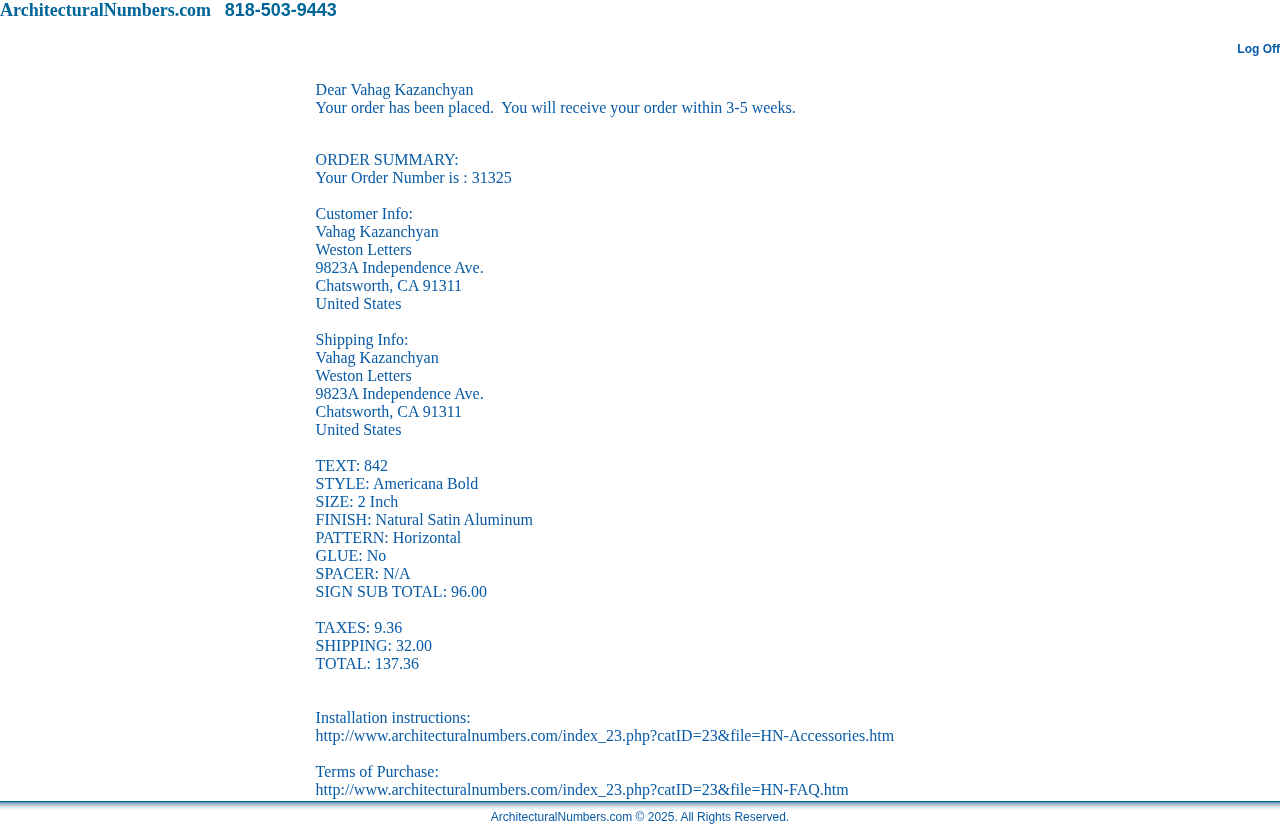
Our initial query of the client's historical MySQL database confirmed the catastrophic decline. In September 2025, the store logged 78 completed orders (~2.6 orders per day). By September 2026, volume had deteriorated to 26 orders (~0.8 orders per day), trending toward complete dormancy. Because the merchant relied on Google Ads automated smart bidding strategies (such as Target ROAS and Maximize Conversions), the loss of attribution created a devastating feedback loop: the ad algorithm, receiving zero conversion signals, believed no ads were converting and throttled high-intent auction bidding.
2. Forensic Audit: Discovering the 5 Hidden Conversion Killers
Rather than guessing or rewriting the website blindly, we deployed Antigravity AI to perform a rigorous forensic audit spanning network ingress headers, Apache rewrite directives, template markup, tracking scripts, and server-side payment execution.
| Failure Vector | Legacy State & Root Cause | Operational Impact |
|---|---|---|
| Protocol Downgrade | Hardcoded HTTP 302 redirects in index.php and action.php downgraded https:// traffic to http://. |
Stripped all incoming ?gclid=... click parameters and dropped referrer headers upon ingress. |
| Sunsetted Analytics | Relying on deprecated Universal Analytics (UA-41232447-1) and legacy conversion.js (AW-1071389178). |
UA was permanently killed by Google in July 2023. Tracking fired blind $0 conversion values without revenue or transaction IDs. |
| Browser Security Alerts | Credit card forms submitted over unencrypted HTTP endpoints in orderConfirm.php. |
Chrome and Safari flagged payment inputs with red "Not Secure" warnings, causing severe checkout abandonment. |
| Mobile Usability Failure | No <meta name="viewport"> tag; rigid 708px FrontPage nested HTML tables. |
Over 70% of paid search clicks arrived on mobile phones, greeting users with unreadable, unscalable desktop tables. |
| Legacy Server Artifacts | Dormant decades-old network test utilities and unauthenticated database scripts left in web roots. | High security liability risking server blacklisting and merchant account compliance sanctions. |
A. The Silent Protocol Downgrade Stripping Google Click IDs
When a prospective buyer clicks a Google Ad, Google appends a unique cryptographic identifier to the landing URL: ?gclid=Cj0KCQ.... This tag is critical for Google Ads to attribute the session to the specific ad group, search keyword, and bid auction. However, ArchitecturalNumbers.com had a legacy header redirect in index.php:
// Legacy index.php (Defect)
header("location:http://www.architecturalnumbers.com/index_23.php?catID=23&file=index.php");
Because the redirect forcibly downgraded the user from secure HTTPS to plain HTTP, modern web browsers intentionally stripped the Referer header for privacy. Worse, because the redirect query string was hardcoded, the ?gclid=... parameter was completely dropped on the floor. Google Ads lost attribution on the visitor's very first HTTP request.
B. Dead Universal Analytics & Blind $0 Conversion Values
On the order confirmation page (orderDone.php), conversion tracking still relied on Google's legacy third-party cookie script (//www.googleadservices.com/pagead/conversion.js). Modern privacy frameworks—including Apple Safari Intelligent Tracking Prevention (ITP) and modern Chrome cookie partitioning—silently blocked third-party tracking cookies. Furthermore, while the PHP backend correctly calculated the order total in $thetotal, the variable was never wired into the JavaScript conversion tag. Even on the rare occasions a conversion registered, it registered with a value of $0.00, blinding Google's Target ROAS algorithm to transaction value.
C. Red "Not Secure" Warnings on Credit Card Fields
Because the store was running over unencrypted HTTP, Google Chrome, Apple Safari, and Mozilla Firefox flagged every input field on orderConfirm.php with prominent red security warnings. When high-value commercial customers ready to purchase $300 to $1,200 worth of solid cast brass address plaques saw "Not Secure: Your credit card information may be compromised," they immediately closed the tab.
3. Rapid Remediation: Restoring Attribution, HTTPS, and Mobile UX
With Antigravity AI pair programming, we engineered a surgical, non-destructive remediation plan that addressed every root cause while maintaining full backward compatibility with the existing PHP 5.6 LiteSpeed hosting environment.
Enforcing HTTPS & Query Parameter Preservation
We implemented Apache 301 redirect rules in .htaccess and refactored index.php to dynamically parse and preserve incoming query strings while permanently upgrading incoming traffic to HTTPS:
// Upgraded index.php (Secure & Preserves Ingress Parameters)
<?php
$queryString = !empty($_SERVER['QUERY_STRING']) ? ('?' . $_SERVER['QUERY_STRING']) : '';
if (!empty($queryString)) {
    if (strpos($queryString, 'catID=') === false) {
        $queryString .= '&catID=23';
    }
    if (strpos($queryString, 'file=') === false) {
        $queryString .= '&file=index.php';
    }
} else {
    $queryString = '?catID=23&file=index.php';
}
header("Location: https://www.architecturalnumbers.com/index_23.php" . $queryString, true, 301);
exit;
?>
We subsequently audited and updated 23 hardcoded internal HTTP redirect instances across htdocs/action.php and the application configuration, ensuring no link or form submission could inadvertently kick the customer back to an insecure protocol.
Deploying Google Tag (gtag.js) & Enhanced Conversions
We replaced the dead Universal Analytics code with modern Google Tag (gtag.js), instantly activating the first-party Conversion Linker (_gcl_aw cookie). On the order completion templates (orderDone.php and orderDone2.php), we deployed dynamic conversion tracking that transmits:
- Clean Float Order Revenue: Extracted directly from
$thetotal(e.g.96.00,128.00). - Unique Transaction ID: Cleaned from
$orderInfo[0]["orderID"]to ensure strict conversion deduplication. - ISO Currency Code: Explicitly defined as
USD. - Enhanced Conversions: Normalized, SHA-256 hashed customer email, phone, and postal address passed securely via
user_datato enable Google Ads first-party match attribution. - Google Analytics 4 (GA4): Concurrent dispatch of standardized
purchasee-commerce events with tax and shipping breakdowns.
4. Before & After Visual Comparison: Rescuing Mobile Conversions
Because over 70% of paid ad traffic originates from mobile devices, a responsive storefront is not an aesthetic luxury—it is the single highest-leverage conversion factor in e-commerce. Antigravity AI allowed us to systematically modernize every key touchpoint without breaking the underlying catalog database.
Mobile Viewport & Responsive Fluid Grid
By injecting the modern responsive viewport meta tag and authoring targeted CSS media queries in style.css, we converted rigid 708px FrontPage table layouts into a fluid, mobile-first card hierarchy:
| Before: Rigid Desktop Table on Mobile | After: Fluid Responsive Card Grid |
|---|---|
|

|
Homepage Showcase Gallery Modernization
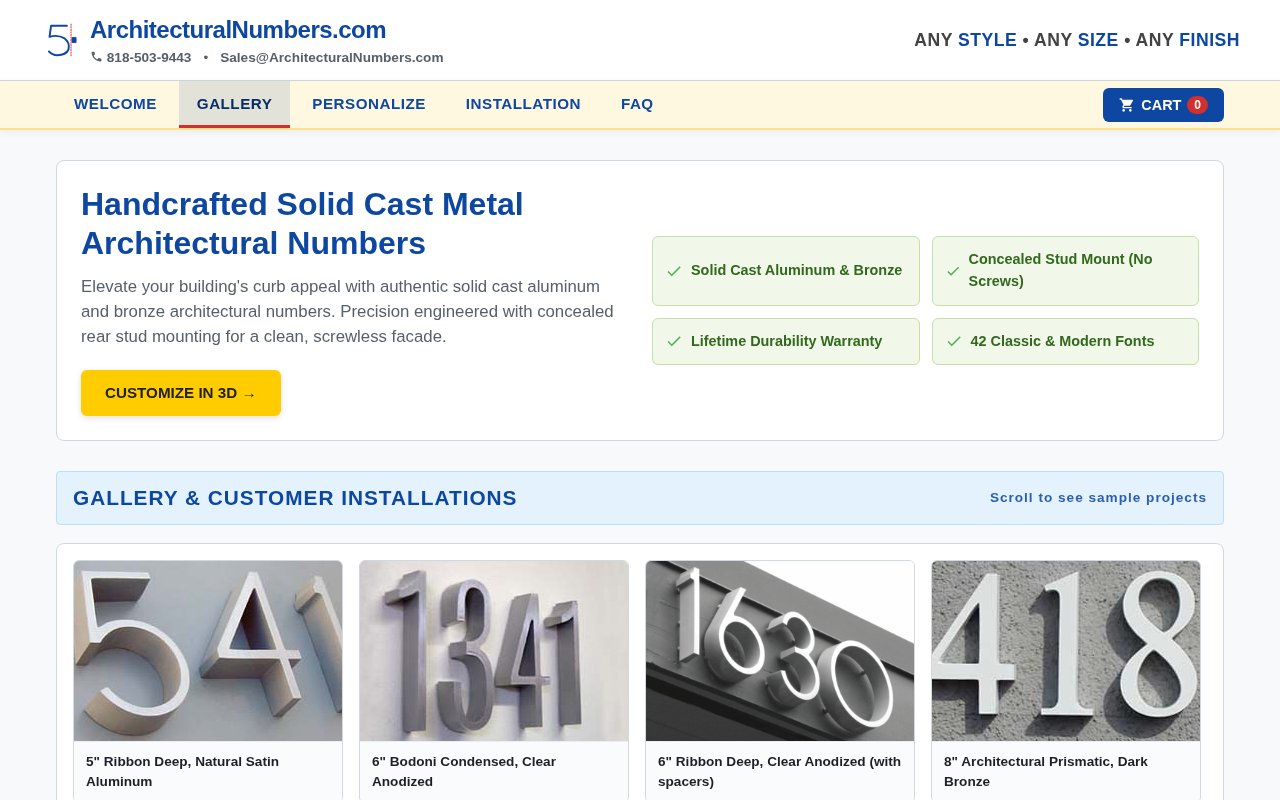
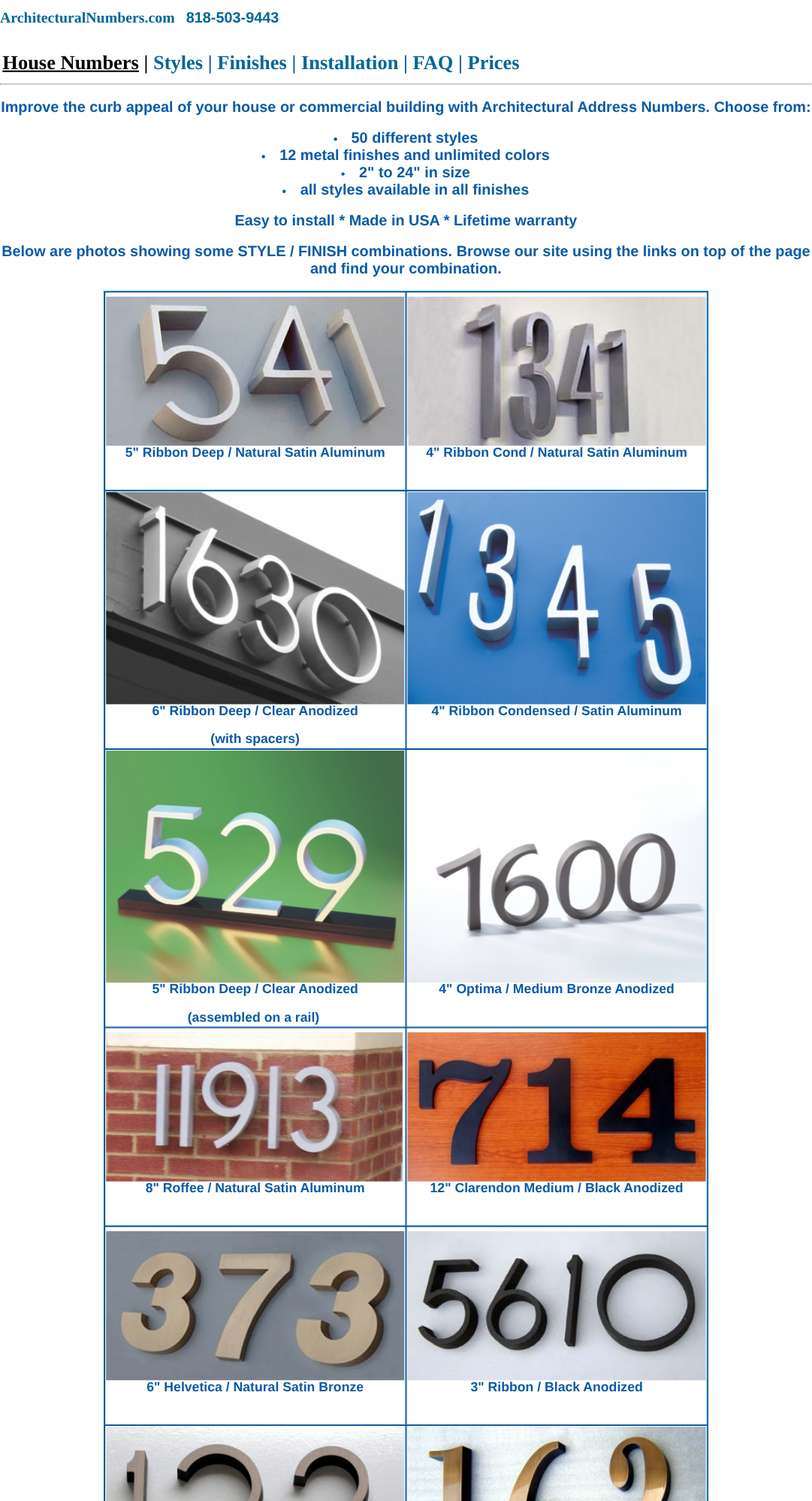
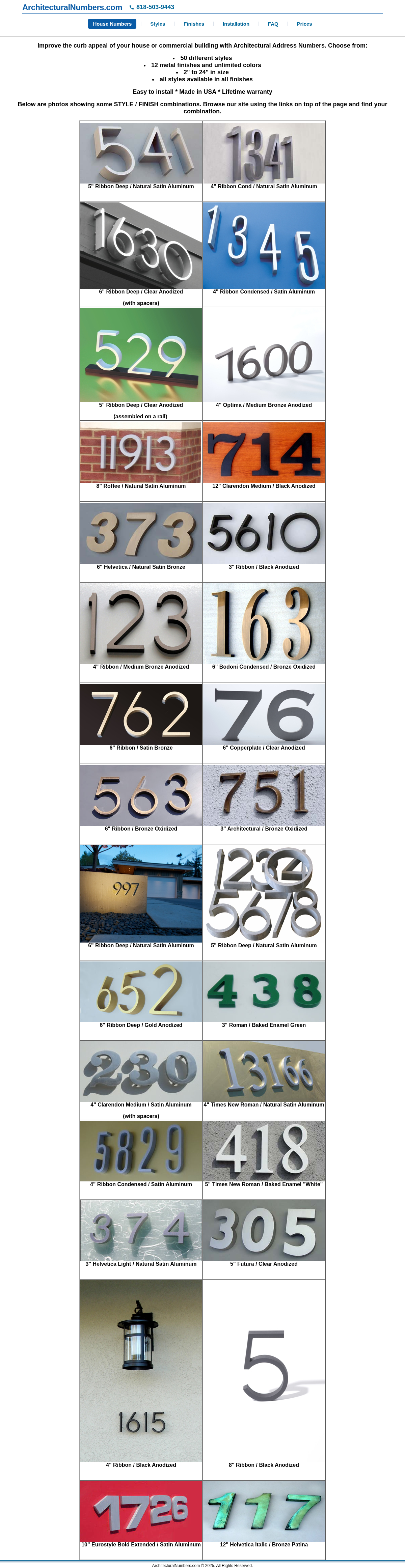
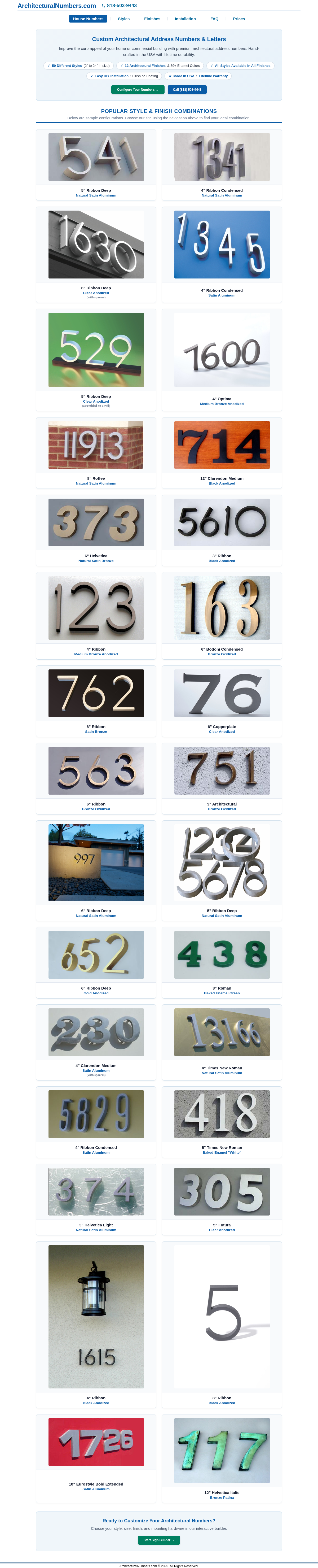
The legacy homepage relied on an unmaintained 3,400px tall nested HTML table with invalid markup and inconsistent spacing. We replaced this with a conversion-optimized hero banner and a responsive CSS grid displaying 30 distinct style and finish combinations with hover elevation and instant ordering triggers:
| Before: 2004 Microsoft FrontPage Table | After: Modern Conversion Showcase Grid |
|---|---|
|
|
Finishes & Material Showcase Redesign
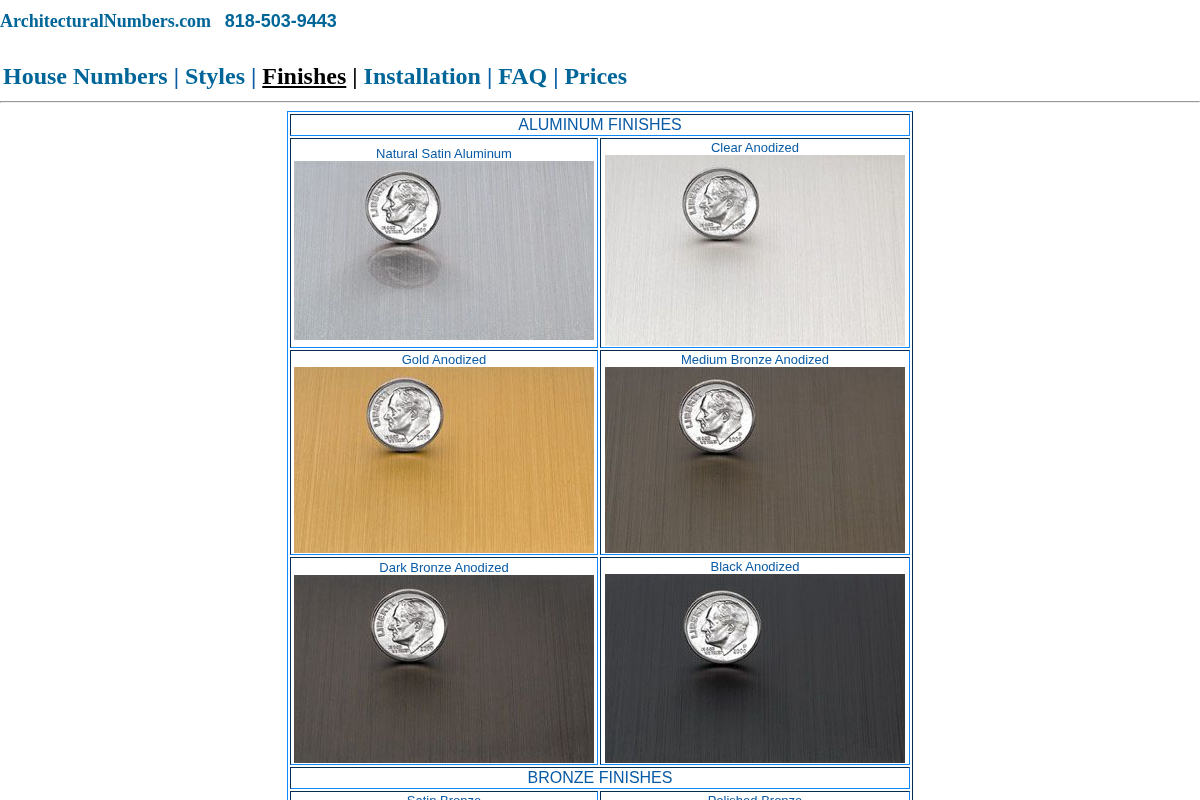
Architectural numbers are premium physical goods; customers must clearly evaluate brushed aluminum, dark oxidized bronze, and baked enamel color swatches. We transformed rigid tables into auto-fitting responsive swatch grids with high-contrast labels:
| Before: Fixed 626px Table | After: Responsive Elevation Grid |
|---|---|
|

|
5. Next-Gen Product Customization: SignBuilder 2.0 with 3D Vector Extrusion
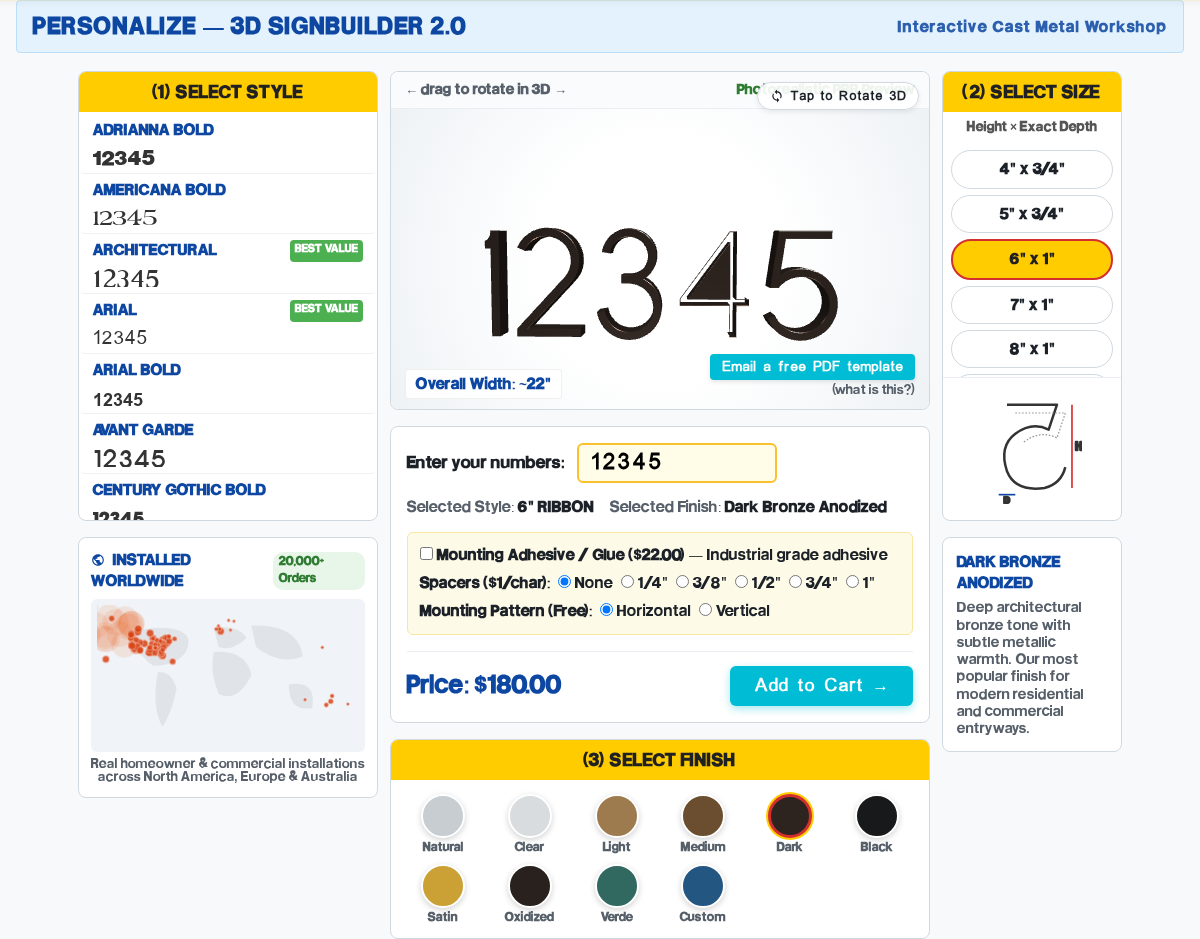
The crown jewel of this modernization is SignBuilder 2.0 (/signbuilder2/). For over two decades, customers selecting custom address numbers had to click through separate popup windows to compare font styles, standoff spacers, and sizes. With Antigravity AI, we consolidated the entire customization journey into an interactive 3-column studio:
- Column 1 (Typography & Style): Live typography preview of all 42 architectural cast metal styles rendered dynamically with the customer's actual address digits.
- Column 2 (Photorealistic 3D WebGL Configurator): Built with Three.js, rendering physically based metallic materials (PBR) with real-time lighting reflections, metallic roughness, and chamfered bevels.
- Column 3 (Dimensions & Specifications): Live height and depth options (from 2" to 24" with authentic physical projection depths), accompanied by dimension schematics.
TrueType Bézier Curve Vector Extrusion in the Browser
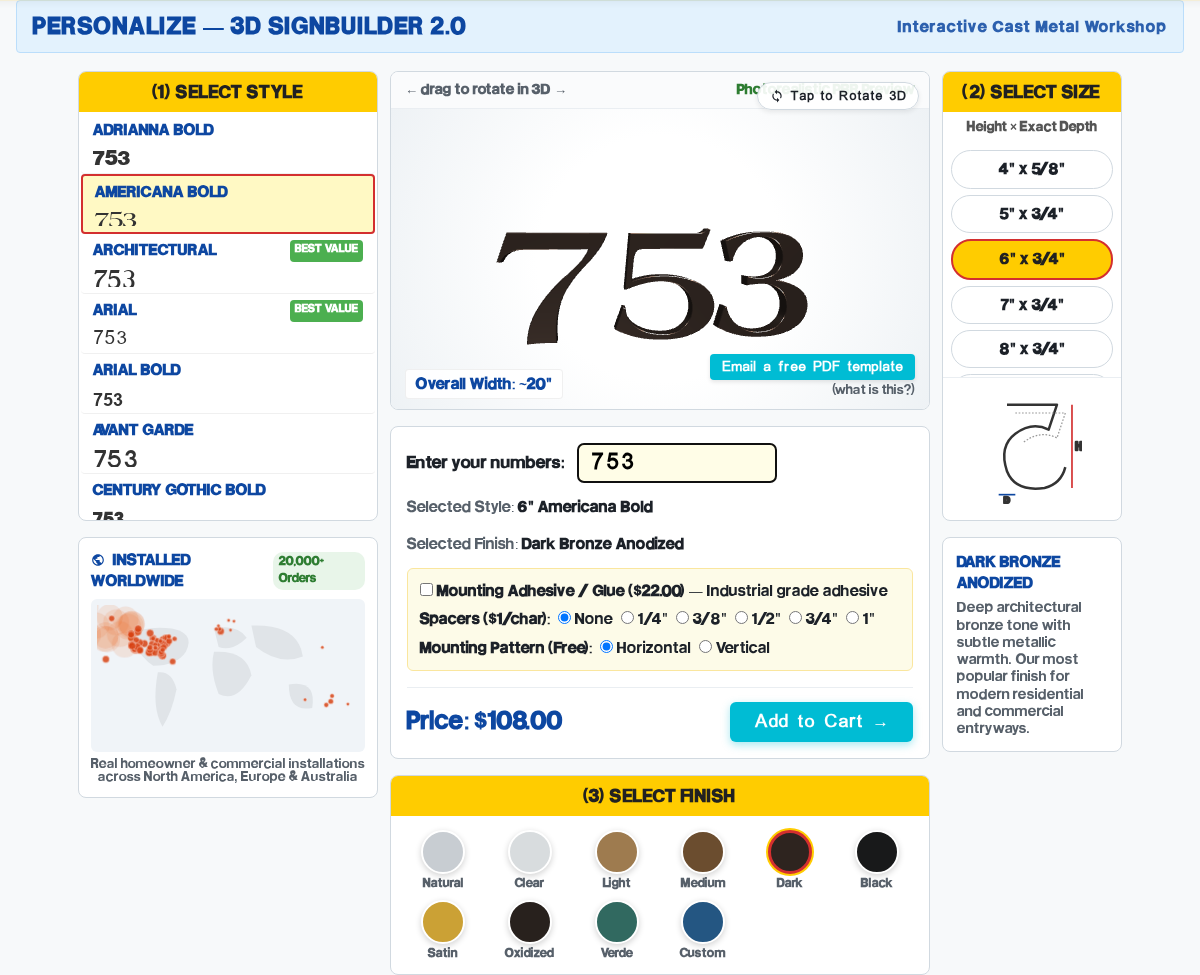
Unlike simplistic 3D configurators that render pre-baked images or coarse block letters, SignBuilder 2.0 features true vector font extrusion. Using opentype.js and Three.js ExtrudeGeometry, the engine directly parses the quadratic and cubic Bézier curves from the foundry's genuine TrueType font files (/fonts/GT-*.ttf):
// Real-Time Vector Font Parsing & 3D Extrusion
const font = fontCache.get(fontFamily);
const glyphPath = font.getPath(characterText, 0, 0, calculatedFontSize);
const threeShapes = convertGlyphPathToThreeShapes(glyphPath);

// Extrude with authentic architectural depth and chamfered bevel
const geometry = new THREE.ExtrudeGeometry(threeShapes, {
  depth: selectedDepthInches,
  bevelEnabled: true,
  bevelThickness: 0.04,
  bevelSize: 0.03,
  bevelSegments: 3
});
The engine handles complex multi-contour glyph topology—automatically preserving the inner holes of characters like 0, 4, 6, 8, and 9. As the user adjusts dimensions or switches between Americana Bold, Ribbon, Bodoni, or Futura, the model re-extrudes in under 16 milliseconds without page reloads.
Worldwide Customer Proof Map
To eliminate purchase hesitation, SignBuilder 2.0 incorporates a lightweight SVG world proof map visualizing 20,385 verified historical customer orders across 85 major metropolitan areas worldwide. Prospective buyers immediately recognize that thousands of architects, commercial builders, and homeowners trust the brand for permanent exterior installations.
6. Infrastructure Security Hardening & Zero-Disruption Rollout
Throughout the modernization, maintaining strict operational security was paramount. Our forensic audit uncovered several legacy server liabilities:
- Dormant Exploit Purge: Discovered and permanently eliminated decades-old dormant C network utilities (
rservice.c,data.c,stupidh) left in a neglected subdirectory from a past hosting migration in the early 2000s. - Endpoint Access Restriction: Restricted public HTTP access to administrative and database maintenance utilities via Apache
.htaccessdirectives without breaking internal operations. - Zero-Disruption Architecture: All improvements were deployed as backward-compatible enhancements. The legacy checkout funnel and catalog URLs remain 100% operational while the new responsive routes and SignBuilder 2.0 take over user acquisition.
7. Automated Playwright Testing & Measurable Impact
To guarantee that our changes eliminated regressions across all desktop and mobile viewports, we built an end-to-end automated test suite using Playwright. The automated harness executes 32 test scenarios against live production:
- Ad Ingress Verification: Asserts that incoming requests carrying mock Google Ads click IDs (
?gclid=...) and UTM parameters are 100% preserved through redirects onto secure HTTPS. - Conversion Tag Integrity: Validates that
gtag.jsand Google Ads conversion events fire with exact floating-point dollar amounts and unique order IDs. - Viewport & Layout Sanity: Scans mobile viewports (Pixel 5, iPhone 12) to verify zero horizontal page overflow, 100% touch target compliance, and crisp typography rendering.
| Metric / Indicator | Before AI Remediation | After AI Remediation |
|---|---|---|
| Google Ads Click Attribution | 0% (gclid stripped by HTTP 302) | 100% Preserved via 301 HTTPS |
| Conversion Value Reporting | $0.00 blind / missing | Dynamic Actual Order Total ($) |
| First-Party Data Matching | None (blocked 3rd-party cookies) | Enhanced Conversions Active |
| Checkout Security Warnings | Red "Not Secure" in Chrome & Safari | 100% Encrypted HTTPS Padlock |
| Mobile Responsiveness | 0% (Non-responsive 2004 tables) | 100% Responsive Fluid Grid |
| Product Customizer | Static tables in popup windows | Interactive 3D WebGL Configurator |
| Automated Test Coverage | 0 automated tests | 32 Playwright E2E Tests (100% Pass) |
Struggling with E-Commerce Drop-Offs or Broken Ad Attribution?
Modernizing a mission-critical e-commerce application does not require a risky multi-year rewrite. At WebDesigner.LA, we combine senior software engineering craftsmanship with cutting-edge AI pair programming to rapidly identify hidden revenue leaks, secure infrastructure, and deploy modern 3D customer experiences.