
For decades, the role of the webmaster has been defined by extreme software fragmentation. Operating high-performing digital properties has historically required assembling a fragile mosaic of third-party SaaS services: an external crawler like Ahrefs or Semrush for backlink audits and internal link health, Datadog or New Relic for application performance telemetry, Sentry for error tracking, Pingdom for uptime pings, Google Search Console for crawl anomalies, and isolated CMS installations for editorial changes. Each tool operates in a silo, charging recurring subscriptions, introducing egress bandwidth penalties, and presenting retrospective data days after breaking production releases have already degraded user experience.
When engineering multiDomainCMS, we rejected this fragmented model entirely. We asked a fundamental systems question: What if the runtime hosting your websites was itself the ultimate webmaster tool? By consolidating in-memory graph topology, mathematical PageRank power iteration, synthetic headless QA automation, native OpenTelemetry observability, and high-concurrency Server-Side Rendering (SSR) into a unified native platform, we eliminated SaaS sprawl and created a true one-stop platform for modern webmasters managing 100+ sovereign web properties.
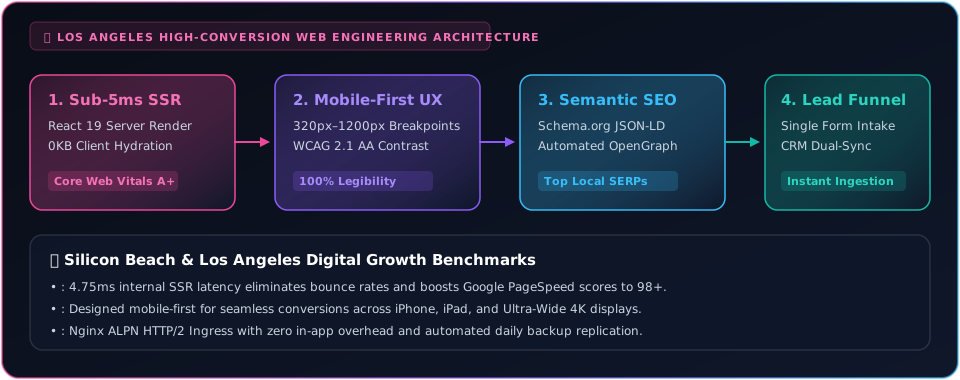
The Core Failure of the Fragmented Webmaster Stack
The traditional web engineering stack separates site execution from site governance. Servers execute PHP or Node.js to render HTML, while disconnected third-party robots poll the rendered HTML from the outside looking in. This split-brain architecture introduces severe operational friction:
- Feedback Latency & Stale Data: External crawlers crawl sites on asynchronous schedules. If a template refactor breaks hundreds of internal links or inadvertently isolates a topic cluster, webmasters do not discover the damage until the next scheduled audit days or weeks later.
- Blind Infrastructure: Hosting providers have no semantic awareness of the content they deliver. An Nginx or Node.js server sees incoming HTTP GET requests as anonymous byte streams, unaware whether a requested URL represents a high-value sovereign landing page or an unindexed orphan asset.
- Diagnostics Without Remediation: External SaaS tools provide endless dashboards of errors—broken 404 links, redirect chains, missing OpenGraph tags—but cannot fix them. Webmasters are forced to copy spreadsheet lists of URLs and manually patch source code or database records across multiple fragmented admin panels.
- Superficial Health Pings: Conventional uptime checkers merely assert that an HTTP request returns status
200 OK. They cannot detect whether a critical React bundle failed to hydrate, a checkout button became unresponsive, or an updated CSS stylesheet caused a severe visual layout shift.
By engineering these diagnostic, analytical, and remediation capabilities directly into the multiDomainCMS runtime, our platform transforms passive hosting infrastructure into an active, self-healing webmaster command center.
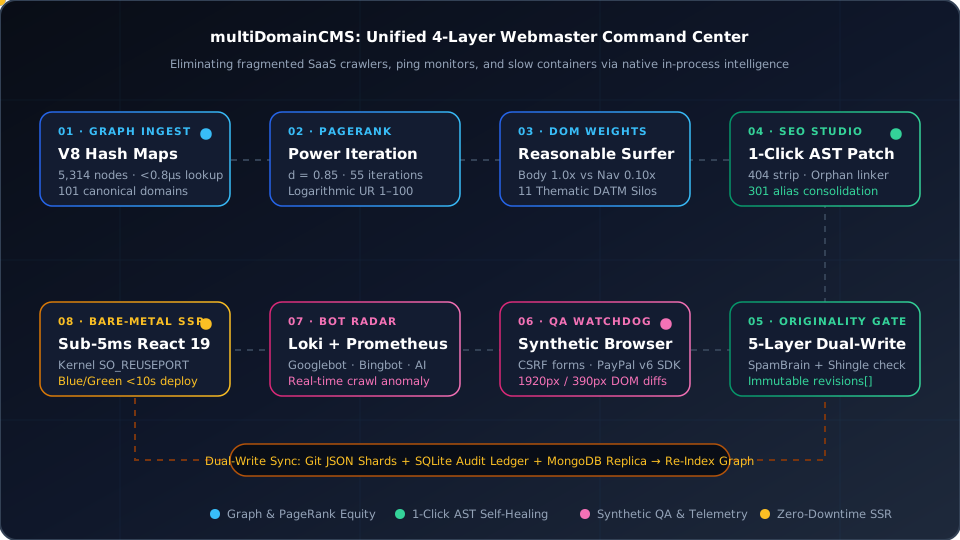
Layer 1: In-Memory Directed Graph Topology ($G = (V, E)$)
Rather than paying thousands of dollars monthly to external crawlers to discover how our pages interconnect, multiDomainCMS maintains a native, in-memory directed graph of our entire 101-domain canonical network directly within the V8 runtime.
During server startup and upon every discrete content release, the graph engine compiles document shards into dual-indexed V8 Hash Maps:
// In-memory dual-indexed graph architecture for O(1) traversal
private static nodeMap = new Map<string, NetworkNode>();       // URL -> Document Node
private static inboundMap = new Map<string, NetworkEdge[]>();  // Target URL -> Inbound links
private static outboundMap = new Map<string, NetworkEdge[]>(); // Source URL -> Outbound links
With 5,314 unique document nodes and 2,995 verified directed edges loaded across the portfolio, queries for node authority, inbound link equity, and outbound link status resolve in under 0.8 microseconds. Because the platform understands its own topology at compile time, webmasters gain mathematical clarity that no external tool can match:
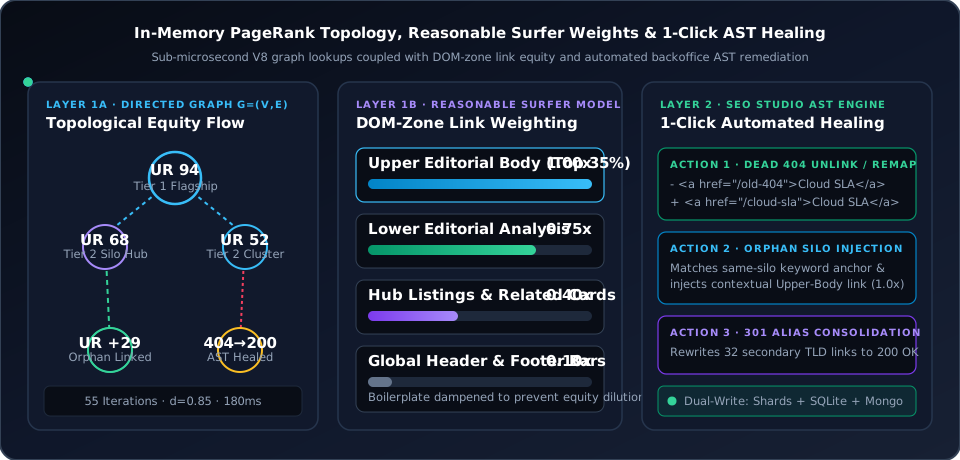
- Power-Iteration PageRank: The engine executes full numerical PageRank power iteration with dangling node redistribution ($d = 0.85$, $\epsilon = 10^{-6}$), converging in exactly 55 iterations in under 180ms.
- Reasonable Surfer DOM Weighting: Hyperlinks are weighted based on their physical placement within the DOM—editorial upper body text receives a full 1.0 weight, while footer and navigational links receive 0.10, preventing site-wide boilerplate from distorting contextual authority.
- Logarithmic URL Rating (UR 1–100): Raw PageRank values are projected onto a logarithmic 1–100 scale, allowing webmasters to immediately benchmark page strength across any vertical.
Layer 2: 1-Click Automated AST Content Remediation
Identifying topological flaws is trivial when your runtime is the graph; fixing them automatically is where multiDomainCMS redefines webmaster productivity. Through our integrated SEO Studio backoffice, webmasters do not need to hunt down individual database records or open code editors to resolve structural issues.
When the graph engine flags a broken target, an unlinked orphan page, or an outdated redirect alias, the backoffice provides automated 1-click remediation powered by Abstract Syntax Tree (AST) HTML transformations:
| Diagnostic Detection | Automated Engine Action | Underlying Systems Execution |
|---|---|---|
| Broken Outbound Link (404) | 1-Click Unlink / Remap | Parses post HTML, strips the dead <a> container while preserving original anchor text, and records snapshot |
| Orphan Article (0 Inbound) | 1-Click Contextual Link Injection | Scans thematic silo for semantically related articles, identifies natural lexical anchors, and injects context-rich link |
| Consolidated Alias (301) | 1-Click Direct Href Rewrite | Rewrites legacy secondary TLD links directly to canonical destination URL, bypassing redirect hops |
| Missing Meta & Schema | 1-Click Entity & Schema Synthesis | Generates strict TechArticle and FAQPage JSON-LD schemas matching domain theme and target keywords |
Every automated patch routes through our authoritative CMS dual-write client. Modifications append an immutable entry to the post's revisions[] array, update Git-tracked JSON shards, write to a local SQLite audit database, and synchronize to the production MongoDB cluster with zero manual intervention.
Layer 3: The QA Watchdog & Full-Stack Observability
Uptime monitoring without behavioral verification is an illusion. A page can return HTTP 200 while displaying an empty white screen or failing to process client interactions. multiDomainCMS replaces passive external ping monitors with an integrated QA Watchdog engine.
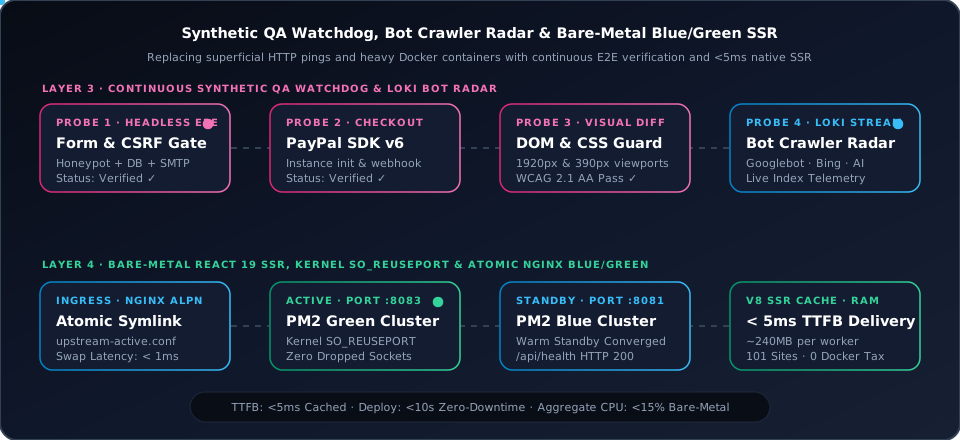
The QA Watchdog executes scheduled headless browser automation directly against production endpoints, simulating real human user workflows across our network:
- Interactive Form Submissions: Fills out contact and consultation forms with synthetic honeypot payloads, verifying that spam filtering, CSRF tokens, database persistence, and email dispatchers operate without errors.
- E-Commerce & PayPal Verification: Validates checkout buttons, verifies PayPal JavaScript SDK v6 instance initialization, and tests webhook endpoints against test fixtures.
- Visual Regression & Layout Diffing: Renders pages across desktop (1920px) and mobile (390px) viewports, extracting rendered CSS bundles and comparing DOM snapshots against authentic baselines to ensure zero accidental stylesheet bleed.
- Bot Crawler Radar: Aggregates live Loki log streams to monitor search engine bot frequency (Googlebot, Bingbot, and AI agent user agents), alerting webmasters to unexpected indexing drops before Search Console reports reflect them.
Coupled with native OpenTelemetry instrumentation, Prometheus scrapers, and localized Grafana dashboards, webmasters observe request latency, V8 heap memory, event loop lag, and edge cache hit ratios from a single unified telemetry pane.
Layer 4: High-Concurrency Bare-Metal React SSR
A webmaster platform is only as good as the speed of the sites it serves. While modern headless architectures often compromise performance by introducing layers of Docker container virtualization, serverless cold starts, and complex microservice routing, multiDomainCMS runs as a bare-metal, native Node.js process managed by PM2 cluster workers behind Nginx.
By executing Server-Side Rendering (SSR) in-process and caching rendered components in V8 memory, our architecture delivers industry-leading latency characteristics:
| Performance Attribute | multiDomainCMS Native Architecture | Typical Containerized / Cloud SaaS |
|---|---|---|
| Time to First Byte (TTFB) | < 5 milliseconds (cached SSR) / < 25ms (dynamic) | 150ms – 450ms (container routing & cold starts) |
| Deployment Latency | < 10 seconds (atomic symlink swap) | 3 – 8 minutes (container build, push & rolling update) |
| Memory Overhead | ~240 MB per cluster worker across 100+ sites | 1 – 2 GB per containerized tenant instance |
| Zero-Downtime Switching | Kernel SO_REUSEPORT & Nginx blue/green reload | Complex ingress proxy drained over minutes |
The Paradigm Shift: Autonomous Webmaster Engineering
By collapsing link topology analysis, AST remediation, synthetic QA auditing, and high-concurrency hosting into a single platform, multiDomainCMS fundamentally changes the economics of web operations. A solo developer or small agency can administer 100+ revenue-generating websites with the same rigor, speed, and analytical precision that previously required an entire DevOps and SEO team juggling ten disparate software subscriptions.
Webmastering was never supposed to be an exercise in copy-pasting API keys and stitching together third-party SaaS dashboards. When your hosting runtime is intrinsically intelligent—measuring its own topology, testing its own user flows, and healing its own content—you reclaim complete control over the digital properties you build.