
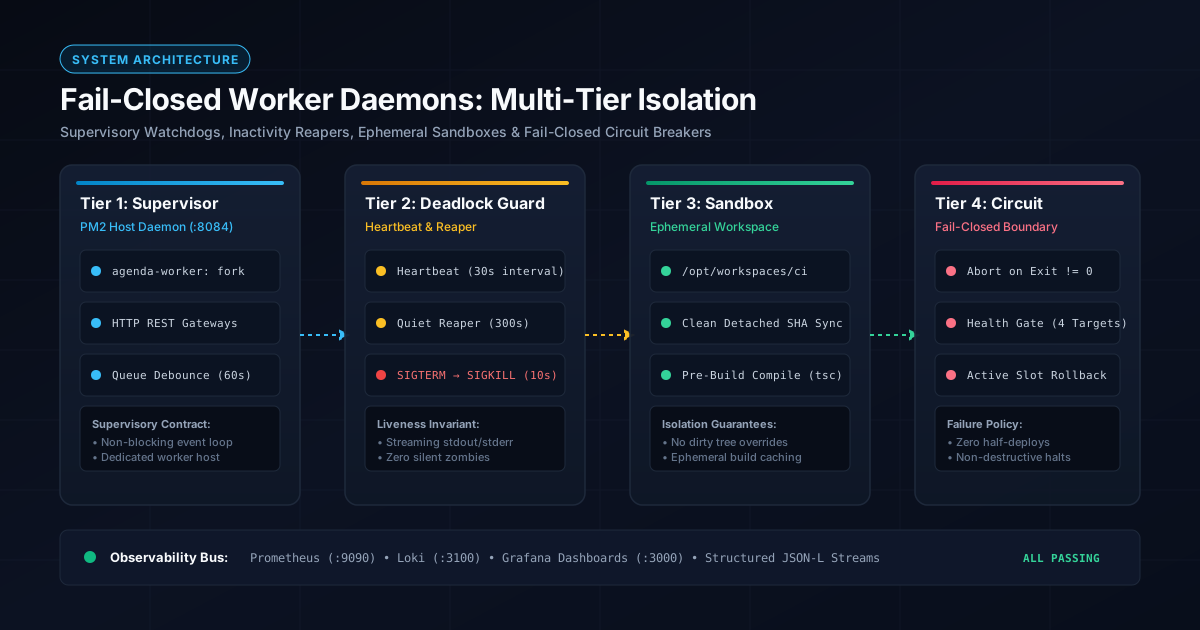
Automated worker daemons and continuous integration orchestrators operate at the high-stakes intersection of system stability and autonomous execution. When background tasks encounter unhandled rejections, deadlocked compilers, or network stalls, a poorly isolated worker can exhaust host file descriptors, dirty version control worktrees, or deploy broken code to live production. In this architectural guide, we dissect the design of fail-closed worker daemons built with multi-tier process isolation, streaming inactivity reapers, transient sandboxed workspaces, and atomic Blue/Green circuit breakers.
The Fragility of Monolithic Automation Daemons
Many engineering teams begin automation with straightforward cron jobs or in-process queue listeners like Agenda, BullMQ, or Celery. A single Node.js or Python process schedules jobs, polls database queues, executes builds, and touches local disks. Under ideal network conditions and predictable workloads, this pattern appears functional. However, production environments inevitably introduce asynchronous anomalies:
- Compiler and Tool Deadlocks: Long-running build commands such as TypeScript compilers (
npx tsc) or test runners can hang silently without emitting output if circular dependencies or pipe backpressure lock child streams. - Event Loop Starvation: Synchronous subprocess calls (
spawnSyncorexecSync) block the parent process's event loop entirely, blinding queue watchdogs and causing false-positive timeouts. - Worktree Contamination: Automated scripts running directly inside developer workspaces or production directories modify tracked files, creating merge collisions and dirty working trees that break subsequent deployments.
- Fail-Open Degradation: When a deployment script encounters an error halfway through file synchronization, failing to abort cleanly leaves production clusters in an inconsistent, hybrid state where half the cluster runs old code while the other half serves broken new dependencies.
To eliminate these systemic failure modes, robust infrastructure requires a fail-closed architecture: an engineering discipline where any anomaly, unhandled timeout, or checksum failure immediately halts operations safely, preserves disk state without mutation, and keeps active production traffic pinned to the known healthy baseline.
Tier 1: Supervisory Process Isolation and Dedicated Worker Nodes
The foundational layer of a resilient daemon is strict process and infrastructure segregation. Background automation and queue scheduling must never share host resources with client-facing web servers.
In a distributed multi-tenant topology, client-facing nodes (such as production web clusters serving HTTP traffic on ports :8081 and :8083) remain strictly reserved for low-latency request handling, in-memory caching, and database read operations. Heavy automation workloads—including continuous integration compilers, SEO spiders, outbound webhooks, and git synchronization—are delegated to dedicated automation worker machines.
Within the worker host, process boundaries are enforced hierarchically:
- Supervisor Daemon: Managed by an operating system process manager such as PM2 or systemd. The supervisor listens on a private local loopback port (for example,
127.0.0.1:8084) and exposes an idempotent HTTP REST API for job dispatching, status querying, and cancellation. - Worker Thread and Queue Decoupling: The supervisor does not execute tasks in its own thread. Instead, it dispatches background jobs via detached child process forks, maintaining an independent process group ID (PGID) for every task.
- Debounce and Queue De-duplication: Incoming execution requests pass through a sliding debounce window (typically 60 to 120 seconds). If an active pipeline run is already processing the target commit or queue topic, duplicate triggers coalesce into the running job, preventing catastrophic thundering herd events.
Tier 2: Real-Time Heartbeats and the Streaming Inactivity Reaper
A frequent anti-pattern in background daemon construction is relying on blunt global execution timeouts. Setting a hard 30-minute ceiling fails to distinguish between a healthy, compute-heavy compilation job and a completely deadlocked process that froze within its first five seconds.
To maintain truthful observability without deadlocks, resilient daemons implement a dual-phase liveness monitor combining streaming standard I/O with an active supervisor heartbeat:
| Liveness Component | Mechanism | Detection Threshold | Operational Recovery Action |
|---|---|---|---|
child.stdout.on('data') |
Streaming Buffer Chunks | Real-Time (0ms) | Pipes compiler output directly to parent logger without buffering in RAM. |
Active Heartbeat Tick |
setInterval Timer |
30 Seconds | Emits periodic liveness pings to supervisor during silent compiler passes. |
Inactivity Reaper |
Watchdog Timestamp Delta | 300 Seconds Quiet | Sends graceful SIGTERM, followed by SIGKILL after a 10s grace window. |
Stage Budget Ceiling |
Cumulative Stage Timeout | 20 Minutes | Halts runaway test suites or infinite loops and triggers fail-closed rollback. |
By piping child stdout and stderr streams directly through the supervisor's logging subsystem, the parent process continuously validates that the child is executing forward progress. If a quiet command—such as npx tsc --noEmit—produces zero standard output for minutes while traversing abstract syntax trees, the 30-second heartbeat ensures the outer supervisor does not mistake deliberate silence for a stalled kernel thread. Conversely, if all output ceases entirely and the child process freezes for more than 300 seconds, the inactivity reaper steps in, terminating the stuck process group cleanly.
Tier 3: Transient Workspaces and Non-Destructive Reconciliation
Automated daemons must never execute builds or tests directly within shared repositories or active production paths. Doing so risks leaving untracked build artifacts, generated test SQLite files, or mutated configuration files that pollute git history.
Instead, resilient systems operate strictly within ephemeral, sandboxed workspace paths (for example, /opt/job-runner/workspaces/app-ci). Each deployment cycle executes a disciplined, non-destructive synchronization protocol:
- Preflight Git Verification: Before touching disk state, the daemon validates that upstream remotes are reachable via SSH deploy keys and resolves the exact commit hash of the target branch.
- Lossless Working Tree Protection: If the workspace contains uncommitted changes from prior test runs, the daemon strictly avoids destructive shell commands like
git reset --hardorgit clean -f. Destructive commands risk permanently destroying uncommitted diagnostic data. Instead, the daemon cleanly preserves state losslessly using structured git stash storage before performing checkouts. - Detached Commit Anchoring: The runner checks out code using detached HEAD mode (
git checkout --detach <commit-sha>). This guarantees that builds and typechecks run against an immutable snapshot, completely immune to branch tracking drifts or subsequent concurrent commits. - Isolated Dependency Trees: In production environments where
NODE_ENV=productionis exported globally by process supervisors, running standard package installs can silently omit devDependencies like TypeScript compiler binaries. Multi-tier runners explicitly pass--production=falseand--legacy-peer-deps, ensuring that compilers, linters, and testing engines are reliably available withinnode_modules/.bin.
Tier 4: Fail-Closed Circuit Breakers and Blue/Green Promotion
The ultimate goal of a fail-closed daemon is safeguarding user-facing production systems. In traditional single-server deployments, pushing updates often involves stopping an application, overwriting files, running migrations, and restarting the service. If the new code contains a syntax error or a broken dependency, the site goes down entirely.
To eliminate deployment downtime, fail-closed worker daemons leverage atomic Blue/Green switching:
- Detect Active Deployment Slot: The daemon checks the active reverse proxy symlink to identify which server instance is currently taking live traffic (for example, Blue on port
:8081). - Deploy Exclusively to Standby: Code synchronization, dependency verification, and Native Secrets Vault configuration updates are applied strictly to the standby instance (Green on port
:8083). The active slot continues serving live customer requests with zero interruption. - Standby Health Gate: Before traffic is shifted, the standby slot undergoes automated local HTTP health checks across critical endpoints (such as
/api/health). If the standby instance fails to return a clean200 OKwithin the retry window, the pipeline halts immediately. The active slot remains 100% untouched. - Atomic Reverse Proxy Switch: Once health verification passes, the daemon atomically switches the Nginx upstream symlink (
sudo ln -sf upstream-green.conf active.conf), flushes edge reverse proxy cache directories cleanly, and reloads Nginx. - Warm Standby Convergence: After the new slot is successfully serving edge traffic, the daemon restarts the previous slot with the updated code, leaving a fully converged, warm standby ready for the next release cycle.
Tier 5: Structured Observability, Audit Ledgers, and Telemetry
An automated worker operating in a vacuum is a liability. Complete operational confidence demands continuous real-time telemetry across every pipeline stage.
Modern worker daemons export execution telemetry across three synchronized channels:
- Structured JSON-L Journals: Every job dispatch, state transition, and execution duration is appended to a structured ledger (e.g.
journal.jsonl). Each record contains immutable metadata: timestamp, job key, unique run ID, commit SHA, exit code, and stage duration in milliseconds. - Loki and Promtail Log Streams: Process stdout and stderr outputs are scraped by Promtail and forwarded to Loki on port
:3100, enabling millisecond-accurate log querying and trace correlation. - Prometheus Metrics: Daemon process metrics—including active task counts, memory RSS, CPU utilization, and failure rates—are exposed to Prometheus scrapers on port
:9090, feeding real-time Grafana monitoring dashboards with automated threshold alerts.
Summary: Fail-Closed vs. Unmonitored Background Daemons
Implementing multi-tier isolation requires deliberate architectural engineering, but the reliability dividends are immense. The table below illustrates the stark contrast between conventional automation scripts and enterprise fail-closed worker daemons:
| Architectural Vector | Traditional Unmonitored Daemon | Fail-Closed Multi-Tier Worker |
|---|---|---|
| Process Topology | Single shared process; runs on production host. | Dedicated worker host; supervisory daemon decoupled from child forks. |
| Failure Handling | Fail-open; partial failures leave broken files on disk. | Fail-closed; any check failure halts pipeline, keeping standby untouched. |
| Timeout Strategy | Rigid global timeout; blind to silent compiler deadlocks. | Streaming I/O heartbeats + 300s quiet inactivity reaper with SIGKILL grace. |
| State Management | Runs in main tree; risk of dirty files and forced resets. | Ephemeral sandboxed workspace with detached SHA checkout and lossless stashing. |
| Deployment Safety | In-place restarts with direct user downtime on error. | Zero-downtime Blue/Green slots with pre-promotion health gates and instant rollback. |
| Telemetry & Audit | Unstructured text files; silent failure modes. | Structured JSON-L audit ledgers, Prometheus metrics, and Loki trace streams. |
By enforcing supervisory process boundaries, active streaming heartbeats, ephemeral workspace sandboxing, and fail-closed Blue/Green promotion gates, software teams can deploy autonomous background automation engines that operate with total operational integrity and zero production downtime.