
Most hiring rubrics and self-assessments fail at the senior and principal level because they measure tool familiarity instead of failure-mode ownership. Listing forty cloud logos on a resume tells a VP of Engineering nothing about whether a candidate can decompose a ten-year-old monolith without downtime, prevent split-brain payment double-charges, or cut a runaway cloud bill by 45%. A rigorous solution architect skills matrix replaces vague star ratings with observable production behaviors across four weighted engineering domains.
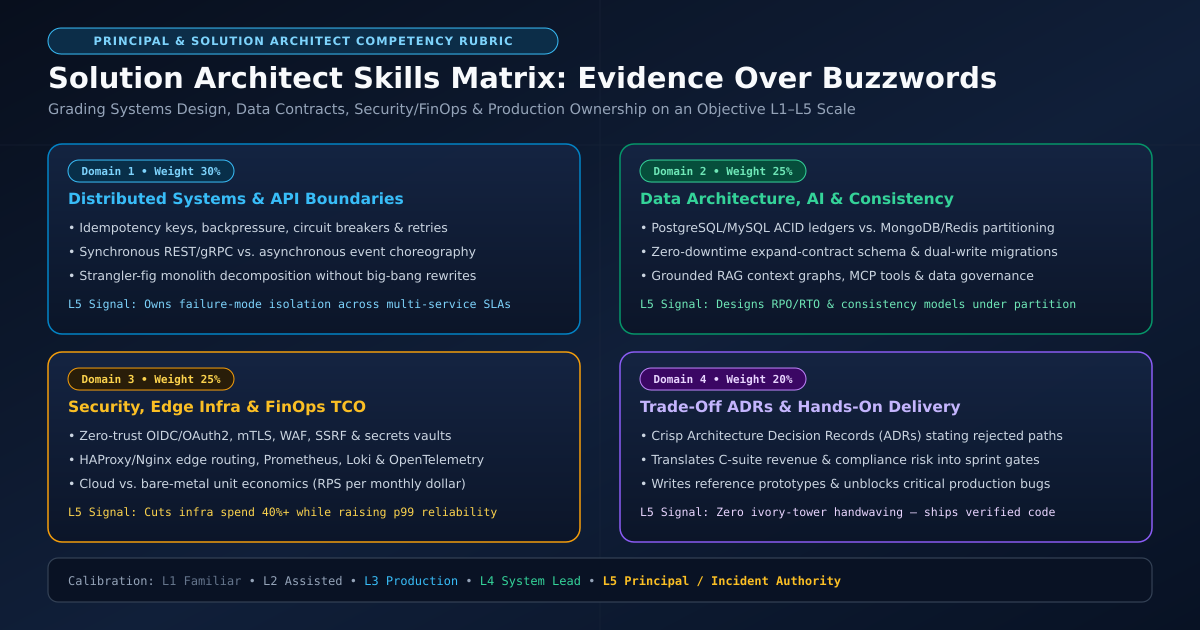
1. Anchoring the L1–L5 Behavioral Competency Rubric
Before listing a single technology, calibrate what each score means in concrete operational evidence. In an objective competency rubric, advancing from L3 to L5 is not about memorizing rarer API flags—it is about expanding blast-radius foresight and organizational leverage:
- L1 — Conceptual Exposure: Understands where a technology fits and its high-level trade-offs, but has not shipped or operated it in production.
- L2 — Scoped Implementation: Implements components within an established architecture pattern with code-review guidance.
- L3 — Production Practitioner: Independently designs, deploys, instruments, and debugs the subsystem under real customer load.
- L4 — Multi-Service System Lead: Owns cross-team contracts, schema migrations, capacity planning, and SLO error budgets across service boundaries.
- L5 — Principal Incident & Architecture Authority: Resolves novel cross-layer outages, authors enduring reference architectures, mentors L3/L4 leads, and aligns technical investments directly with unit economics.
2. The Four Core Domains of a Modern Solution Architect
A balanced principal systems architect or enterprise solution architect should be evaluated across four complementary pillars—preventing the two classic failure modes of hiring either a pure infrastructure specialist who ignores application UX or a slide-deck strategist who hasn't touched a debugger in five years.
| Matrix Domain (Weight) | Core Capabilities Assessed | L3 Mid-Senior Bar | L5 Principal Distinction |
|---|---|---|---|
1. Distributed Systems & APIs (30%) |
REST/gRPC/WebSockets, idempotency, queues, backpressure, strangler-fig | Builds clean typed APIs with retries and rate limits | Models distributed systems trade-offs: thundering herds, poison pills & partial partition recovery |
2. Data, Search & AI (25%) |
ACID SQL, NoSQL sharding, caching, expand-contract, grounded RAG | Writes indexed queries and normalized schemas | Designs dual-write zero-downtime cutovers, RPO/RTO bounds & hallucination-free RAG context graphs |
3. Security, Edge & FinOps (25%) |
OIDC/mTLS, OWASP/SSRF, HAProxy/Nginx, Prometheus/Loki, TCO | Configures CI pipelines, TLS, and basic alerts | Enforces defense-in-depth threat models while normalizing infra by SLO-compliant RPS per dollar |
4. ADRs & Delivery Governance (20%) |
Written ADRs, build-vs-buy math, stakeholder alignment, code prototypes | Documents feature specs for a single squad | Authors crisp Architecture Decision Records with explicit rejected alternatives & ships reference code |
3. Why Hands-On Prototyping Belongs in Every Architect Matrix
The fastest way an architecture group loses credibility with product engineers is prescribing unverified abstractions from an ivory tower. High-performing solution architects validate risky seams—such as an OAuth2 token-exchange edge proxy, a WebGL VRAM disposal loop, or a lockless PostgreSQL backfill—by building a working vertical slice and measuring real latency before mandating organization-wide adoption.
Inspect a Live, Interactive 70+ Technology Implementation: Want to see how an evidence-backed matrix looks in practice? Open Robert Baindourov's Interactive Technical Skill Matrix on WebDesigner.LA, filterable by domain, years of production experience (up to 17+ years), and verified live project links.
4. Interviewing With Architecture Decision Records Instead of Trivia
When hiring or promoting against a solution architect skills matrix, replace whiteboard puzzle trivia with a ninety-minute collaborative review of a real historical outage or migration led by the candidate. Ask four probing questions that immediately separate L3 builders from L5 architects:
- Which viable alternative did you explicitly reject in your ADR, and under what future traffic or team condition would that rejected option become the right choice?
- Where was the hardest stateful boundary during rollout, and how would you have rolled back cleanly twenty minutes after cutover if data writes had already occurred?
- Which specific telemetry signal (not customer support tickets) proved the new architecture met its latency and cost hypothesis?
- What operational complexity did you deliberately remove from the system rather than add?
Explore Our Live Interactive Skill Matrix
Drill into 17+ years of verified full-stack, cloud, Linux, 3D WebGL, and AI/MCP systems engineering across 70+ technologies—or reach out directly for principal architecture engagements.