
A single hallucinated sentence in a consumer chatbot is a mild annoyance; a single hallucinated clause in enterprise sales AI—promising HIPAA Business Associate Agreement coverage on a Starter plan, quoting a sunsetted 2024 volume discount, or claiming FedRAMP High authorization on an RFP security questionnaire—creates immediate legal, financial, and reputational liability. Standard chunk-and-embed vector search cannot prevent these failures on its own. Reliable commercial hallucination mitigation requires pairing hybrid retrieval with typed RAG context graphs, symbolic pricing tools, and pre-dispatch citation verification.
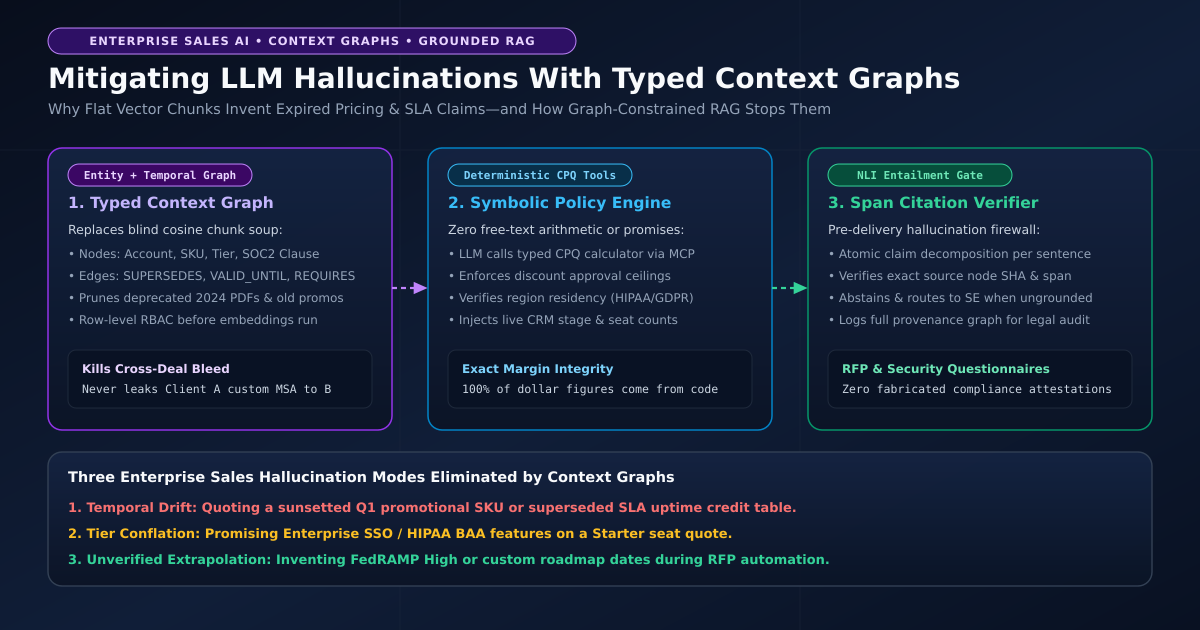
1. Why Flat Vector Chunking Fails Revenue & RFP Workflows
Naive Retrieval-Augmented Generation slices PDFs, Notion pages, Slack threads, and past proposals into 500-token chunks and ranks them by cosine similarity. In an active enterprise sales organization, that flat vector store rapidly becomes a minefield of contradictory truth:
- Temporal Blindness: A retired Q4 promotional deck and the current Q3 price sheet have nearly identical semantic embeddings for the query “annual 500-seat enterprise discount.” Without temporal validity edges, top-k retrieval injects both chunks into the prompt and the LLM blends them.
- Structural Tier Conflation: When a 40-page security whitepaper splits mid-table across chunk boundaries, column headers detach from row cells—causing the generator to attribute Dedicated VPC Single-Tenant isolation to a multi-tenant Pro SKU.
- Cross-Tenant Deal Contamination: Indexing historical redlined Master Services Agreements (MSAs) without strict entity-level ACL filtering risks surfacing bespoke indemnity concessions negotiated for one Fortune 500 buyer inside a draft email to a mid-market prospect.
2. Modeling Commercial Truth With Typed RAG Context Graphs
Upgrading from flat document chunks to RAG context graphs preserves the explicit relational and temporal invariants that govern B2B deals. Instead of treating text passages as isolated islands, every ingested artifact is linked to typed domain entities and directed edges before retrieval executes:
| Graph Primitive | Schema Examples | Hallucination Class Prevented |
|---|---|---|
Typed Entity Nodes |
ProductSKU, PlanTier, ComplianceControl, Region, Account |
Prevents mixing capabilities from unrelated product lines or regions |
Temporal & Lineage Edges |
SUPERSEDES, VALID_FROM, VALID_UNTIL, APPROVED_BY |
Prunes expired price books, retired API versions, and draft proposals |
Entitlement Edges |
INCLUDED_IN_TIER, REQUIRES_ADDON, MIN_SEAT_THRESHOLD |
Blocks promising Enterprise SSO/SAML or 99.99% SLA on lower tiers |
RBAC Scope Predicates |
PUBLIC_ENABLEMENT vs. ACCOUNT_CONFIDENTIAL(acct_id) |
Enforces zero cross-customer leakage at query-plan compilation time |
At query time, retrieval executes as a two-phase subgraph traversal: first resolving the active CRM opportunity's target product family, region, plan tier, and current date to filter candidate graph nodes deterministically (valid_until IS NULL OR valid_until > NOW()), and only then ranking attached evidence passages via hybrid BM25 lexical + dense vector scoring.
3. Delegating Numbers & Approvals to Deterministic CPQ Tools
Language models should never perform multi-line quote arithmetic, currency conversion, or margin-floor checks in free-form token space. Even frontier reasoning models occasionally drop a line-item proration factor when summarizing long conversation threads.
Enforce a hard architectural boundary: the LLM parses buyer intent into structured parameters and invokes deterministic CPQ tools exposed over the Model Context Protocol (MCP) or typed internal RPCs:
// Deterministic CPQ tool contract — LLM cannot invent unit prices or override approval gates
interface QuoteCalculationResult {
  quoteId: string;
  priceBookVersion: string; // e.g. "2026-Q4-US-ENT"
  lineItems: Array<{ sku: string; seats: number; unitAnnualUsd: number; subtotalUsd: number }>;
  appliedDiscountPct: number;
  requiresDealDeskApproval: boolean;
  approvalReason?: string;
  verifiedExpiresAtIso: string;
}
The orchestration layer locks those exact returned numbers into read-only template slots or structured UI cards so the prose generator can explain value and implementation timelines without ever altering a single digit of the quote.
4. Pre-Dispatch NLI Citation Verification & Graceful Abstention
For outbound artifacts—automated RFP responses, security questionnaire answers, and prospect follow-up drafts—add a synchronous post-generation gate powered by NLI citation verification (Natural Language Inference entailment scoring):
- Atomic Claim Extraction: Split candidate output into discrete factual assertions (for example, “Data at rest is encrypted using AES-256-GCM with customer-managed KMS keys in us-west-2.”).
- Span-Level Entailment Check: Require every factual assertion to carry an explicit
[node_id:span_sha]citation, and verify with a fast cross-encoder/entailment classifier that the cited graph node strictly entails the claim—not merely shares keywords with it. - Confidence-Driven Escalation to Solutions Engineering: When an RFP asks about a roadmap feature or bespoke contractual term absent from the approved context graph, the system explicitly abstains and routes a pre-packaged review card to the assigned Solutions Engineer rather than guessing.
Building Private Revenue & Knowledge Agents? Explore how we deploy isolated, citation-grounded AI workflows on dedicated infrastructure in our AI Agentic Development Hub and 7.5B Open-Source AI Models Production Guide.
Deploy Hallucination-Free Enterprise Sales & RFP AI
Partner directly with Principal Architect Robert Baindourov to design typed RAG context graphs, MCP CPQ tool servers, and citation-verified sales automation inside your private cloud.