
Static product photography breaks down as soon as a buyer needs to specify custom dimensions, brushed metal finishes, typography, LED halo backlighting, or modular joinery. Whether a manufacturer in Los Angeles is quoting architectural signage or an Italian luxury millwork atelier is deploying a multilingual configuratore 3D WebGL for international dealers, an interactive 3D WebGL configurator replaces days of back-and-forth CAD proofs with instant visual certainty and server-verified pricing.
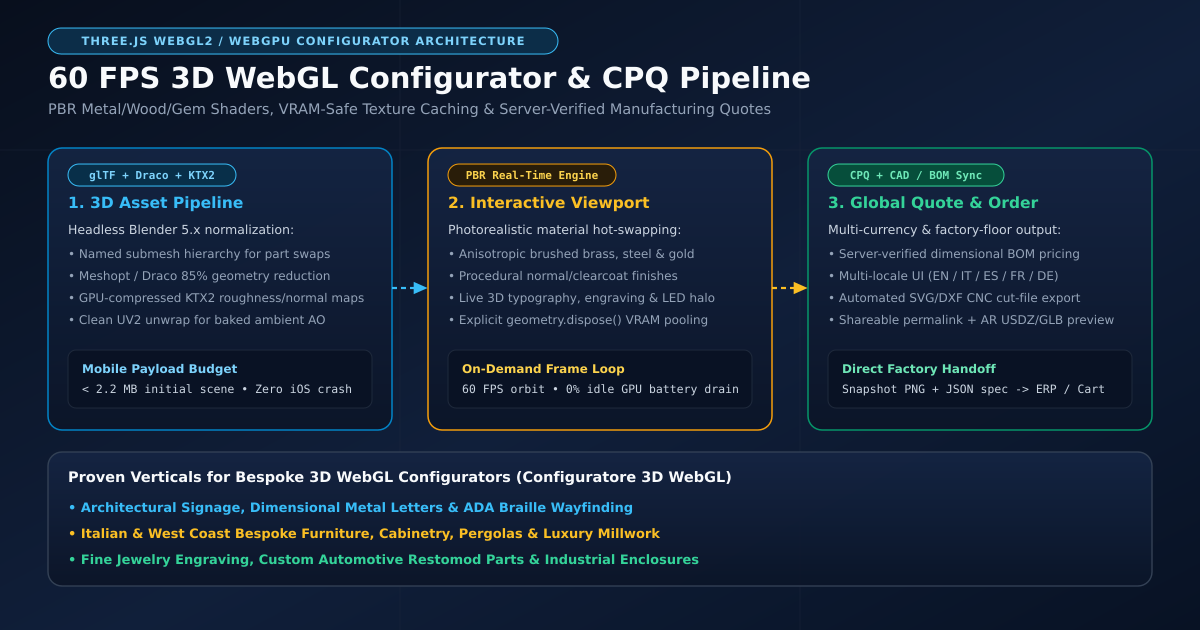
1. Why Prototype Three.js Demos Crash Mobile Safari
Building a spinning cube on a desktop workstation with an RTX GPU is easy; keeping a multi-part customizer running at a locked 60 FPS on an iPhone without triggering a WebKit memory eviction reload is an engineering discipline. Most prototype configurators fail in production for three specific reasons:
- Uncompressed 4K PNG/JPEG Textures Flooding GPU Memory: Four 4096×4096 RGBA textures (albedo, normal, roughness/metalness, ambient occlusion) expand to more than 340 MB of uncompressed VRAM once mipmaps are generated—crashing iOS Safari after the user clicks through five finish swatches.
- Orphaned Geometry & Material Leaks on Keystroke Updates: Regenerating
ExtrudeGeometryor text meshes on every character typed without callinggeometry.dispose()and pooling shared materials leaks megabytes of WebGL buffers per second. - Continuous
requestAnimationFrameSpin Loops: Rendering 60 frames per second when the camera and scene are completely stationary drains laptop batteries, spins fans, and starves main-thread UI controls.
2. Headless Blender Normalization & KTX2 Texture Compression
Raw CAD exports (STEP, IGES, SolidWorks, Rhino) routinely contain millions of non-manifold triangles, inverted face normals, and missing UV channels. Before any model touches the browser, we run an automated headless Blender pipeline (blender -b -P) that separates interactive submeshes by semantic slot (for example, FacePlate, Return Trim, Standoff_Studs, Backplate_Halo), bakes ambient occlusion onto UV2, decimates planar regions, and exports quantized glTF/GLB binaries.
Pairing Meshopt or Draco geometry compression with KTX2 texture compression (UASTC for normal maps and ETC1S for diffuse/roughness channels) keeps textures compressed directly inside GPU VRAM—shrinking memory footprint by 75%–82% and cutting initial scene download below 2.2 MB.
| Pipeline Layer | Naive CAD-to-Web Export | Engineered Production WebGL Stack |
|---|---|---|
Geometry Payload |
45 MB raw OBJ/STL with 900k unindexed tris | 1.4 MB quantized GLB (Draco/Meshopt, clean quads/tris) |
Material Textures |
PNG maps expanding to 300+ MB GPU VRAM | BasisU KTX2 texture compression staying < 48 MB in VRAM |
Metal & Finish Realism |
Flat Phong colors looking like plastic | Three.js PBR shaders with HDRI PMREM & anisotropic grain |
Render Scheduling |
Unthrottled 60 Hz loop burning mobile battery | Invalidate-on-change frame loop (0% GPU usage when idle) |
3. Tactile Realism With Three.js PBR Shaders & Procedural Grain
Customers paying $800 to $15,000 for custom architectural letters, bespoke Italian cabinetry, or engraved gold signet rings need to trust what they see on screen. Using MeshPhysicalMaterial and custom Three.js PBR shaders alongside pre-filtered studio HDRI environment maps (PMREMGenerator), we model authentic surface physics:
- Directional Brushed Metals: Procedural anisotropic tangent maps and micro-roughness variation distinguish satin brushed aluminum, oil-rubbed bronze, mirror-polished 316 stainless steel, and 18k yellow gold under orbit rotation.
- Baked Enamel, Acrylic & Wood Clearcoats: Dual-layer clearcoat and transmission parameters accurately render thermoformed frosted acrylic, automotive-grade powder coat, and open-pore walnut veneers.
- Real-Time LED Halo & Dimensional Shadows: Soft contact shadows and emissive bloom passes let buyers toggle warm 3000K versus daylight 6000K halo illumination against brick, stucco, or dark stone wall backdrops.
4. Multi-Locale CPQ Manufacturing Quotes & Direct CAD Handoff
A 3D viewport is only half of the system; the backend must translate visual choices into tamper-proof CPQ manufacturing quotes and shop-floor fabrication files. Never trust client-side JavaScript math for checkout totals. Instead, serialize a compact JSON specification state (dimensions in millimeters or inches, SKU finish code, mounting hardware, font vector ID, and quantity) to a typed server pricing engine:
- Server-Side Bill of Materials (BOM) Pricing: Computes sheet-stock nesting yield, CNC router machine minutes, LED power-supply wattage, crating surcharges, and tiered wholesale dealer discounts across USD, EUR, and GBP.
- International Multi-Locale UX: Clean currency, metric/imperial unit switching, and localized UI dictionaries allow a single codebase to power both a North American B2B portal and a European configuratore 3D WebGL storefront.
- Automated Production Artifacts: Upon PayPal or Stripe payment capture, the server attaches a high-resolution viewport snapshot PNG, a shareable permalink token, and vector SVG/DXF cut paths directly to the factory work order.
See Live Production 3D Configurator Case Studies: Review our production SignBuilder 2.0 and PBR workstation engineering write-ups in ArchitecturalNumbers 3D WebGL & PBR Engineering and 3D Sign Configurator E-Commerce Automation.
Ready to Launch a Custom 3D WebGL Configurator?
Work directly with Principal Architect Robert Baindourov to turn complex custom-manufactured catalogs into a 60 FPS interactive 3D customizer and automated CPQ checkout.