
Every team evaluating canary vs blue green deployment wants the same outcome: shipping code multiple times a day without waking an on-call engineer at 2:00 AM. Yet whiteboard diagrams routinely gloss over the hardest operational questions—how much traffic a 2% canary actually needs for statistical confidence, what happens to hashed JavaScript bundles during mixed-version windows, and why neither strategy can save a release that mutates a live PostgreSQL column destructively.
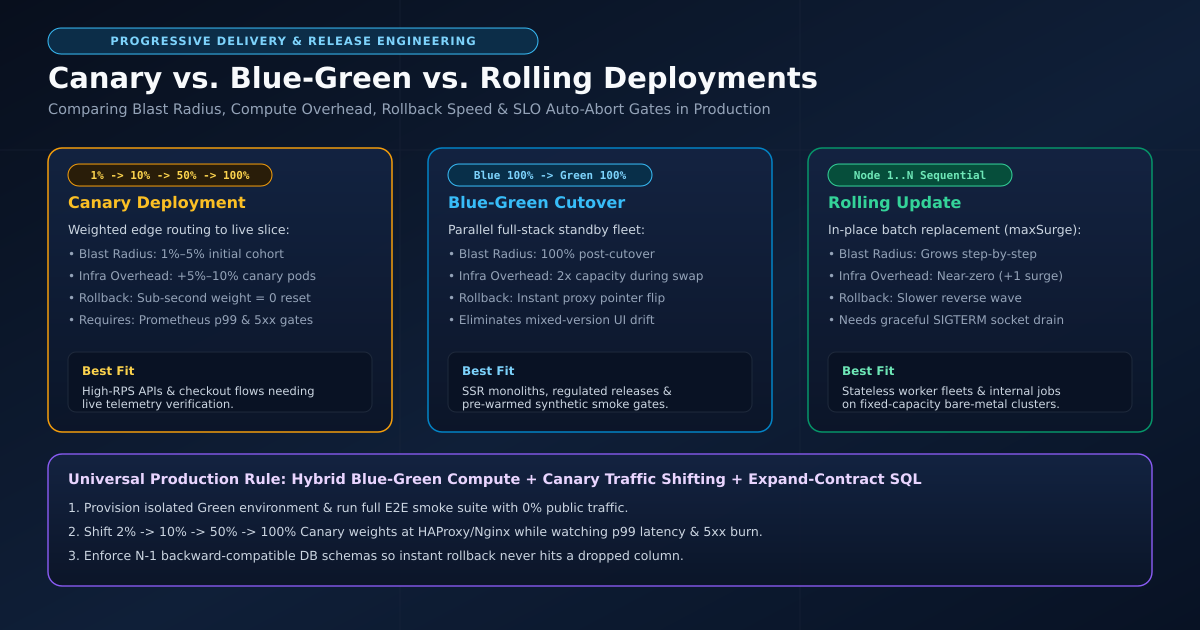
1. Quantitative Trade-Off Matrix: Canary, Blue-Green & Rolling Updates
Choosing between canary deployment vs blue-green—or weighing a rolling update vs canary deployment on fixed bare-metal capacity—comes down to four measurable variables: customer blast radius, transient infrastructure cost, mixed-version tolerance, and Mean Time to Recovery (MTTR) when a regression slips past pre-deploy tests.
| Engineering Dimension | Canary Deployment | Blue-Green Deployment | Rolling Update |
|---|---|---|---|
Initial Blast Radius |
1%–5% of live requests (or internal header cohort) | 0% during dark smoke tests; 100% upon router flip | 1 / N pods/workers, climbing linearly to 100% |
Peak Compute Overhead |
Low (+5%–10% canary capacity alongside baseline) | High (2x parallel environment footprint during cutover) | Minimal (maxSurge: 1 or zero extra hosts) |
Mixed-Version Window |
Yes—v1 and v2 serve live users simultaneously | No—public edge cuts cleanly from Blue to Green | Yes—both versions coexist throughout the wave |
Rollback Latency |
Milliseconds (set canary backend weight to 0) |
Milliseconds (flip upstream symlink/VIP back to Blue) | Minutes (must drain and re-roll previous image across nodes) |
Telemetry Requirement |
High—needs per-revision 5xx & p99 comparison |
Moderate—synthetic E2E gates + post-flip global alerts | Moderate—per-pod readiness probes & graceful SIGTERM |
2. The Statistical Trap Inside Low-Traffic Canary Releases
A progressive canary only protects users if your traffic volume generates enough observations during each step to distinguish a real regression from background noise. Suppose a payment endpoint normally experiences a 0.1% transient error rate and a subtle null-pointer bug raises errors to 1.0% on specific cart shapes. If that endpoint only receives 40 requests per minute and you route 2% to the canary, the canary sees fewer than one request per minute—meaning a five-minute promotion gate will almost certainly promote the broken build straight to 25% and 100% without tripping an alert.
Sample-Size Rule of Thumb: Before promoting a canary step automatically, require both a minimum wall-clock bake window (for example, 10 minutes to expose memory leaks and connection-pool exhaustion) and a minimum request sample count (typically at least 500–1,000 requests through the canary slice). For lower-traffic B2B portals, Blue-Green with deterministic Playwright end-to-end smoke verification against the dark Green stack is far more reliable than an under-sampled 1% canary.
3. Implementing Weighted Traffic Shifting Without Breaking Sessions
When executing weighted traffic shifting at HAProxy, Nginx, Envoy, or an ingress controller, naive round-robin weighting creates a classic frontend failure mode: a user loads HTML from the v2 canary referencing /assets/app.9f4c1a.js, and the browser's very next request for that chunk lands on a v1 baseline server that returns 404 Not Found.
Eliminate split-brain asset and session bugs with three architectural guardrails:
- Deterministic Cohort Hashing: Hash on a stable request attribute—such as an anonymous session cookie or organization ID—rather than per-TCP-request randomness so a user pinned to the 5% canary stays on v2 for all sub-resource and API calls unless the canary is aborted.
- Content-Addressed Shared Static Storage: Publish immutable hashed CSS/JS bundles to an object store or shared static root before shifting application traffic so both Blue/baseline and Green/canary workers can resolve both asset generations.
- Header-Routed Dark Canaries First: Before exposing even 1% of external customers, route requests carrying a signed internal header (for example,
X-Release-Cohort: green-candidate) directly to the new pool so automated full-stack suites exercise real production middleware safely.
4. Automated SLO Burn-Rate Abort Gates
Manual canary watching—staring at a dashboard for three minutes and clicking “Promote”—inevitably degrades into rubber-stamping. Wire your release controller directly to Prometheus and HAProxy telemetry (see our HAProxy 3.x Observability Pipeline guide) and abort immediately when the canary cohort diverges from the live baseline running at the exact same moment:
# Compare canary 5xx error ratio against live baseline cohort over a 5m window
(
  sum(rate(http_requests_total{deployment="canary",status=~"5.."}[5m]))
  /
   clamp_min(sum(rate(http_requests_total{deployment="canary"}[5m])), 1)
)
-
(
  sum(rate(http_requests_total{deployment="baseline",status=~"5.."}[5m]))
  /
  clamp_min(sum(rate(http_requests_total{deployment="baseline"}[5m])), 1)
) > 0.005
Comparing the canary slice relatively against the simultaneous baseline prevents false-positive rollbacks when an external third-party payment gateway or upstream DNS provider blips across all versions at once.
5. Combining Blue-Green + Canary With Expand-Contract Migrations
In mature production stacks, Canary and Blue-Green are not mutually exclusive—the cleanest pattern combines both: provision a complete isolated Green pool (Blue-Green compute isolation), run dark end-to-end verification at 0% public weight, and then step traffic across the router at 2% -> 15% -> 50% -> 100% (Canary progressive exposure) while keeping Blue warm for fifteen minutes post-cutover.
Above all, pair every progressive release strategy with strict expand-contract migrations in your database (covered in depth in our Database Contracts & Failure Modes companion): add nullable columns or dual-write tables in Release N, backfill asynchronously, switch reads in Release N+1, and drop deprecated columns only in Release N+2 after rollback windows close.
Need Zero-Downtime Release Pipelines & Edge Routing?
From HAProxy/Nginx blue-green switching to automated pre-deployment quality gates and Prometheus/Loki observability, review Robert Baindourov's systems engineering background or book a direct architecture consultation.