
Most introductory comparisons of Blue-Green, Canary, and Rolling deployments stop at cartoon load-balancer diagrams: swap two servers, trickle five percent of traffic, or replace containers one by one. In real production environments, outages rarely happen because an engineer misunderstood the diagram—they happen in the seams that simplified tutorials leave out: asynchronous Kubernetes endpoint propagation races, destructive database migrations that silently break rollbacks, server-side rendered (SSR) JavaScript bundle skew, sticky HTTP/2 keep-alive pools, and statistically underpowered canary windows. This guide dissects all three release topologies from the kernel socket and reverse-proxy layer down to relational and document persistence contracts.
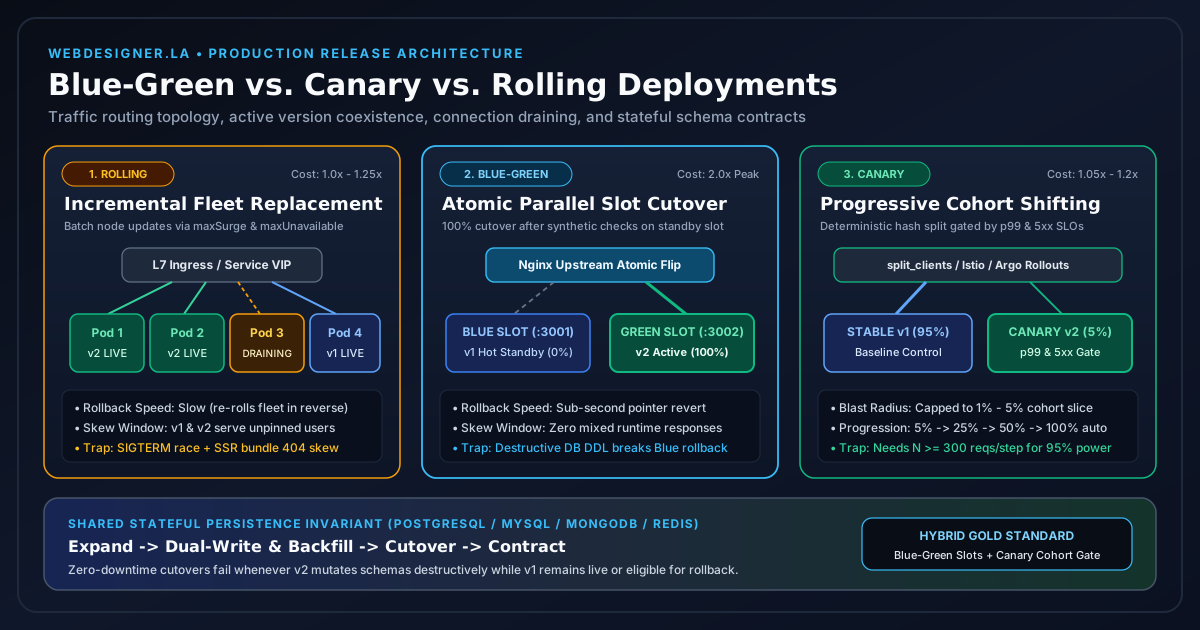
Side-by-Side Production Architecture Matrix
Choosing a release strategy is fundamentally a trade-off across compute headroom, active version coexistence, rollback latency, and observability maturity. Before examining kernel and proxy mechanics, evaluate the four production patterns across ten operational constraints:
| Operational Dimension | Rolling Update | Blue-Green Cutover | Canary Progression | Hybrid (Blue-Green Slots + Canary Gate) |
|---|---|---|---|---|
| Peak Compute Overhead | 1.0x - 1.25x (governed by maxSurge) |
2.0x active RAM/process footprint during cutover |
1.05x - 1.20x (baseline fleet plus canary slice) |
2.0x slot capacity with weighted L7 ingress |
| Concurrent Runtime Skew | High: v1 and v2 serve traffic simultaneously |
Near-zero at L7 cutover (drain overlap only) | Controlled: v1 and v2 coexist for minutes or hours |
Controlled by deterministic cohort hash |
| Mean Time to Rollback (MTTR) | Slow (2 - 15 min reverse batch replacement) |
Sub-second (atomic upstream pointer revert) | Sub-second weight reset to 0% on canary |
Sub-second upstream weight revert to warm Blue |
| Production Blast Radius | Scales linearly from first batch to 100% |
100% immediately after cutover if smoke gates miss a bug |
Capped at initial cohort slice (1% - 5%) |
Pre-verified on Green, then capped at 5% slice |
| Minimum Traffic Required | Any traffic volume | Any traffic volume (relies on deterministic pre-flight probes) | High (>= 300 requests per canary step for 95% confidence) |
Works at low traffic (smoke mode) and high traffic (canary mode) |
| Database Schema Constraint | Strict backward compatibility required | Expand-Contract required if preserving instant rollback | Strict bi-directional read/write compatibility required | Strict Expand-Contract discipline |
| SSR & SPA Asset Skew Risk | High without sticky sessions or immutable N-1 asset retention |
Low (briefly occurs for tabs opened right before cutover) | Moderate unless users are cohort-pinned by hash or cookie | Minimal with cohort pinning and content-hashed static roots |
| Edge Routing Complexity | Low (built into Kubernetes Deployment & ASGs) |
Low-Moderate (Nginx upstream swap, ALB target group switch) | High (requires L7 hash splitting + automated SLO telemetry) | Moderate (Nginx split_clients or Envoy/Argo Rollouts) |
1. Rolling Deployments: Fleet Economics vs. The Endpoint Propagation Race
A Rolling deployment replaces running instances of v1 with v2 incrementally across an existing server pool. In Kubernetes, this is the default RollingUpdate strategy governed by two parameters: maxSurge (how many extra pods may be scheduled above desired replica count) and maxUnavailable (how many existing pods may be taken offline simultaneously). Because you never provision a duplicate production environment, rolling updates maximize infrastructure utilization on fixed bare-metal clusters and large GPU or high-memory node pools.
Why Naive Rolling Updates Still Drop Packets (The SIGTERM Race)
Teams adopting Kubernetes or systemd rolling restarts frequently discover brief bursts of HTTP 502 Bad Gateway and 504 Gateway Timeout responses during every release, even when their application listens for SIGTERM. The root cause is a distributed race condition in the control plane:
- When a pod transitions to
Terminating, the API server simultaneously instructs the kubelet to sendSIGTERMto the container and updates theEndpointSliceobject. - Ingress controllers (Nginx, Envoy, HAProxy) and
kube-proxywatchEndpointSliceasynchronously. Updating iptables/IPVS rules and upstream worker pools across dozens of nodes takes 500ms to 3,000ms. - If your Node.js, Go, or Rust server calls
server.close()on millisecond zero of receivingSIGTERM, requests already routed by Ingress during that two-second propagation window hit a closed TCP listening socket and receiveECONNREFUSED.
Eliminating rolling-update 502s requires decoupling readiness withdrawal from socket closure: fail the readiness probe (or sleep inside a preStop hook for 5–8 seconds) while continuing to serve incoming keep-alive and in-flight requests, and only invoke server.close() after load balancers have drained the endpoint:
// Production Node.js / Express graceful drain handler for zero-502 rolling & slot updates
let isShuttingDown = false;

app.get('/health/ready', (_req, res) => {
  if (isShuttingDown) {
    // Signal L7 Ingress / Service Registry to remove this instance from rotation immediately
    return res.status(503).json({ status: 'draining' });
  }
  return res.status(200).json({ status: 'ok' });
});

process.once('SIGTERM', () => {
  isShuttingDown = true;
  // 1. Hold listening socket OPEN for 6s while Nginx / Envoy EndpointSlices propagate removal
  setTimeout(() => {
    // 2. Stop accepting new TCP connections; allow active SSR / API transactions to finish
    httpServer.close((err) => {
      closeDatabasePools().finally(() => process.exit(err ? 1 : 0));
    });
    // 3. Close idle HTTP/1.1 & HTTP/2 keep-alive sockets without truncating active streams
    if (typeof httpServer.closeIdleConnections === 'function') {
      httpServer.closeIdleConnections();
    }
  }, 6000);
});
The Unpinned Version-Skew Problem in SSR and Multi-Step Workflows
During a 10-minute rolling deployment, half your fleet serves v1 while the other half serves v2. If a browser downloads HTML from a v2 SSR node referencing /assets/checkout.9d4a2f.js, and the subsequent asset request lands on an un-updated v1 pod whose local filesystem only contains /assets/checkout.1b8c0e.js, the client crashes with a white-screen ChunkLoadError. Rolling deployments on web frontends therefore mandate serving hashed static bundles from a shared content-addressed store or immutable CDN bucket that retains at least N-2 prior build artifacts.
2. Blue-Green Deployments: Atomic Cutovers and the Stateful Rollback Illusion
Blue-Green deployment eliminates concurrent runtime mixing by maintaining two complete, isolated execution environments: Blue (currently serving 100% of live production traffic, e.g., local port cluster :3001) and Green (idle or standby environment on :3002). You deploy v2 to Green, run warm-up routines to populate local LRU caches and JIT-compile hot code paths, execute real end-to-end synthetic transactions directly against Green's loopback port, and then flip the L7 router atomically from Blue to Green.
On bare-metal Linux clusters and NVMe VPS fleets, Nginx paired with dual PM2 or systemd process slots delivers true microsecond Blue-Green cutovers without container-orchestrator overhead. When nginx -s reload runs after validating nginx -t, the Nginx master process spawns new worker processes bound to the Green upstream while allowing old Nginx workers to finish every last byte of active Blue responses before exiting—achieving zero dropped packets (see our Nginx Blue/Green socket draining runbook and Linux SO_REUSEPORT kernel handoff deep dive):
# /etc/nginx/conf.d/cms_upstream.conf — Atomic Blue-Green upstream with passive failover safety
upstream multidomain_ssr_active {
    # Active slot (flipped atomically by CI gate from 127.0.0.1:3001 -> 127.0.0.1:3002)
    server 127.0.0.1:3002 max_fails=2 fail_timeout=5s;

    # Previous verified slot remains warm as an automatic hot-standby backup during bake window
    server 127.0.0.1:3001 backup;

    keepalive 64;
    keepalive_requests 1000;
    keepalive_time 5m;
}Blue-Green gives you instant compute rollback, not instant state rollback. If Green runs a migration on startup that renames orders.total_cents to orders.amount_minor, or writes Protobuf/JSON payloads into a shared Redis cache using a v2 schema that Blue cannot parse, flipping Nginx back to Blue during an incident triggers an immediate, total 500 Internal Server Error cascade. Blue remains a valid rollback target only if every database and cache mutation deployed with Green is 100% backward-compatible with Blue.
3. Canary Deployments: Progressive Exposure, Cohort Pinning, and Sample-Size Math
Even rigorous synthetic test suites on a Green staging slot cannot reproduce every permutation of real-world production traffic: malformed third-party webhook payloads, adversarial bot crawlers, Unicode edge cases, cache-stampede lock contention, or regional payment-gateway latency spikes. Canary deployments bound the blast radius of unknown unknowns by routing a small, controlled fraction of live traffic (typically 1% to 5%) to v2 while 95% to 99% stays on battle-tested v1.
Two engineering disciplines separate a genuine production canary from brittle percentage roulette:
- Deterministic Cohort Pinning: Never use pure random per-request load balancing for user-facing canaries. If a customer hits
v2onGET /cartandv1onPOST /checkoutthree seconds later, UI state and API payload expectations will collide. Hash a stable request attribute—such as a session cookie, tenant ID, or client IP + User-Agent tuple—so each visitor stays consistently inside either the Canary cohort or the Stable control cohort. - Automated Comparative SLO Gatekeeping: A human staring at a dashboard for three minutes will miss tail-latency degradation. Automated controllers (such as Argo Rollouts, Flagger, or an internal telemetry gate querying structured
status_class="5xx"andp99latency histograms) must compare the Canary error rate directly against the concurrent Stable baseline—not against a static threshold alone—so global upstream blips do not falsely abort healthy rollouts, and quiet memory leaks get caught before promotion.
# Nginx deterministic 5% Canary cohort routing via MurmurHash3 (split_clients)
split_clients "${remote_addr}${http_user_agent}release_2026_11" $target_ssr_pool {
    5.0%    ssr_canary_v2;
    *       ssr_stable_v1;
}

upstream ssr_stable_v1 {
    server 127.0.0.1:3001;
    keepalive 64;
}

upstream ssr_canary_v2 {
    server 127.0.0.1:3002;
    keepalive 16;
}

server {
    listen 443 ssl http2;
    server_name example.com;

    location / {
        proxy_http_version 1.1;
        proxy_set_header Connection "";
        add_header X-Release-Cohort $target_ssr_pool always;
        proxy_pass http://$target_ssr_pool;
    }
}
The Low-Traffic Canary Fallacy (Binomial Sample-Size Reality)
One of the most common anti-patterns in mid-sized engineering teams is copying hyperscaler 1% -> 5% -> 25% canary pipelines onto services that receive modest request volume. By the statistical Rule of Three in binomial sampling, if a new release introduces a severe 1% crash rate (p = 0.01) and zero errors are observed so far, achieving 95% statistical confidence that the true defect rate is below 1% requires observing at least N = 3 / 0.01 = 300 independent requests inside the canary slice itself.
At a 2% canary weight, observing 300 canary requests requires 15,000 total production requests during that single step. If your B2B SaaS API processes 30 requests/minute, a 2% canary receives 0.6 requests per minute—meaning a 10-minute canary step evaluates just six requests before auto-promoting to production! Below ~500 requests per minute, percentage canaries provide a false sense of security; use Blue-Green cutover preceded by deterministic synthetic test suites and shadow traffic replay instead.
4. The Shared Persistence Law: Expand, Dual-Write, Backfill, Contract
Whether you deploy via Rolling batches, Blue-Green flips, or Canary cohorts, decoupling stateful schema changes from application binary cutovers is non-negotiable. Every breaking relational column change, MongoDB document restructuring, or RPC contract revision must execute across four discrete, independently deployable stages:
| Migration Phase | Database / Storage Action | Application Runtime Behavior | Rollback Safety |
|---|---|---|---|
Phase 1: Expand |
Add nullable column, new index (CONCURRENTLY / background: true), or additive table without locking reads/writes. |
v1 continues reading and writing legacy fields unchanged. |
100% instant rollback; additive columns are ignored by v1. |
Phase 2: Dual-Write & Backfill |
Run batched, idempotent background worker to populate the new field across historical rows without saturating IOPS. | Deploy v2: writes to both legacy and new fields; reads from legacy with verification shadow-reads on new. |
100% instant rollback! Because v2 still populates the legacy column, reverting to v1 loses zero transactions. |
Phase 3: Read Cutover |
Verify zero null/divergent records across hot and cold queries. | Deploy v3: reads exclusively from the new structure while maintaining dual-writes during the rollback bake window. |
100% instant rollback to v2 or v1. |
Phase 4: Contract |
Drop legacy column or archive deprecated index after the rollback window closes. | Deploy v4: removes legacy write path cleanly. |
Safe forward state; old code versions are permanently retired. |
5. Choosing the Right Topology (and Why Mature Teams Combine Them)
Rather than treating Rolling, Blue-Green, and Canary as mutually exclusive religions, map each workload to its failure physics:
- Use Rolling Deployments for stateless background worker pools, queue consumers with idempotent retry semantics, and large homogeneous Kubernetes microservice fleets where provisioning
2xpeak RAM is cost-prohibitive—provided you enforce apreStopreadiness drain window and immutable static asset storage. - Use Pure Blue-Green Deployments for low-to-medium traffic web applications, monolithic APIs, and bare-metal SSR clusters where you want zero mixed-version responses, full synthetic integration verification against production-like resources before a single user sees
v2, and sub-second rollback. - Use Canary Deployments for high-throughput edge gateways, checkout/payment APIs, and multi-tenant platforms where request volume easily clears
N >= 300canary requests within minutes and automated telemetry can halt ap99latency or5xxspike at5%blast radius.
The Principal Engineering Gold Standard — Blue-Green Slots Behind a Canary Edge Gate: Provision two isolated process slots (Blue and Green) so you never mutate live code on disk in place. Deploy and smoke-test the candidate build on the idle Green slot at
0%public traffic. Next, shift5%of cohort-pinned edge traffic to Green while holding95%on Blue and comparing structured5xxand latency metrics over a statistically valid sample window. Once verified, shift100%to Green—and keep Blue running warm at0%for 30 minutes so a single upstream reload restores the entire platform in under 50 milliseconds.