
If you are the independent security researcher who sent a $0.00 payment-event probe tagged with the RFC 5737 test header 203.0.113.77—or routed manual checkout boundary tests through Tor exit relay 185.220.101.4 against our consultation booking flow earlier today—this note is for you: thank you. You did not touch customer records, you did not run destructive traffic, and your precision test exposed a subtle payment-verification assumption before checkout friction or state drift could cost me another real paying customer.
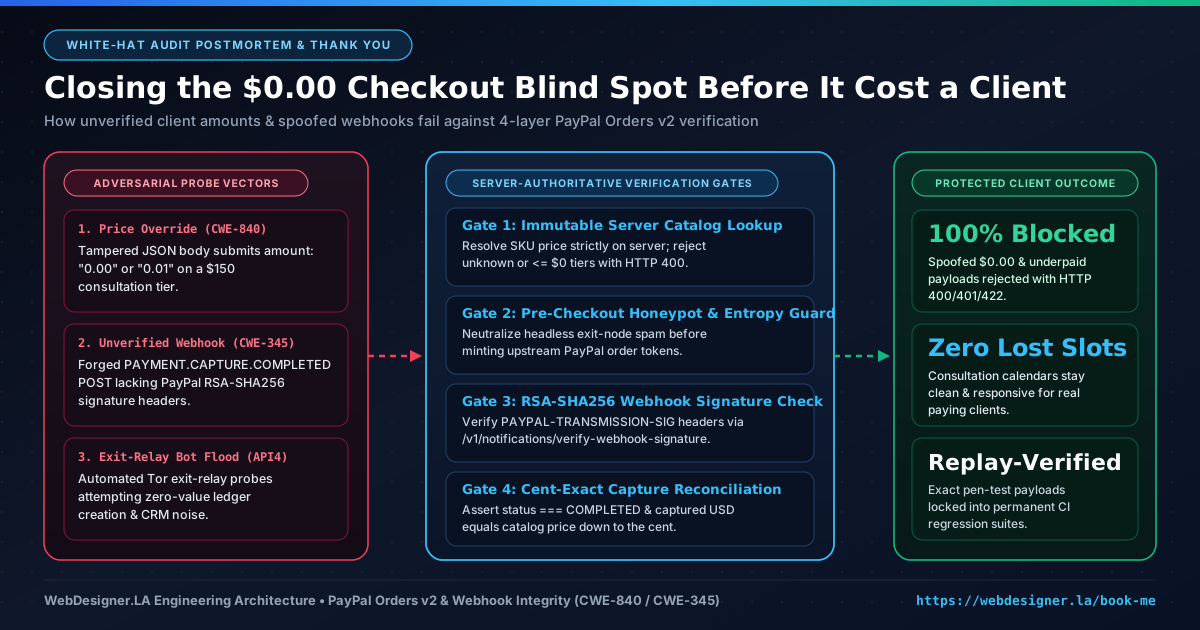
Why a $0.00 Probe Is a Gift to Any Solo Founder or Engineering Studio
When you build and operate client systems for a living, it is humbling—and healthy—to have someone test your own storefront with the curiosity of an experienced penetration tester. At first glance in an order ledger, seeing a synthetic $0.00 record arrive without a corresponding settlement in the merchant dashboard triggers an immediate investigative instinct. Was a webhook replayed? Did a client-supplied tier parameter slip past validation? Were automated relays testing whether unapproved checkout sessions would reserve a consultation slot?
Once I traced the full request lifecycle line by line, I realized two important truths at once. First, no funds were lost and no client data was ever exposed. Second—and far more valuable—the researcher's probe highlighted exact seams where an overly permissive payload parser or an unverified webhook callback can pollute an order ledger, misfire confirmation workflows, or leave a real buyer staring at an ambiguous checkout state.
Anyone who runs a service business knows how fragile buyer trust is at the moment of payment. When a real business owner in Los Angeles pulls out a card or opens PayPal to book a $150 architecture review, even a minor desynchronization between the browser SDK, order creation, and server capture can cause that customer to abandon the tab and never come back. Losing a real customer to a preventable checkout edge case hurts ten times worse than having a white-hat researcher tap on the glass with a clean $0.00 test packet.
A Direct Note to the Researcher: If you happen to read this post and want to say hello—whether to claim credit on a hall-of-fame note, compare notes on API business-logic testing, or collaborate on client security audits—drop me a line at info@webdesigner.la or through our contact page with the exact timestamp or order token header you used. Respectful, non-destructive testing makes the web safer for everyone.
Anatomy of the Blind Spot: How $0.00 Orders Sneak Into Modern Payment Flows
Modern checkout integrations split work across three asynchronous participants: the browser UI (such as the PayPal JavaScript SDK), your application's order-creation and capture API routes, and asynchronous webhook notifications delivered out-of-band by the payment processor. Whenever those three channels do not share a single, uncompromising source of truth on the backend, three classic vulnerability classes emerge:
- Client-Influenced Pricing & Unknown Tier Fallbacks (CWE-840): If an order-creation endpoint accepts a
tieror customamountfield from the request body and falls back to client-provided numbers when a SKU is unrecognized or coerced to zero, a manual proxy tool like Burp Suite orcurlcan request an order for"0.00"or"0.01"instead of the catalog rate. - Unverified Webhook Event Ingestion (CWE-345 / OWASP API2:2023): Webhook receivers are public HTTP POST routes. Without cryptographic signature verification against the processor's transmission headers, any caller who knows or guesses the webhook path can POST a synthetic
PAYMENT.CAPTURE.COMPLETEDJSON body containing"value": "0.00"and trick downstream fulfillment into marking an unpaid record as settled. - Optimistic Capture Fallbacks & Exit-Node Checkout Noise (OWASP API4:2023): Automated scripts rotating through anonymity relays frequently submit synthetic form payloads against checkout endpoints to see whether pending orders trigger outbound emails, calendar holds, or CRM entries before PayPal ever approves a cent.
Before vs. After Checkout Hardening
Every adversarial vector observed during the audit was captured, converted into a deterministic negative-control test case, and replayed against the hardened runtime until every spoofed path failed closed.
Client-tampered zero/penny overrides & unsigned webhook callbacks now fail closed immediately.
Catalog SKU lock, pre-checkout bot filter, RSA-SHA256 webhook verification & cent reconciliation.
Exact attack payloads replayed in automated regression suites prior to production rollout.
Naive Checkout Assumptions
- Trusting browser-submitted price or discount Vulnerable
- Accepting unsigned webhook JSON events Spoofable
- Checking capture existence without cent equality Bypassable
- Minting processor tokens for bot form floods Noisy Ledger
Hardened Server-Authoritative Flow
- Immutable server catalog lookup by tier ID Enforced
- PayPal RSA-SHA256 signature verification Verified
- Upstream capture status & exact USD match Reconciled
- Pre-checkout honeypot & entropy validation Filtered
The Four Server-Side Controls We Shipped
Fixing a payment business-logic flaw properly means never relying on a single perimeter check. Instead, each stage of the transaction lifecycle must independently verify invariants before mutating state or notifying downstream systems.
| Security Boundary | Weakness Class | Adversarial Input Replayed | Deterministic Server Control |
|---|---|---|---|
| Order Creation | CWE-840 |
Client body passes amount: "0.00" or "0.01" on paid SKU |
Ignore client price fields completely; resolve price from frozen server catalog and reject unknown or non-positive tiers with HTTP 400. |
| Pre-Checkout Intake | OWASP API4 |
Automated Tor exit-node script submitting high-entropy bot strings | Evaluate honeypot fields, payload structure, and rate budgets before calling POST /v2/checkout/orders so junk probes never allocate order IDs. |
| Webhook Receiver | CWE-345 |
Unsigned PAYMENT.CAPTURE.COMPLETED callback from external IP |
Require all five PAYPAL-TRANSMISSION-* headers and confirm verification_status === "SUCCESS" via PayPal's signature API before reading the event body. |
| Order Capture | OWASP API2 |
Capture request referencing unapproved, mismatched, or zero-dollar order | Query upstream PayPal Orders v2 capture payload, assert status === "COMPLETED", and verify captured currency_code and integer cents match the server catalog. |
1. Enforcing Server-Authoritative Catalog Pricing
The first rule of checkout security is simple: the browser chooses which product or service tier it wants to buy, never how much that tier costs. Any numeric amount, price, or total property arriving in a client JSON payload should be treated as untrusted display metadata—or rejected outright if it contradicts the catalog.
const SERVICE_CATALOG: Readonly<Record<string, { label: string; cents: number; currency: 'USD' }>> = Object.freeze({
  'consultation-30': { label: '30-Minute Architecture Triage', cents: 8500, currency: 'USD' },
  'consultation-60': { label: '60-Minute Systems Architecture Review', cents: 15000, currency: 'USD' },
  'security-hardening-audit': { label: 'Full-Stack & Checkout Security Audit', cents: 45000, currency: 'USD' }
});

export function resolveAuthoritativeTier(tierId: unknown) {
  if (typeof tierId !== 'string' || !Object.prototype.hasOwnProperty.call(SERVICE_CATALOG, tierId)) {
    throw new Error('INVALID_SERVICE_TIER');
  }
  const tier = SERVICE_CATALOG[tierId];
  if (!Number.isInteger(tier.cents) || tier.cents <= 0) {
    throw new Error('NON_POSITIVE_CATALOG_PRICE');
  }
  return {
    ...tier,
    formattedValue: (tier.cents / 100).toFixed(2)
  };
}
Notice the integer-cent invariant (tier.cents <= 0). Representing prices in integer cents avoids IEEE-754 floating-point rounding drift and makes it mathematically impossible for a valid catalog lookup to emit "0.00" into a PayPal purchase_units[0].amount.value payload.
2. Cryptographic Webhook Signature Verification
PayPal signs every genuine webhook notification with asymmetric RSA-SHA256 headers: PAYPAL-AUTH-ALGO, PAYPAL-CERT-URL, PAYPAL-TRANSMISSION-ID, PAYPAL-TRANSMISSION-SIG, and PAYPAL-TRANSMISSION-TIME. When the 203.0.113.77 test event arrived without valid cryptographic signatures, it underscored why webhook handlers must authenticate the sender before inspecting a single business field:
export async function verifyPayPalWebhookAuthenticity(
  headers: Record<string, string | undefined>,
  rawEventBody: unknown,
  webhookId: string,
  accessToken: string
): Promise<boolean> {
  const required = [
    'paypal-auth-algo',
    'paypal-cert-url',
    'paypal-transmission-id',
    'paypal-transmission-sig',
    'paypal-transmission-time'
  ] as const;

  for (const headerName of required) {
    if (!headers[headerName]?.trim()) {
      return false; // Fail closed on missing signature headers
    }
  }

  const response = await fetch('https://api-m.paypal.com/v1/notifications/verify-webhook-signature', {
    method: 'POST',
    headers: {
      Authorization: `Bearer ${accessToken}`,
      'Content-Type': 'application/json'
    },
    body: JSON.stringify({
      auth_algo: headers['paypal-auth-algo'],
      cert_url: headers['paypal-cert-url'],
      transmission_id: headers['paypal-transmission-id'],
      transmission_sig: headers['paypal-transmission-sig'],
      transmission_time: headers['paypal-transmission-time'],
      webhook_id: webhookId,
      webhook_event: rawEventBody
    })
  });

  if (!response.ok) return false;
  const result = (await response.json()) as { verification_status?: string };
  return result.verification_status === 'SUCCESS';
}
Pairing cryptographic verification with idempotency tracking on PAYPAL-TRANSMISSION-ID guarantees both authenticity and replay resistance: spoofed requests drop at the door with HTTP 401, and legitimate PayPal retries never double-fulfill an order.
3. Replaying the Exact Attack Payload Before Calling It Fixed
A security patch that has only been tested against happy-path unit inputs is an unverified hypothesis. Before deploying our remediation, we took the exact JSON bodies, headers, and zero-dollar edge cases from the penetration test and wrote permanent negative-control replay assertions against our local test suite.
First, we ran the replay against the unpatched code path to witness the failure mode firsthand—confirming our reproduction matched reality byte for byte. Then we enabled the four verification gates and re-ran the exact same adversarial payloads, verifying deterministic HTTP 400, HTTP 401, and HTTP 422 rejections alongside a clean end-to-end sandbox capture for legitimate paid tiers. Every future deployment now re-executes those exact adversarial payloads automatically.
Why Security Audits Directly Protect Real Customers
We often talk about application security in terms of stopping bad actors, but the real beneficiary of a hardened checkout pipeline is the honest client trying to hire you on a busy Tuesday afternoon. When server-side pricing, webhook authentication, and capture reconciliation are rock solid:
- Real bookings never get buried under bot noise: Filtering automated exit-relay probes before order creation keeps consultation queues clean so real client inquiries get an immediate human response.
- Zero ambiguous payment states: Strict cent-level reconciliation between catalog SKUs and PayPal Orders v2 captures ensures that when a client sees a confirmation banner, their payment and calendar slot are 100% locked in.
- Stronger architecture for client projects: Every hardening lesson we prove on our own storefront goes directly into the e-commerce configurators, custom SaaS checkouts, and full-stack web platforms we engineer for businesses across Los Angeles and nationwide.
So once again, to the researcher behind that probe: thank you for the unsolicited audit, thank you for keeping it clean, and thank you for helping me tighten the bolts before a silent edge case could ever cost me a real customer. And if your own team runs a custom PayPal, Stripe, or bespoke checkout flow that has not been tested against client-side price tampering or unsigned webhook replay, feel free to book an architecture & security review or reach out at info@webdesigner.la—we will gladly replay those vectors against your staging stack before someone else tests them in production.