
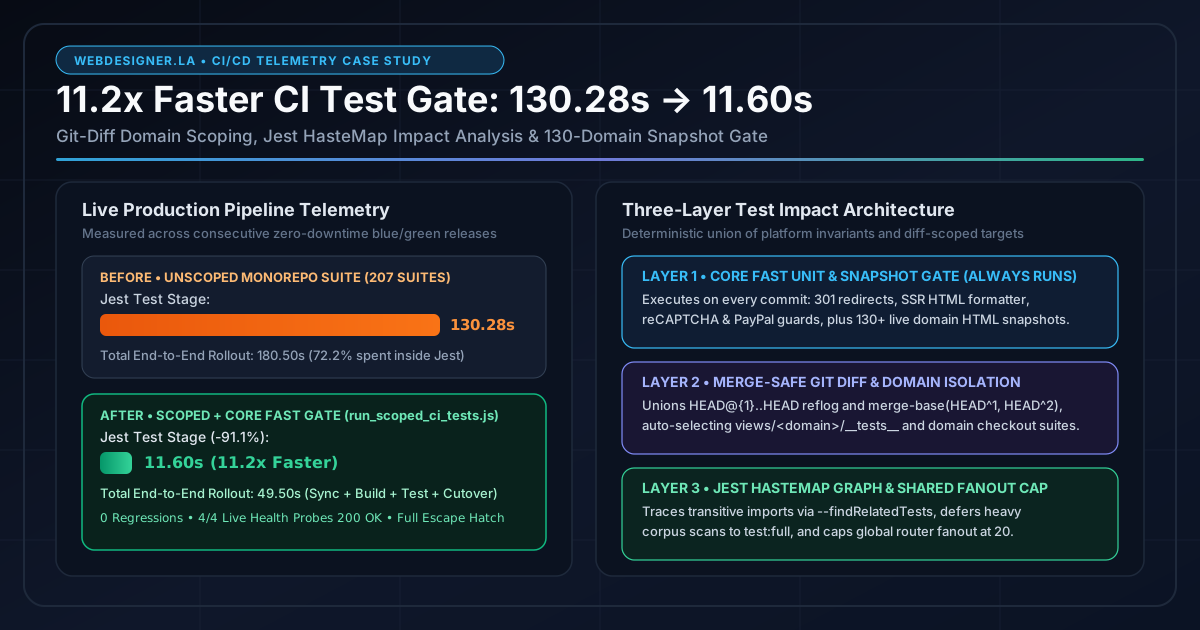
Fast continuous delivery dies by a thousand well-intentioned tests. Every time your team ships a checkout fix, adds a redirect rule, or launches a new client property inside a shared multi-tenant codebase, adding another automated test suite feels like pure upside—until the day a routine ten-line patch takes three minutes to clear pre-deployment verification. Today on WebDesigner.LA, while shipping a PayPal Orders v2 checkout upgrade for our Book-Me consultation page, we audited our native self-hosted ci:platform deployment gate, pinpointed why 72.2% of every rollout was stalled inside Jest, and engineered a deterministic three-layer test impact runner that cut CI test execution 11.2x—from 130.28 seconds down to 11.60 seconds—reducing total zero-downtime deployment wall time to under 50 seconds.
1. Profiling the Bottleneck: Where Were 180.5 Seconds Going?
Unlike teams burning monthly cloud runner quotas on third-party CI providers, we run our entire build, verification, and blue/green deployment gate natively on dedicated cluster hardware managed by our internal Job Runner service. Every release records structured per-stage timing receipts down to the millisecond: repository fetch, clean checkout, dependency verification, TypeScript compiler validation, production compilation, Jest execution, zero-downtime PM2 slot cutover, and live HTTP health probes.
When we pulled the stage telemetry from the prior release (42bce57c9), the skew was unmistakable: compiling the entire TypeScript server and React SSR view tree took barely three seconds combined, yet npm test (wired to jest src/__tests__) consumed more than two full minutes on its own.
Pipeline Stage (ci:platform) | Before (42bce57c9) | After (3af551a99) | Delta / Speedup |
|---|---|---|---|
sync:fetch + sync:checkout | 1.40s (1,397 ms) | 1.13s (1,134 ms) | -18.8% |
install (workspace lock check) | 4.25s (4,248 ms) | 4.09s (4,088 ms) | -3.8% |
typecheck (tsc --noEmit) | 1.53s (1,527 ms) | 1.96s (1,960 ms) | Sub-2s gate |
build (tsc production emit) | 1.54s (1,540 ms) | 1.56s (1,564 ms) | Sub-2s build |
test (Jest verification gate) | 130.28s (130,275 ms) | 11.60s (11,599 ms) | 11.2x faster (-91.1%) |
deploy + 4 live HTTPS health checks | 38.98s | 25.59s | -34.4% |
| Total End-to-End Release Duration | 180.50s (3m 00.5s) | 49.50s (0m 49.5s) | 3.6x faster (-72.6%) |
Inspecting src/__tests__/ revealed why. Over months of rapid feature delivery across 130+ hosted domains, the root test folder had accumulated 207 separate test suites. Alongside fast unit tests and live PayPal Sandbox integration harnesses sat dozens of historical single-article publication receipts (*Article.test.tsx, cohort verification suites, and full-portfolio content scanners). Each of those historical suites booted inside a Jest worker and rebuilt cross-domain n-gram originality indexes across thousands of JSON post shards from disk—burning 13.3 seconds per file—even when our commit only touched two files on webdesigner.la.
Key Engineering Principle: Deleting tests to make CI faster destroys your safety net; running full-disk portfolio corpus audits on a single-domain checkout patch wastes engineering velocity. The right solution is separating per-commit Test Impact Analysis from full-corpus scheduled audits while keeping an explicit one-command escape hatch (npm run test:full).
2. Why Naive git diff HEAD~1 + jest --changedSince Fails in Production
On paper, selective testing in Jest looks like a one-liner: pass --changedSince=HEAD~1 or pipe git diff --name-only HEAD~1..HEAD into jest --findRelatedTests. In practice, when we tested that naive one-liner against real commit history in a multi-tenant Express and React SSR codebase, four subtle failure modes surfaced immediately:
- Two-Parent Merge Commits Blind-Spot One Branch: When two engineers—or two parallel workspaces—land changes on
main, mergingorigin/mainproduces a commit with two parents (HEAD^1andHEAD^2). DiffingHEAD~1..HEADonly compares the merge result against the first parent, completely ignoring code modified on the other side of the merge! Computinggit merge-base HEAD^1 HEAD^2first and diffing from that common ancestor toHEADcaptures 100% of changed files across both branches. - Multi-Commit Pushes & Trailing Documentation Commits: Engineers frequently commit a feature or bug fix first and follow it two minutes later with a clean
docs(...)changelog commit before pushing. A naiveHEAD~1..HEADcheck sees only Markdown files on tip and skips the code commit right beneath it. By unioning Git's reflog checkout anchor (HEAD@{1}..HEAD—which inside our persistent CI workspace points to the exact SHA deployed on the previous CI run) with a recent-commit lookback when tip is docs-only, multi-commit pushes never slip past untested. - Global Router Fanout Explosion in HasteMap: Jest's
--findRelatedTeststraverses staticimportandrequiregraphs via HasteMap. When you edit an isolated domain route likesrc/routes/domains/webdesigner.la.ts, HasteMap cleanly returns the 17 suites touching that domain. However, if you edit a shared utility likesrc/utils/htmlFormatter.ts—which is imported by the root Express app—HasteMap traces upward intosrc/index.tsand fans out to 97+ leaf suites, dragging all the slow historical corpus scans right back into the run. - Zero-Test Gaps on CSS or Configuration Edits: Pure stylesheet edits (
public/stylesheets/webdesigner.la.css) or post shard updates have no TypeScriptimportedge in HasteMap, so--findRelatedTestsalone would run zero tests unless paired with explicit domain path extraction and a baseline snapshot gate.
3. Inside Our Three-Layer Scoped CI Runner (run_scoped_ci_tests.js)
To eliminate every one of those blind spots without writing fragile custom AST parsers, we built a zero-dependency Node.js orchestrator (scripts/run_scoped_ci_tests.js) backed by its own unit suite (scopedCiTestRunner.test.ts) and wired it directly to npm test.
Layer 1: Mandatory Core Fast Unit & 130-Domain Snapshot Gate (~5.8s)
No deploy ever runs zero tests. Even on a documentation-only commit, Layer 1 always executes eight foundational platform suites: portfolio business invariants, SSR HTML formatting, universal free-form reCAPTCHA injection and payment-form exclusions, 301 slug and canonical host redirects, SERP meta tag contracts, our runner's own unit tests, and liveDomainComponentSnapshots.test.tsx—which renders and verifies component HTML snapshots across all 130+ hosted domains in just 5.2 seconds.
Layer 2: Merge-Safe Git Diff & Tenant Domain Isolation
Next, extractTouchedDomains() inspects every changed path across src/views/<domain>/, src/routes/domains/<domain>.ts, public/stylesheets/<domain>.css, local media directories, llms.txt artifacts, and data/posts/<domain>/ shards. For every touched tenant domain, the runner automatically includes:
- Every layout and visual contract suite inside
src/views/<domain>/__tests__/*.test.*(catching domain-local view tests that flatjest src/__tests__sweeps previously missed!). - Every functional checkout, preview, or interactive widget suite matching that domain's stem inside
src/__tests__/. - Fast SERP and social-image validation gates whenever
data/posts/**shards are modified.
// Merge-safe + reflog-aware diff discovery in scripts/run_scoped_ci_tests.js
const prevReflogSha = gitSingleLine(['rev-parse', '--verify', '-q', 'HEAD@{1}'], cwd);
if (prevReflogSha && isAncestor(prevReflogSha, currentSha) && distance <= 20) {
  addDiff(`${prevReflogSha}..HEAD`);
}
const secondParent = gitSingleLine(['rev-parse', '--verify', '-q', 'HEAD^2'], cwd);
if (secondParent) {
  const mergeBase = gitSingleLine(['merge-base', 'HEAD^1', secondParent], cwd);
  if (mergeBase) addDiff(`${mergeBase}..HEAD`);
}
Layer 3: Jest HasteMap Graph With Shared-Module Fanout Capping
Finally, changed TypeScript and JavaScript source files are passed to jest --listTests --findRelatedTests, with two smart guardrails:
- Corpus Audit Deferral: Multi-minute historical single-article 8-gram corpus scans are filtered out of transitive HasteMap fanout unless that specific test file itself was edited in the commit (while remaining 100% available via
npm run test:full,FULL_CI_TESTS=1 npm test, and scheduled QA Watchdog jobs). - Fanout Circuit Cap (
MAX_RELATED_FANOUT = 20): When an isolated route or service returns 20 or fewer dependents, all of them run. When a shared entrypoint or global middleware triggers wide fanout across 90+ files, the runner caps leaf fanout and substitutesSHARED_CORE_INTEGRATION_SUITES—a curated set of fast integration harnesses covering CMS REST endpoints, PayPal Sandbox orders and webhooks, lead forms, spam guards, edge cache invalidation, and full-page SSR snapshots.
4. Developer Ergonomics & Production Impact
Great tooling stays out of an engineer's way during interactive debugging. When invoked with explicit arguments—such as npm test -- src/__tests__/webdesignerCheckout.test.tsx or npm test -- -t PayPal—parseRunnerCliArgs() switches cleanly into passthrough mode and forwards flags straight to Jest unchanged. When invoked bare by ci:platform, it logs the exact changed file count, touched tenant domains, and selected suite manifest at the top of the CI log for instant auditability.
On its very first live production run (ci-platform-1794510129763-1, commit 3af551a99), the new gate validated TypeScript types, compiled the platform, executed all scoped and core suites in 11.60 seconds, performed a zero-downtime blue/green Nginx cutover, and passed 4/4 live HTTPS health checks in 49.50 seconds end to end.
Building a multi-domain SaaS platform, e-commerce storefront, or custom web application where slow deployments or brittle checkout flows are holding your team back? Schedule an architecture and performance review on our Book-Me page or get in touch with WebDesigner.LA to ship faster with zero downtime.