
While headlines fixate on 400-billion-parameter frontier clusters requiring eight H100 GPUs just to load weights, production systems architects quietly run 80% of high-volume enterprise inference on compact 7B-to-8B dense checkpoints. For teams researching open-weight sources 7.5B AI architectures—such as Alibaba's 7.61-billion-parameter Qwen2.5-7B family, DeepSeek-R1-Distill-Qwen-7B, Mistral-7B-v0.3, and Llama-3.1-8B—this parameter tier hits a remarkable hardware threshold: it fits comfortably onto a single 24 GB GPU (RTX 3090, RTX 4090, or NVIDIA L4) with generous KV-cache headroom, sub-15ms Time-to-First-Token, and zero external data egress.
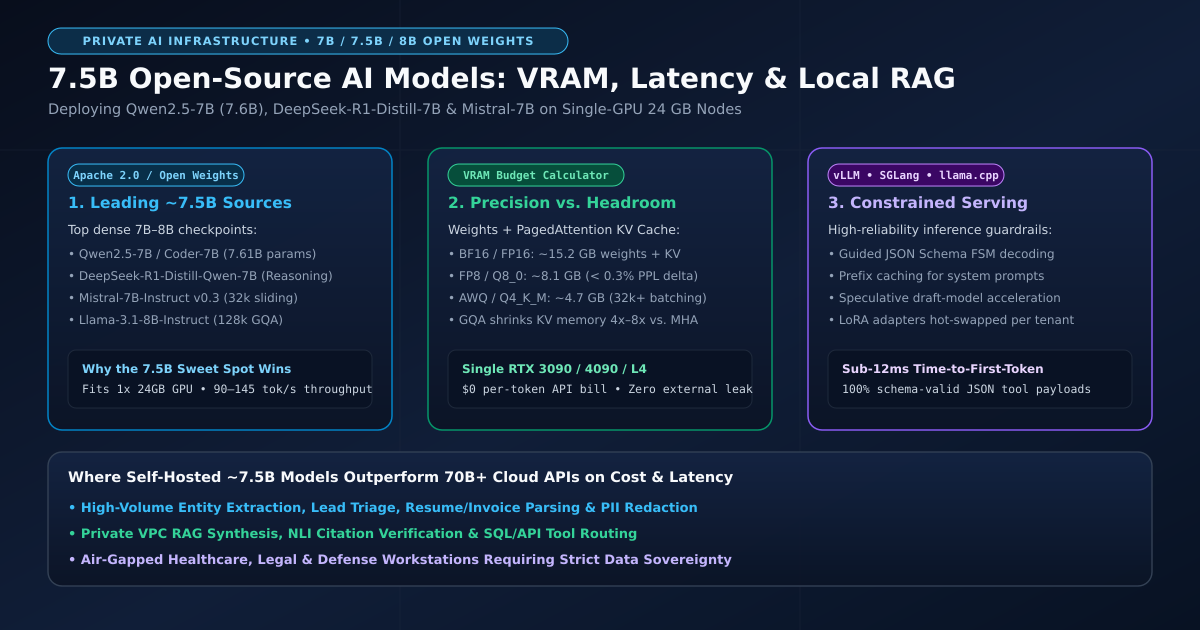
1. Comparing the Leading ~7.5B Open-Weight Model Families
Not all 7B–8B open-source AI models share the same license terms, tokenizer efficiency, or attention geometry. Selecting the right base checkpoint before fine-tuning or wiring up MCP tools saves weeks of downstream prompt rework:
| Model Checkpoint | Exact Params | License | Context & Attention | Sweet-Spot Production Workload |
|---|---|---|---|---|
Qwen2.5-7B-Instruct / Coder-7B |
7.61B (~6.5B non-embed) |
Apache 2.0 | 128k (GQA 28Q / 4KV) | Structured JSON extraction, SQL/TypeScript synthesis & multilingual RAG |
DeepSeek-R1-Distill-Qwen-7B |
7.61B |
MIT | 128k reasoning traces | Multi-step math, CPQ rule verification & root-cause log triage |
Mistral-7B-Instruct-v0.3 |
7.25B |
Apache 2.0 | 32k (GQA 32Q / 8KV) | Low-latency classification, PII scrubbing & customer email routing |
Llama-3.1-8B-Instruct |
8.03B |
Llama 3.1 Community | 128k (GQA 32Q / 8KV) | General conversational assistants & NLI citation entailment scoring |
2. Exact VRAM & KV-Cache Math on a Single 24 GB GPU
Newcomers often calculate weight size alone (7.6B × 2 bytes = 15.2 GB in BF16) and wonder why their 24 GB card still throws CUDA out of memory under 16 concurrent users. Total VRAM equals static model weights plus CUDA/PyTorch workspace (~1.2 GB) plus the dynamic Key-Value (KV) attention cache across active tokens.
Because modern ~7.5B models use Grouped-Query Attention (GQA—only 4 or 8 KV heads instead of 32 full Multi-Head Attention heads), KV footprint drops dramatically. Applying Qwen2.5-7B quantization (FP8 on Ada/Hopper GPUs or 4-bit AWQ / GGUF Q4_K_M) frees more than 14 GB of VRAM exclusively for concurrent PagedAttention batches:
- BF16 / FP16 Unquantized (~15.2 GB weights): Leaves ~7.4 GB for KV cache on a 24 GB card—great for offline batch evals or low-concurrency 16k-context reasoning.
- FP8 / GGUF
Q8_0(~8.1 GB weights): Visually indistinguishable perplexity delta (< 0.3%) while doubling concurrent 8k-context RAG throughput. - 4-Bit AWQ / Marlin /
Q4_K_M(~4.7 GB weights): Unlocks 100–145 tokens/second single-stream generation and dozens of simultaneous batched requests on a single consumer RTX 3090/4090 or cloud L4 node.
3. Production Serving With vLLM PagedAttention & Guided JSON Decoding
Never wrap raw HuggingFace model.generate() behind a synchronous Python web server in production—static tensor padding wastes up to 60% of GPU memory and serializes requests. Deploy vLLM PagedAttention (or SGLang / llama-server) with continuous iteration-level batching and automatic prefix caching so shared 2,000-token system instructions are computed once and reused across every request in microseconds.
Even more importantly, eliminate JSON parsing failures mechanically with guided JSON decoding (finite-state-machine logit masking via Outlines or XGrammar):
// OpenAI-compatible vLLM request enforcing 100% schema-valid JSON output
const response = await fetch("http://ai-worker.internal:8000/v1/chat/completions", {
  method: "POST",
  headers: { "Content-Type": "application/json" },
  body: JSON.stringify({
    model: "Qwen/Qwen2.5-7B-Instruct-AWQ",
    temperature: 0.1,
    messages: [
      { role: "system", content: "Extract structured lead routing metadata from the inquiry." },
      { role: "user", content: rawCustomerInquiry }
    ],
    response_format: {
      type: "json_schema",
      json_schema: {
        name: "LeadTriageReceipt",
        strict: true,
        schema: {
          type: "object",
          properties: {
            intent: { type: "string", enum: ["quote_request", "support", "spam"] },
            zipCode: { type: "string" },
            urgencyScore: { type: "integer", minimum: 1, maximum: 5 }
          },
          required: ["intent", "zipCode", "urgencyScore"],
          additionalProperties: false
        }
      }
    }
  })
});
Because invalid tokens are masked to -∞ before sampling, a 7.5B model constrained by a strict JSON schema achieves 100.0% syntactic validity at a fraction of frontier API latency.
Combining Small Open Models With Typed Context Graphs: Pair a local 7.5B extraction and NLI entailment model with our Enterprise Sales AI & RAG Context Graphs architecture to verify citations and scrub PII before any sensitive document ever touches a public network.
Want Private, Zero-Per-Token AI Infrastructure?
From dedicated Linux GPU nodes running vLLM and llama.cpp to custom RAG and CRM agents, consult directly with Principal Architect Robert Baindourov.