
Disclosed on November 17, 2026, CVE-2026-114938—widely tracked by defenders as Java2Shell or Java4Shell—is a CVSS v4.0 9.2 Critical heap-based buffer overflow (CWE-122) inside the HotSpot JVM itself. Because the defect resides in the standard runtime library rather than a third-party JAR, traditional dependency scanners like OWASP Dependency-Check or Maven BOM audits alone will miss exposed production workloads.
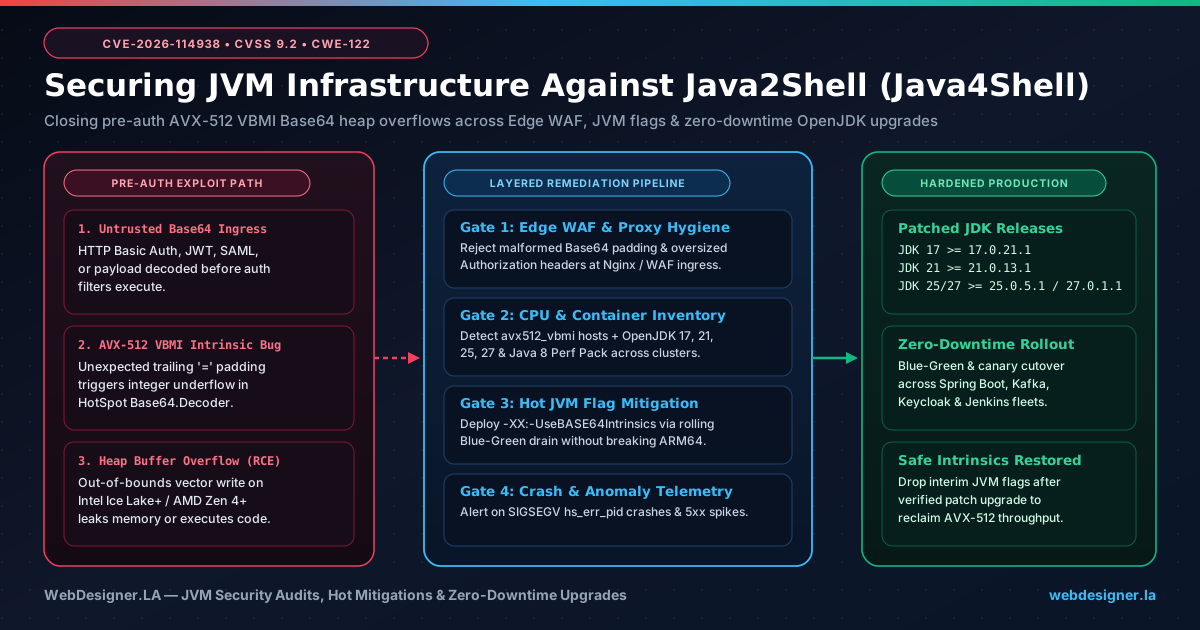
If your engineering team recently watched Low Level's technical breakdown of the Java runtime flaw and wondered what concrete steps separate vulnerable clusters from resilient ones, this guide covers both the low-level mechanics and how our systems engineering practice helps organizations audit, hot-mitigate, and permanently patch affected fleets without downtime.
Why Java2Shell Bypasses Traditional Application Audits
Unlike Log4Shell, where security teams could grep Maven or Gradle lockfiles for an outdated artifact, CVE-2026-114938 stems from a vectorized JIT intrinsic for java.util.Base64.Decoder discovered by researchers at Calif. Every service parsing HTTP Basic Authentication headers, JWT segments, SAML assertions, API webhooks, or Base64-encoded JSON fields before reaching application business logic can expose the parser directly to unauthenticated callers.
In real-world middleware stacks—including Apache Kafka brokers, Atlassian Jira and Confluence instances, Jenkins controllers, Keycloak identity providers, Spring Boot microservices, and JFrog Artifactory nodes—Base64.getDecoder().decode(...) routinely executes inside servlet filters or authentication interceptors prior to session validation.
avx512_vbmi vector instructions, and (3) untrusted external input routed into java.util.Base64.Decoder.
Root Cause: Vector Store-Mask Integer Underflow in AVX-512 VBMI
To accelerate throughput on modern server silicon (Intel Ice Lake, Sapphire Rapids, Emerald Rapids, and AMD Zen 4 or newer), OpenJDK compiles tight decoding loops using 512-bit SIMD instructions from the AVX-512 Vector Byte Manipulation Instructions (AVX-512 VBMI) extension. When processing malformed input sequences containing valid-alphabet runs terminated by unexpected trailing padding characters—specifically 64 or 128 'A' bytes followed by a single '=' depending on the runtime minor version—the JIT stub miscalculates remaining output capacity.
That length-calculation bug creates an integer underflow when computing the AVX-512 vector store mask, writing attacker-controlled bytes past the end of the allocated heap buffer. Even before an attacker leverages full remote code execution chains, malformed payloads trigger immediate JVM aborts (SIGSEGV), heap data leakage, and sustained denial-of-service loops behind public ingress endpoints.
Step 1: Fleet Discovery Across CPU Flags and JVM Distributions
Before blindly cycling pods or adding invasive startup switches across heterogeneous clusters, teams need a deterministic inventory pairing host hardware capabilities against running Java runtimes. Architecture diversity works in your favor here: AWS Graviton ARM64 nodes, Apple Silicon build agents, and older pre-Ice Lake or pre-Zen 4 x86-64 hosts do not dispatch the avx512vbmi Base64 intrinsic path.
# 1. Verify whether the host or container node exposes AVX-512 VBMI
grep -oE 'avx512(_)?vbmi' /proc/cpuinfo | head -n 1

# 2. Inspect exact JDK runtime build and vendor across running JVMs
java -XshowSettings:properties -version 2>&1 | grep -E 'java.runtime.version|java.vendor'

# 3. Audit active JVM intrinsic flags on a live process PID
jcmd <PID> VM.flags | tr ' ' '\n' | grep -E 'UseBASE64Intrinsics|UseAVX'
Notice one subtle runtime detail: standard OpenJDK 8, standard OpenJDK 11, and Eclipse OpenJ9 runtimes are not exposed to this specific AVX-512 Base64 vector intrinsic defect. However, Oracle Java 8 Enterprise Performance Pack build 8u511b33-perf backports newer HotSpot optimizations and is therefore affected alongside OpenJDK 17, 21, 25, and 27.
Step 2: Immediate Hot Mitigations Without Rebuilding Images
When base container rebuilds require multi-hour CI approvals or vendor appliance maintainers have not yet shipped updated OS packages, disabling only the vulnerable HotSpot Base64 JIT intrinsic closes the overflow vector immediately upon process restart:
- Preferred Global Switch: Append
-XX:-UseBASE64Intrinsicsto systemd unit files, Helm deployment manifests, or container environment variables viaJDK_JAVA_OPTIONS(OpenJDK 9+) orJAVA_TOOL_OPTIONS. Pure Java scalar Base64 decoding remains intact with minimal latency impact outside ultra-high-throughput Base64 batch pipelines. - Architecture-Guarded Fallback: On older administrative tooling where disabling the specific intrinsic flag cannot be validated,
-XX:UseAVX=2prevents 512-bit VBMI code generation on x86-64 hosts. Never deploy-XX:UseAVX=2globally to mixed x86-64 and ARM64 Kubernetes clusters, because ARM64 JVMs reject unrecognized x86-specific AVX flags at startup.
# Kubernetes Deployment / Compose emergency patch environment variable
export JDK_JAVA_OPTIONS="${JDK_JAVA_OPTIONS:-} -XX:-UseBASE64Intrinsics"

# Legacy JDK or wrapper scripts honoring JAVA_TOOL_OPTIONS
export JAVA_TOOL_OPTIONS="${JAVA_TOOL_OPTIONS:-} -XX:-UseBASE64Intrinsics"
Step 3: Patched JDK Vendor Matrix and Permanent Upgrades
JVM flags serve as a vital bridge, not a permanent end state. Upstream OpenJDK maintainers and major downstream binary distributors published coordinated security releases on November 17, 2026 correcting the intrinsic store-mask bounds check.
| JDK Line / Vendor | Vulnerable Build Range | Verified Patched Release |
|---|---|---|
| Oracle Java 8 Perf Pack | 8u511b33-perf | 8u513-perf |
| OpenJDK / Oracle 17 | 17.0.6 – 17.0.21.0.3 | 17.0.21.1 (Temurin 17.0.21.1+2 / Corretto 17.0.21.1.2) |
| OpenJDK / Oracle 21 | Up to 21.0.13.0.3 | 21.0.13.1 (Temurin 21.0.13.1+2) |
| OpenJDK / Oracle 25 | Up to 25.0.5.0.3 | 25.0.5.1 (Temurin 25.0.5.1+2) |
| OpenJDK / Oracle 27 | Up to 27.0.1.0.3 | 27.0.1.1 (Temurin 27.0.1.1+4) |
Rolling out runtime upgrades across stateful brokers or high-traffic web services requires disciplined release orchestration. Following our blue-green and canary deployment methodology alongside zero-downtime DevOps rollout guards prevents simultaneous JVM warm-up storms and thread-pool exhaustion while rotating hardened container base images into production.
Step 4: Edge Proxy Hygiene and Telemetry Detection
Even before every downstream microservice restarts with -XX:-UseBASE64Intrinsics or an upgraded JDK image, reverse proxies and API gateways give you immediate leverage at the perimeter. Most legitimate HTTP Basic Authentication tokens and RFC 4648 Base64 credentials do not match pathological 64-byte or 128-byte aligned padding anomalies with single trailing equals signs inside oversized header values.
Adding strict Nginx or edge WAF inspection rules to reject structurally anomalous Authorization: Basic credentials, bounding maximum header sizes before requests reach Tomcat, Jetty, Netty, or Undertow servlet dispatchers, and shipping JVM crash indicators (hs_err_pid*.log creation events, unexpected SIGSEGV exit codes 139, and sudden 502 upstream reset spikes) into centralized Loki and Prometheus alerting ensures active exploit probes trigger immediate operator visibility instead of silent pod restarts.
How WebDesigner.LA Secures Your Production Fleet
When a critical runtime CVE hits an active commercial platform, engineering teams rarely have spare bandwidth to audit dozens of Dockerfiles, third-party vendor appliances, CI pipelines, and reverse-proxy configurations simultaneously without risking an outage. Our security and infrastructure engineering practice steps in with hands-on execution tailored to your exact stack:
- Rapid 24-Hour Exposure and Blast-Radius Audit: We map every Java service, vendor appliance, Kubernetes node CPU architecture, and unauthenticated Base64 ingress path (Basic Auth, JWT, SAML, multipart webhooks) into a prioritized remediation register.
- Non-Disruptive Emergency Mitigation Rollout: We implement architecture-aware
JDK_JAVA_OPTIONSflag injection and canary-tested Nginx/WAF edge filters so exposed services gain immediate protection before full container rebuild cycles complete. - Permanent JDK Patching and Immutable CI Pipelines: We upgrade base images across Temurin, Corretto, Azul Zulu, Microsoft OpenJDK, or Red Hat builds, pin reproducible digest tags, and validate throughput regression benchmarks in staging.
- Real-Time Crash and Exploit-Attempt Observability: We wire Loki LogQL alerts, Prometheus exporters, and incident notifications to catch anomalous header probes, JVM segfault exit codes, and regression anomalies early.
Need Immediate Help Hardening Your Java Infrastructure?
Whether you run Spring Boot clusters, legacy enterprise appliances, Kafka pipelines, or public SaaS APIs, we can audit your CVE-2026-114938 exposure, deploy hot mitigations safely, and lock down your edge perimeter.