
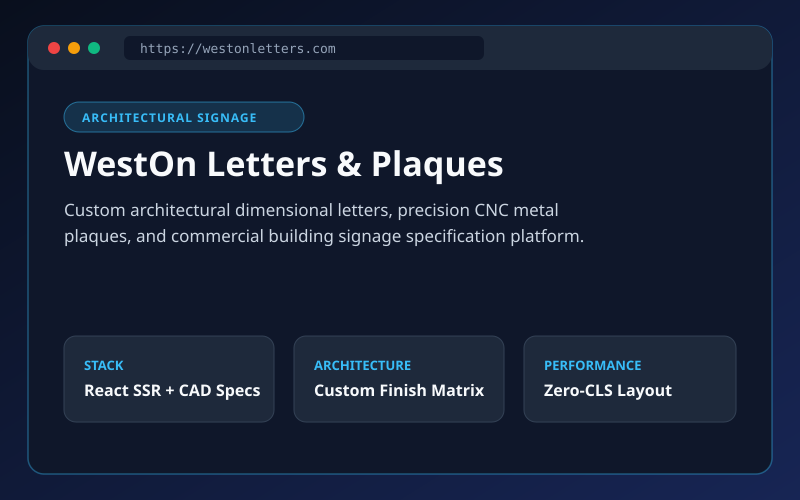
Twenty years ago, around 2004, I took over a stalled PHP4 and MySQL codebase for WestOnLetters.com—a custom architectural metal lettering and building signage catalog that had been started earlier and left half-finished. Instead of throwing everything out and rebuilding from scratch, I stabilized that inherited catalog, wired interactive sizing workflows, and kept it earning revenue for decades. This week, we healed that exact same twenty-year-old web property again—this time using our automated, telemetry-driven website self-healing pipeline.
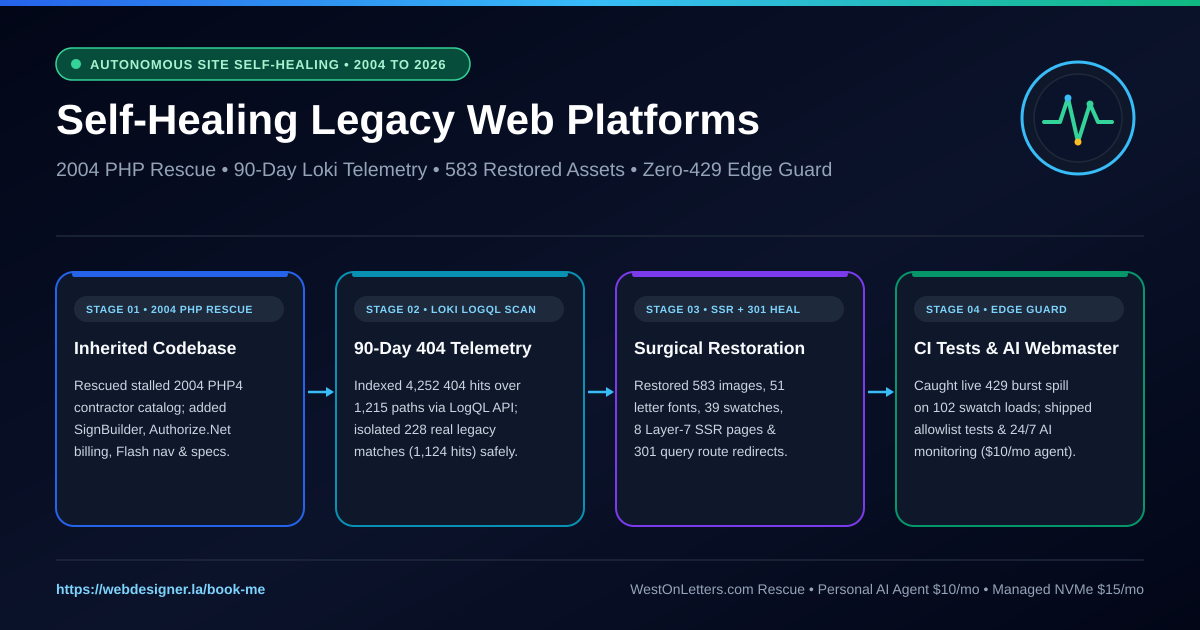
Part 1: The 2004 Inheritance — Rescuing a Half-Built PHP4 Storefront
If you look at the early chapters on my career timeline under LAMP rescues, WestOnLetters.com was never a greenfield build. When the codebase landed on my desk in the mid-2000s, a prior developer had assembled the opening scaffolding: loose PHP4 scripts using deprecated short tags, direct mysql_query() string concatenation, nested HTML table layouts, a cookie-backed session handle named wolSess, dropdown JavaScript navigation helpers, and a Macromedia Flash top banner (navbar_westonletters.swf).
Clients rarely hire a rescue engineer because they want another endless rewrite. They hire you because orders are waiting, product photos sit unused in shared-hosting folders, and the checkout handler is broken. Rather than scrapping years of architectural signage specifications, I refactored the class library modules (utility, category, cart, signBuilder, and order), connected live card processing through the classic Authorize.Net gateway (transact.dll), and kept fifty-one cast letter typefaces and dozens of anodized and baked-enamel finish tables running reliably on shared Linux hosting.
Later, active e-commerce configuration graduated to the owner's dedicated 3D configurator storefront at ArchitecturalNumbers.com, while the original domain moved onto our sub-50ms multi-tenant React SSR cluster. That migration eliminated two decades of PHP4 runtime exposure overnight—yet migrating a twenty-year-old domain always exposes a quieter problem.
Why Legacy Migrations Bleed Traffic Silently After Launch
A website that has stayed online continuously since the George W. Bush administration accumulates thousands of deep bookmarks across architects, sign shops, contractors, and search engine indexes. Visitors still arrive looking for /HouseNumbers.htm, /index.php?catID=23&file=HN-Styles.htm, embedded installation photos such as SAMP-751.jpg, or legacy swatch thumbnails buried inside /images/HouseNumbers/.
Conventional agencies either ignore those edge misses or throw a lazy wildcard redirect at /, wiping out every product photo, finish table, and comparison chart buyers actually clicked through to inspect. Even worse, combing multi-gigabyte rotated log files over SSH with ad-hoc zgrep pipelines burns disk I/O and still struggles to tell legitimate contractor traffic apart from vulnerability scanners hammering .env and wp-login.php.
Principle Behind Our Self-Healing Service
Never guess what visitors lost during a migration or theme overhaul, and never rewrite everything blindly. Query indexed edge telemetry first, cross-reference real 404 misses against verified historical archives, heal only high-value routes and assets surgically, and lock the repairs behind automated CI tests.
Part 2: How Our Telemetry Self-Healing Workflow Restored WestOnLetters.com
Using the exact same closed-loop remediation architecture we run for managed WinWinHost MultiDomain CMS shards and Personal AI Website Agent clients, we walked WestOnLetters.com through four measurable healing stages:
| Healing Stage | Data Source Inspected | Verified Telemetry Finding | Production Remediation Shipped |
|---|---|---|---|
| 1. LogQL Edge Scan | 90-day Loki Nginx stream | 4,252 total 404 hits across 1,215 unique paths | Isolated human & search-bot URLs away from scanner probes |
| 2. Webroot Archive Match | Site5 PHP mirror (1,107 files) + SQL category seeds | 228 legacy paths matching 1,124 genuine 404 hits | Filtered out non-web artifacts (Thumbs.db, build headers) |
| 3. Surgical Asset & SSR Heal | Legacy categories 22, 23, 67, 68 & FrontPage tables | 51 letter fonts, 39 enamel colors, missing CSS & favicons | Restored 583 images, 2 legacy stylesheets, WL icons, 8 SSR pages & /about |
| 4. Legacy Query & Edge Fix | Live ?catID= traffic + post-deploy 102-image burst | 14 HTTP 429s from global A2A limiter spillover on images | Shipped 301 map (signBuilder → storefront) & explicit path allowlist |
Stage 1 & 2: Separating 1,124 Real Buyer Misses From Scanner Noise
Instead of grepping log files on a production box, we queried our indexed Loki stream for ninety days of 4xx events on westonletters.com. Out of 4,252 total 404 events across 1,215 unique paths, automated archive matching against the backed-up legacy PHP directory (1,107 files) and database seed tables pinpointed exactly 228 authentic historical paths responsible for 1,124 misses.
Notice how disciplined triage protects both bandwidth and security: random scanner probes and orphaned desktop files inside the archive backup (like Thumbs.db or C header clutter) stayed out of production, while every legitimate cast numeral photograph, swatch chip, and style chart moved into clean host-scoped storage.
Stage 3: Restoring 583 Images, 51 Letter Fonts & Nine Clean Destinations
Rather than dumping unstyled 2004 HTML tables back onto the internet, we restored the authentic specifications inside clean React SSR layouts wrapped in semantic markup and verified Open Graph cards:
- Host-Scoped Asset Restoration: All 583 clean photographs and GIF/PNG typography strips now resolve cleanly under
westonletters.com/images/*(plus a case-safe regex alias for space-encoded filenames likeRibbon Deep -- Clear Anodized-360x256.jpg), paired with restored legacy CSS paths and a custom WL SVG/PNG/ICO favicon suite. - Architectural House Numbers Hub & Spec Matrix: House Numbers plus dedicated guides for all 51 font styles and casting depths, 12 metallic & 39 baked enamel finishes, concealed stud installation, sample photography, FAQ, Foam Letters, About, and clean Contact details.
- Surgical 301 Equity Routing: Legacy
/index.php?catID=23&file=HN-Styles.htm,/htdocs/templates/center/..., and/HouseNumbers.htmURLs now return deterministic301redirects to canonical SSR destinations, whilesignBuilder=startroutes shoppers directly to ArchitecturalNumbers.com.
Stage 4: How Self-Healing Caught a Live 429 Burst Minutes After Launch
Genuine self-healing does not end at the first green deployment. Seconds after shipping the restored pages, browsing /house-numbers/styles—which renders 102 restored font specimen images on a single specification matrix—tripped 14 HTTP 429 responses logged immediately in Loki.
Inspecting upstream response headers revealed RateLimit-Limit: 45 coming from an unscoped router.use(...) middleware inside the platform's agent-commerce router (a2aChannelsAndX402.ts), which sits in the global Express pipeline ahead of domain-scoped static handlers and CMS pages. Because domainSwitchboard resolved /images/HouseNumbers/* after that middleware, any page rendering more than forty-five domain-scoped images exhausted the 45-requests-per-minute agent discovery cap within one second.
We replaced the brittle blocklist with a strict path allowlist (isA2AChannelOrX402Path) scoped solely to /api/a2a/*, /.well-known/*, /api/mcp/*, /api/benchmark/*, and machine JSON catalogs, backed it with integration tests verifying 60 concurrent westonletters.com requests return 200 OK without rate-limit headers while preserving 429 enforcement on A2A endpoints, and redeployed cleanly through Job Runner CI.
Get Autonomous Self-Healing & Legacy Rescue on Your Own Site
If you run a long-standing PHP, WordPress, custom e-commerce, or React site that has quietly collected broken backlinks, missing catalog images, outdated templates, or unexpected gateway errors, you do not need a five-figure agency retainer to fix it. We offer the exact same self-healing monitoring, telemetry diagnosis, and hands-on engineering fixes directly through our managed plans:
- Personal AI Website Agent ($10/mo): Continuous site health monitoring, 404 telemetry remediation, ongoing text, pricing, and image updates, and zero surprise hourly developer bills.
- All-in-One Growth Bundle ($15/mo): Pairs our autonomous website agent and GA4 + Loki 404 auto-healing pipeline with high-speed bare-metal NVMe hosting on WinWinHost, free migration, business inboxes, and auto-renewing SSL.
- Legacy Code Rescue & Architecture Review ($150): Direct 1-on-1 engineering session—or start with a free website performance & code repair audit—for inherited 2000s–2020s PHP, MySQL, and JavaScript codebases that need surgical stabilization without breaking live revenue.