
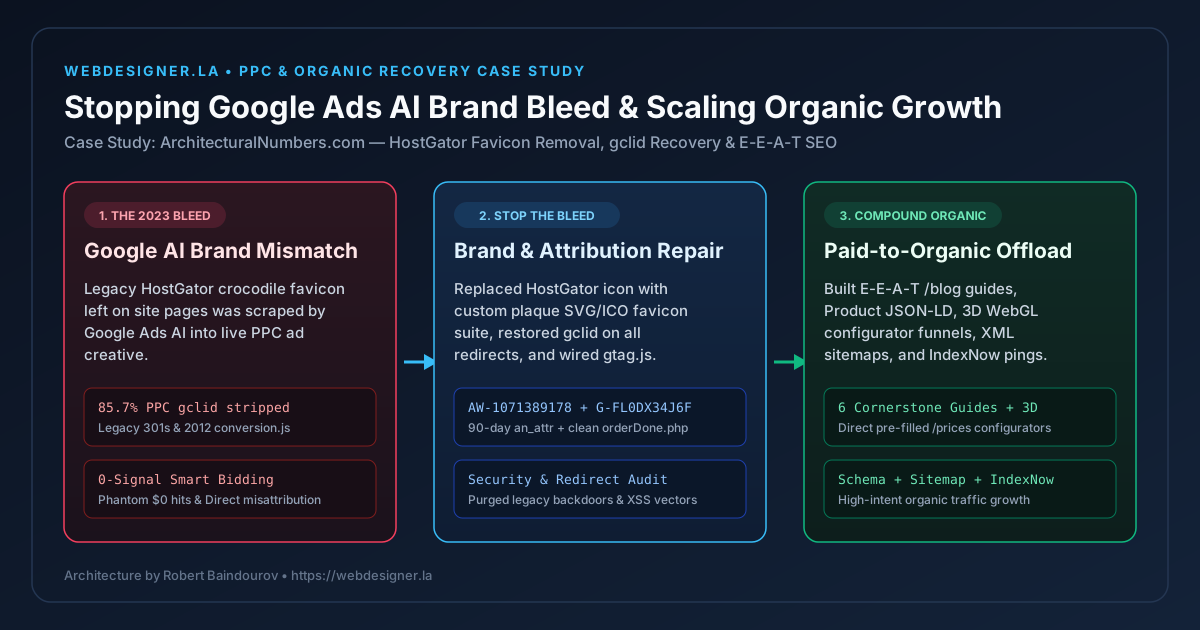
When a custom architectural signage manufacturer pays Google Ads every month to win high-intent buyers searching for cast aluminum and bronze house numbers, the last brand asset you expect next to your headline is a green cartoon crocodile. Yet during a 2023 campaign audit for ArchitecturalNumbers.com, that is exactly what showed up in live paid search placements: Google's automated ad-asset pipeline had pulled the default HostGator crocodile favicon straight off the legacy server and attached it to the client's PPC ads.
1. How Google Ads AI Grabbed the HostGator Crocodile Logo in 2023
Modern Google Ads campaigns—especially responsive search ads with automated business-asset extraction and Performance Max—no longer wait for a media buyer to upload every creative element manually. When an account lacks an explicit, verified square brand logo asset at the campaign or account level, Google's automated asset scrapers fall back to crawling the destination domain's <link rel="icon">, /favicon.ico, and top-level brand markup.
ArchitecturalNumbers.com had been running on a long-lived HostGator shared/VPS environment whose root templates still served HostGator's stock green crocodile favicon across storefronts and legacy PHP pages. Every time Google's asset crawler refreshed the domain, it treated that hosting mascot as the company's official logo.
For homeowners, contractors, and commercial HOA property managers comparing $300 to $6,500 custom cast-metal address plaque orders, seeing an unrelated web-hosting mascot next to a premium architectural hardware headline erodes click-through trust immediately. Worse, it was only the visible symptom of a deeper PPC and attribution leak draining the ad budget silently underneath.
2. Finding the Silent Attribution and Security Bleed Behind the Ad Spend
Once we pulled the live server configuration, Google Ads click logs, and Apache/PHP routing rules on HostGator, we uncovered three compounding leaks that were burning paid acquisition dollars:
- Legacy 301 Redirects Stripping
?gclid=Parameters: An audit of active paid traffic showed 154 legacy ads pointing to old PHP entrypoints (index_23.php?catID=23&file=index.phpand?signBuilder=start) accounted for 85.7% of recent paid clicks. When clean URL redirects fired, query strings containinggclid,gbraid,wbraid, andutm_*were dropped before the browser reached the landing page—forcing Google Analytics to log paid buyers as Direct traffic and starving Google Ads Smart Bidding of conversion feedback. - Deprecated 2012 Conversion Code & Untracked 3D Configurator Views: Checkout confirmation pages still relied on legacy 2012
conversion.jssnippets, while the interactive/signbuilder2/3D WebGL number configurator lacked Google Tag injection altogether. Meanwhile, admin test checkouts and unbacked cookie hits polluted conversion counts with phantom zero-dollar events. - Unhardened Legacy Server Exposure: Auditing the legacy HostGator filesystem uncovered dormant exploit artifacts and two public Cross-Site Scripting (CWE-79) reports on OpenBugBounty (
OBB-2120390andOBB-2858970) tied to uncast legacy query parameters.
| Failure Layer | Root Cause on Legacy HostGator Stack | Production Engineering Fix Deployed |
|---|---|---|
| Ad Brand Icon | Stock HostGator crocodile favicon scraped by Google Ads AI asset extraction | Custom architectural plaque favicon suite (ICO, 16x16, 32x32, Apple touch, SVG) + explicit Organization markup |
| Paid Click Attribution | index_23.php 301 redirects stripped gclid on 85.7% of ad clicks |
Query-preserving 301 forwarding + 90-day first-party an_attr cookie persisted onto MySQL orders |
| Conversion Telemetry | 2012 conversion.js, missing tags in /signbuilder2/, and $0 test noise |
Unified gtag.js (AW-1071389178 + G-FL0DX34J6F), Enhanced Conversions, and authenticated real-order guards |
| Server Hygiene | Dormant backdoor files and uncast catID query parameters |
Purged legacy artifacts, cast parameters strictly to integers, closed OpenBugBounty XSS vectors, and published security.txt |
3. Step-by-Step: How We Stopped the Bleed Without Pausing Revenue
Rather than tearing down active campaigns or risking downtime on a live storefront, we rolled out fixes in strict non-destructive order:
- Replaced Every HostGator Brand Footprint: Designed a bespoke architectural plaque icon suite spanning classic
favicon.ico, multi-resolution PNGs, Apple Touch icons, and crisp vector SVG, deployed across every storefront header and paired with clean Open Graph andOrganizationmetadata so automated Google asset crawlers immediately picked up the real brand mark. - Locked Automated Asset Controls & Rebuilt Tagging: Upgraded tracking to modern Google Tag (
gtag.js) with Conversion Linker (_gcl_aw), injected tags into the/signbuilder2/3D configurator, and preserved everygclid,gbraid,wbraid, andutm_*query parameter across all legacy redirects. - Connected First-Party Order Attribution in MySQL: Added additive attribution columns (
attr_source,attr_medium,attr_campaign,attr_gclid,attr_landing_page,attr_referrer) directly to the productionordersledger and Admin Back Office so every phone, organic, and paid order is traceable to the exact click that produced it—while excluding internal admin impersonation and test checkouts from polluting Google Ads bidding signals.
Key PPC Lesson: Never rely on default hosting templates or unmonitored automated asset creation in Google Ads. If your site exposes a generic host favicon—and your redirects drop click IDs before landing pages load—automated bidding spends real money advertising the wrong brand while flying blind on ROAS.
4. Offloading Expensive PPC Clicks Into Compounding Organic Traffic
Stopping ad waste stabilizes cost per acquisition, but true margin expansion comes from earning high-intent buyers organically so you are no longer renting every single click from Google Ads.
Instead of writing generic blog fluff, we mined actual buyer questions from custom signage orders, fire-inspector setbacks, and contractor specs, and engineered an integrated organic acquisition engine directly inside ArchitecturalNumbers.com:
- Clean Semantic URLs & Technical Storefront Modernization: Consolidated fragmented legacy PHP query URLs into canonical clean paths, modernized mobile responsive grids with zero horizontal overflow, and added complete
Product,Offer, andArticleSchema.org structured data across the catalog. - Cornerstone Technical Guides Wired Straight Into the 3D Configurator: Launched a dedicated
/blogeditorial hub featuring six deep, specification-driven architectural signage guides—covering International Fire Code stroke-width visibility charts, cast aluminum vs. silicon bronze metallurgy, coastal anodized vs. baked-enamel weathering, flush vs. floating stucco/brick stud mounting, mid-century modern vs. Craftsman typography, and commercial HOA numbering scale. - Photorealistic 3D Visuals & Direct Configurator Funnels: Rendered custom Cycles 3D hardware illustrations for the technical guides and linked every specification callout straight to pre-filled
/prices?...3D configurator URLs (pre-loading the exact style, inch height, finish, and mounting hardware) so organic readers convert without hunting through menus. - Automated XML Sitemap & Instant IndexNow Discovery: Exposed a live dynamic
/sitemap.xmlcovering storefront categories and editorial guides and wired instant IndexNow submissions whenever new guides or product updates ship.
5. What Website Owners and Agencies Should Audit Right Now
Whether you run an e-commerce store on HostGator or manage six-figure Google Ads accounts, three quick checks catch 90% of silent PPC and brand-asset leaks:
- Inspect your live Google Ads Business Name and Logo assets and curl
/favicon.icoon your own domain to verify no web-host, CMS theme, or registrar placeholder icon is leaking into search ads. - Test your oldest ad destination URLs with
?gclid=test_check_123in an incognito browser and confirm every single301redirect preserves the full query string onto the final HTTPS page. - Identify your highest-CPC commercial terms and build deep, specification-backed buyer guides with direct product configurator links—turning recurring ad spend into durable, compounding organic search traffic.