
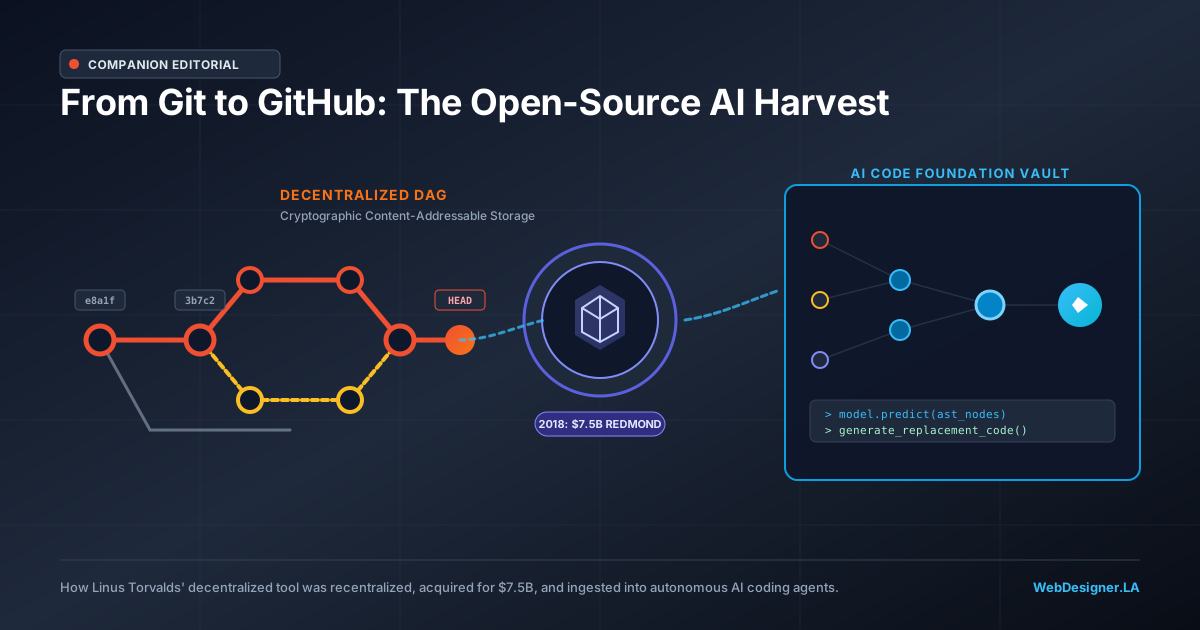
In our companion essay, Stackoverflow or Stepping Stone, we traced how fifteen years of developer Q&A were transformed into a hand-labeled supervised training dataset for machine-generated code. But developer explanations were only one half of the equation. To build autonomous coding agents capable of writing entire modules, test suites, and microservices, foundation models needed something far more vast than forum threads: they needed the source code itself. The story of how that code was gathered, centralized, and harvested begins with an angry two-week sprint by Linus Torvalds, winds through a $7.5 billion corporate acquisition in Redmond, and ends with the quiet inversion of the open-source social contract.
The BitKeeper Mutiny & the Birth of a Decentralized Tool
In April 2005, the development of the Linux kernel was thrown into sudden disarray. For three years, kernel contributors had used BitKeeper, a proprietary distributed revision control system provided free of charge by BitMover. When open-source developer Andrew Tridgell reverse-engineered BitKeeper's networking protocols to create an interoperable client, BitMover revoked the free licensing tier for the entire kernel development team.
Rather than adopt an existing commercial tool or surrender control to a centralized server like Subversion, Linus Torvalds retreated for ten days of intense isolation. His design imperatives were radical, unforgiving, and explicitly anti-monopolistic:
- Content-Addressable Cryptographic Immutability: Every file, directory tree, and commit was identified by its SHA-1 hash within a directed acyclic graph (DAG). History could never be rewritten or tampered with silently.
- Radical Decentralization: Every local clone was a complete, standalone repository containing the full project history. There was no authoritative central server required by the protocol.
- Absolute Peer-to-Peer Autonomy: Developers could pull, branch, and merge between peers via SSH or email patches without asking permission from any central gatekeeper.
Linus named the project Git. Its core philosophical architecture was built to guarantee that no company, no vendor, and no cloud host could ever hold the developer commons hostage again.
The Great Recentralization: From Decentralized DAG to Social Coding
While Git's underlying mathematics were flawless, its early command-line user experience was famously brutal. Rebasing branches, resolving merge conflicts, and navigating detached HEAD states terrified novice programmers and created friction for distributed teams.
In 2008, Chris Wanstrath, PJ Hyett, and Tom Preston-Werner recognized an immense opportunity: wrap Linus's powerful engine in a modern Ruby on Rails web interface and make repository collaboration frictionless. They launched GitHub around the rallying cry of "Social Coding."
GitHub introduced the innovations that defined modern collaborative software development:
- The Fork & Pull Request: Instead of formatting email patches with
git format-patch, developers could fork a repository with one click, push changes to the web, and open a visual pull request with inline code reviews. - The Developer Resume: The green contribution activity graph and public repository stars became the universal credentials for software engineers worldwide.
- Frictionless Public Hosting: Unlimited free public repositories meant that open-source creators no longer had to maintain private servers or deal with antiquated SourceForge pages.
Developers eagerly adopted the platform. Yet in doing so, the global development community walked into a profound architectural paradox: an entire generation of software engineers voluntarily re-centralized their work onto a single privately owned cloud service—re-creating the exact single point of failure that Linus Torvalds had designed Git to eliminate.
The $7.5 Billion Bet: Microsoft's Strategic Masterstroke
For decades, Microsoft had viewed open-source software with open hostility. In 2001, former chief executive Steve Ballmer infamously described Linux as "a cancer that attaches itself in an intellectual property sense to everything it touches."
Under Satya Nadella, Microsoft embarked on a radical cultural and technical transformation. Embracing Linux and cloud computing, the company joined the Linux Foundation, open-sourced the .NET runtime, and turned VS Code into the world's dominant code editor. Then, in June 2018, Redmond dropped a bombshell on the technology industry: Microsoft announced it was acquiring GitHub for $7.5 billion in stock.
The Strategic Shift: When the deal was inked, financial analysts debated whether GitHub generated enough SaaS subscription revenue to justify a $7.5 billion valuation. Microsoft was not looking at git hosting fees; they understood that GitHub held the single most valuable collection of structured human intellectual labor on Earth—precisely as modern deep learning models were scaling up.
Despite assurances that GitHub would operate independently, the strategic pieces fell into place with astonishing speed. Microsoft invested heavily in OpenAI, secured exclusive cloud computing agreements on Azure, and gained direct, legal custodial access to the vast vault of the world's open-source source code.
| Era of Source Control | Architectural Model | Primary Governance | Relationship to AI Synthesis |
|---|---|---|---|
| 2005: The Git Revolution | Decentralized cryptographic DAG | Linus Torvalds & Linux Kernel Team | Zero central ingestion point; pure peer-to-peer code distribution |
| 2008–2018: The GitHub Boom | Centralized web platform ("Social Coding") | Independent startup (GitHub, Inc.) | Unified metadata, stars, forks, and pull requests centralized globally |
| 2018–2021: The Redmond Custody | Enterprise cloud ecosystem & Azure integration | Microsoft Corporation ($7.5B acquisition) | Direct pipeline connection to OpenAI foundation model compute clusters |
| 2021–Present: The Copilot Harvest | Generative neural weights & coding agents | Commercial AI providers | Billions of lines of public code ingested into commercial autocomplete models |
The Copilot Launch & the Ingestion of the Commons
In June 2021, the true objective of the acquisition became apparent: Microsoft and OpenAI launched GitHub Copilot, powered by Codex, a specialized neural network trained on hundreds of millions of public repositories across dozens of programming languages.
For decades, software engineers had released their work under open licenses—MIT, Apache 2.0, BSD, and the GNU General Public License (GPL). The implicit social contract of open source was straightforward: code was made free for human study, peer learning, and collaborative building. If you used someone's GPL-licensed library in your project, copyleft rules dictated that your derivative work must also remain open.
Generative AI bypassed this contract entirely. AI providers argued that scraping public repositories and training neural network weights fell under "fair use"—asserting that the model learns statistical correlations between tokens rather than copying copyrighted files. Yet in practice, early versions of coding models frequently generated memorized code verbatim, complete with the original author's idiosyncratic comments and license headers, but stripped of the author's copyright attribution.
The Copyleft Paradox: Laundering the Code Commons
Richard Stallman created copyleft to protect programmer freedom against corporate enclosure. The brilliant legal mechanism of the GPL ensured that commercial vendors could not take public community code, wrap it in a proprietary shell, and sell it back to developers without releasing their modifications.
Generative models broke that defense by operating in a legal gray zone:
- Neural Weight Obfuscation: Because model weights are matrices of floating-point numbers rather than readable source trees, vendors argue that the resulting model is not a derivative work under copyright law.
- Monetizing the Contributor Commons: Programmers who spent years maintaining open libraries now pay $10 to $20 per month to commercial providers to receive autocomplete suggestions derived from their own uncompensated code.
- Erosion of Attribution: The core requirement of permissive licenses like MIT and BSD—preserving the author's copyright notice—is effectively bypassed when an autonomous coding agent emits an algorithm without citing its origin.
The code commons that developers built over twenty-five years was effectively laundered into closed commercial foundation models.
The Two Halves of the Harvest
When you place Stack Overflow and GitHub side by side, the full picture of modern AI code generation snaps into sharp relief:
- Stack Overflow provided the intent and reasoning: Millions of detailed explanations, human bug diagnostics, and voting signals that taught neural networks how developers think and reason through problems.
- GitHub provided the implementation and architecture: The massive corpus of real-world file structures, continuous integration pipelines, unit tests, and production codebases that taught models how software systems are assembled.
Together, these two developer monuments formed the twin engines of modern coding models. Without twenty years of uncompensated human collaboration on Stack Overflow and GitHub, today's automated coding tools simply could not exist.
The Enduring Need for Human Craftsmanship
Does the automated synthesis of code mean software craftsmanship is dead? On the contrary: as the cost of generating raw syntax drops to near zero, the value of human judgment, taste, and accountability rises exponentially.
An automated agent can write a hundred lines of boilerplate in seconds, but it cannot decide whether a feature should exist in the first place. It cannot understand the human frustration of a slow checkout flow, empathize with an end user navigating an confusing mobile navigation, or guarantee that an architecture remains lean and maintainable five years down the road.
At WebDesigner.LA, we build fast, rock-solid websites and applications that focus on what matters most: real human customers and real business results. We use the most modern tools available, but we never outsource human taste, discernment, and care. In an era where code is generated by machines, building websites that are fast, intuitive, and genuinely delightful remains an unmistakably human craft.