
Viral demos where a language model writes Python into Blender and produces a dramatic room render make 3D automation look effortless—right until you try shipping real WebGL game zones or connecting untrusted community assets to a developer workstation. Over the past three days in our studio, we re-engineered our entire 3D and 2D sprite pipeline for Ella's World from first principles: locking down local Model Context Protocol sockets against remote code execution, compiling declarative 2D floorplans into walkable Three.js dungeons, grading rigged bosses with zero-context visual critics, and training a compact Retro Diffusion pixel-art LoRA inside under two gigabytes of VRAM on a local 4 GB GPU.
1. Closing the Localhost Socket Gap and Quarantining External 3D Meshes
Connecting an AI coding assistant directly to Blender's embedded Python interpreter introduces two subtle attack surfaces that stock open-source setups leave wide open. First, default addon listeners bind an unauthenticated TCP socket on localhost where any unprivileged local process—or a malicious web page firing cross-origin localhost requests—can dispatch raw Python execution payloads. Second, third-party .blend, .glb, and .obj downloads routinely carry embedded startup driver expressions or smuggle indirect prompt-injection instructions inside scene node names, material labels, and custom RNA metadata.
Before building a single new character or dungeon room, we hardened our local studio bridge across four layers:
- HMAC-SHA256 Socket Signing & Replay Windows: Every command sent between the MCP server and Blender's addon listener now carries a canonical payload signature keyed by a
0600-permissioned 256-bit local secret alongside a strict plus-or-minus 30-second timestamp window, while dropping raw HTTPGET,POST, andOPTIONSbrowser probes immediately on arrival. - AST Sandbox Validation & Disabled Auto-Start: Code blocks pass through static abstract-syntax-tree validation blocking shell escapes, arbitrary filesystem reads, and dynamic driver injection before reaching the socket, and addon listeners stay explicitly off until toggled for an active session.
- Telemetry & Shared Trial Key Removal: We stripped third-party telemetry endpoints and disabled hardcoded shared commercial 3D trial keys so studio prompts and concept sheets never leave local hardware uninvited.
- Headless Quarantine Sanitizer (
-b -Y --factory-startup): Every external mesh enters through an isolated headless Blender 5.2.2 LTS pass with--disable-autoexecenforced, purging allbpy.data.textsdatablocks, animation drivers, and custom properties, renaming hierarchy nodes to safe studio prefixes, and baking parentEmptyworld transforms directly into vertex coordinates so glTF exports never collapse to origin.
2. Deterministic 2D Floorplan Compilation into Walkable Three.js Zones
Freehand AI-generated room scripts frequently look convincing from a single fixed camera angle while failing basic gameplay physics: doorways end up ten centimeters too narrow for the player capsule, staircases float above floor slabs, or Blender's +Z Up coordinates get exported without matching server-side collision boxes. To make level creation repeatable for browser games, we built a declarative JSON-to-glTF zone compiler.
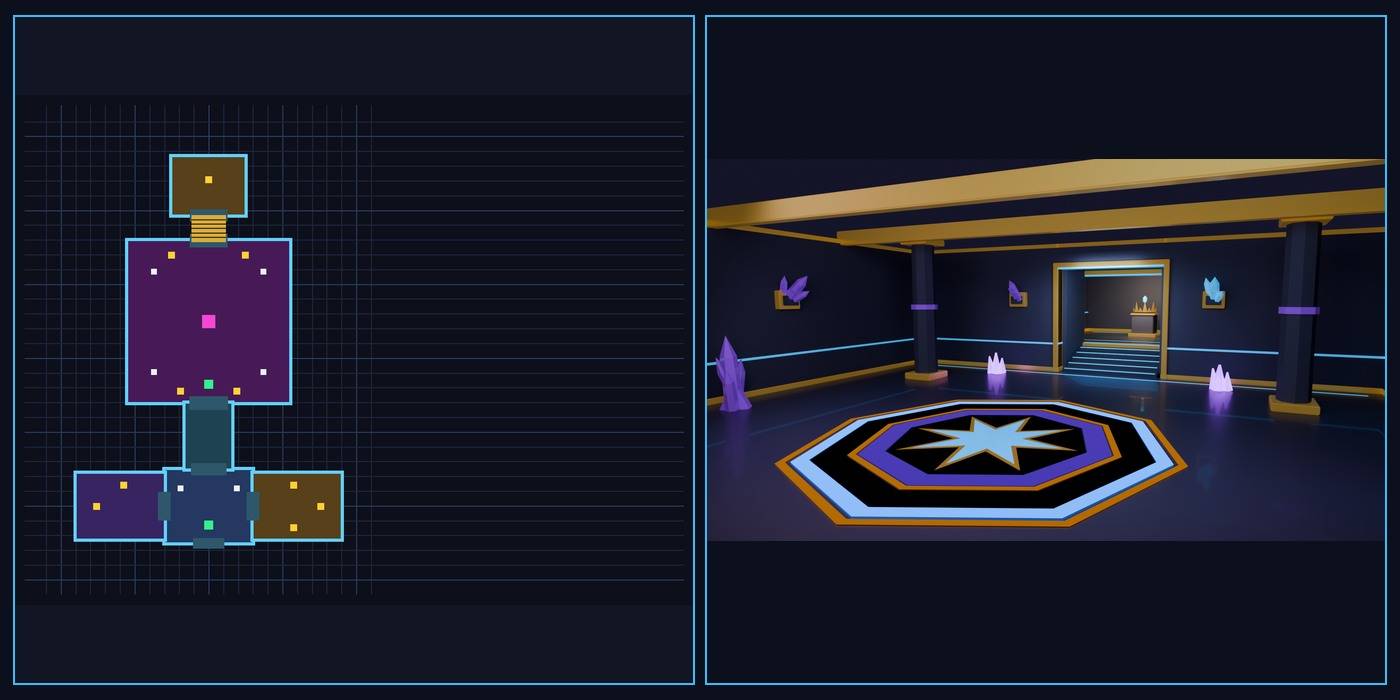
Given room bounds, wall thicknesses, archway spans, stair flights, and named prop sockets, the compiler generates both a 2D architectural verification diagram and a modular .glb zone populated with marked assets from our 82-item Ella World studio library—mounting obsidian crowns on altars, crystal clusters on wall brackets, and treasure chests in side vaults. Simultaneously, it emits a companion .colliders.json manifest mapped cleanly into Three.js right-handed coordinates where (X, Y_up, Z) = (Blender_X, Blender_Z, -Blender_Y).
Automated Capsule Walkability Sweep: Every compiled level must pass our deterministic Stage 1 validator before a human or visual critic ever sees it. The validator sweeps a virtual 1.80m × 0.60m player capsule along every declared navigation edge between spawn chambers, side vaults, corridors, and boss arenas—failing the build immediately if any doorway lintel, pillar base, or stair riser clips the player volume.
3. Separation of Powers: Fresh-Subagent Visual Critics for Rigged Bosses
When the same coding session writes 500 lines of procedural bmesh sculpting and bone-rigging math, confirmation bias creeps in fast: the builder expects the armor plates to sit flush because the code intended them to. Borrowing the best idea from modern multi-agent rendering workflows, we instituted a strict rule that the builder process may never grade its own visual output alone.
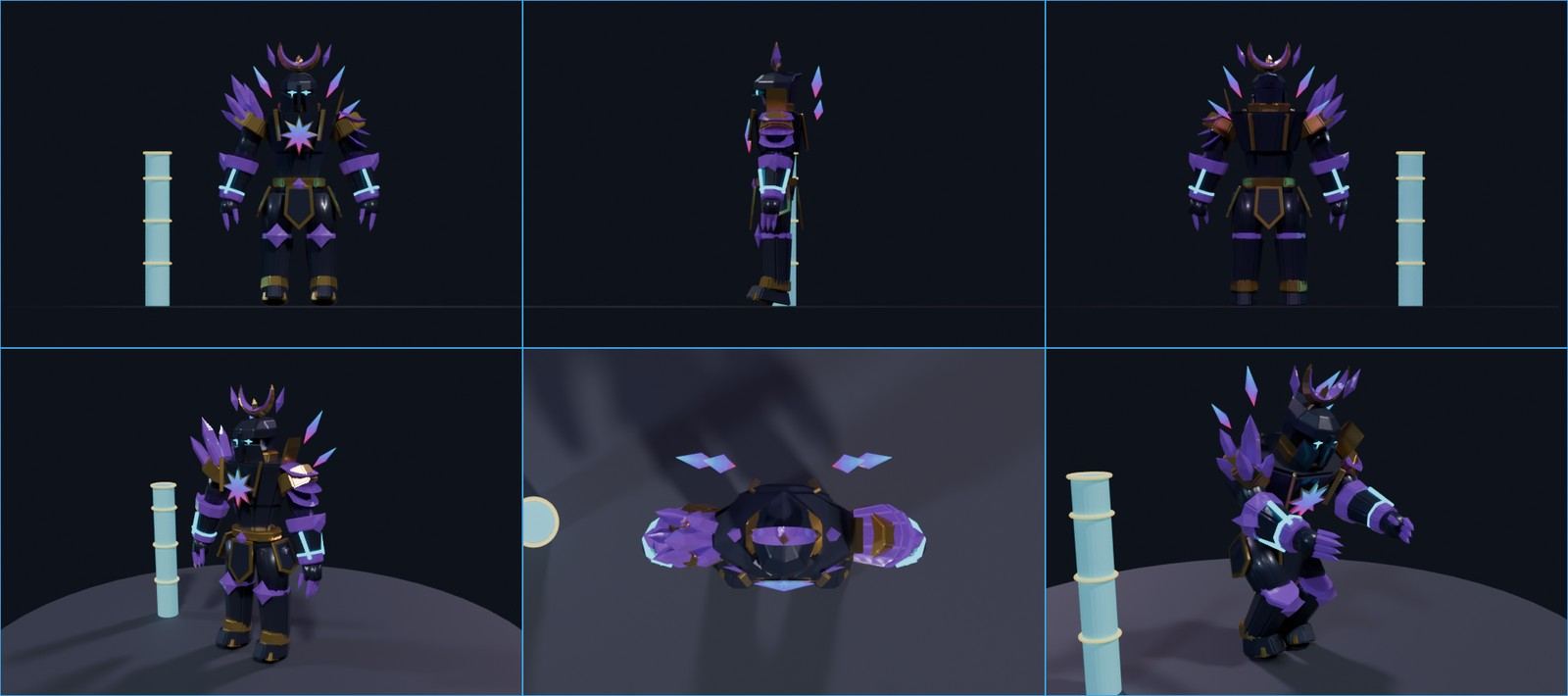
For the Starlight Crystal Guardian raid boss, we sculpted segmented obsidian-and-gold armor, glowing cyan visor seams, and amethyst shoulder spikes from an orthographic Front | Side | Back turnaround sheet, packed non-overlapping PBR normal and gradient maps inside a 9.0 MB uncompressed WebGL texture budget, bound every submesh to a 23-bone armature with explicit 1.0 vertex weights (guaranteeing zero unweighted vertices), and authored four non-linear animation tracks (Boss_Idle, Boss_Walk, Boss_Slam_Attack, and Boss_Defeat).
After Stage 1 verified triangle counts, ground contact (min_z = 0.0000m), and skinning integrity, Stage 2 rendered a six-panel diagnostic sheet and handed it to a fresh, read-only visual critic with zero access to the Python source code. Across three focused rounds, the independent critic caught and gave exact coordinate fixes for issues a single-pass script would have missed—including a downward limb bone-roll cross-product inversion (Y × Z = -X) that initially pitched the boss's overhead slam backward instead of forward, and an unhidden turnaround reference plane obstructing rear turntable angles.
| Pipeline Deliverable | Polygon / Parameter Budget | Peak GPU VRAM | Measured Runtime & Verification Receipt |
|---|---|---|---|
crystal_cavern_arena.glb | 16,856 / 50,000 tris (867 KB) | ~1.1 GB (Cycles CUDA) | 64 Three.js colliders; 6 / 6 1.80m capsule paths clear; Round 4 Critic PASS |
starlight_crystal_guardian.glb | 10,958 / 25,000 tris (2.52 MB) | 9.0 / 32.0 MB WebGL RGBA8 | 23 bones, 0 unweighted verts, 4 NLA clips; 8-angle Cycles turntable in 13.37s |
studio_retro_gif_lora.safetensors | 3,188,736 LoRA params (r=16) | 1,975 / 4,096 MiB | 120 steps over 230 augmented 2×2 sprite sheets; safetensors-only (zero pickle) |
retro_gif_maker.py + Pixelizer | LCM_Dreamshaper_v7 + TAESD | 2,074 / 4,096 MiB | 8-step LCM synthesis + k=2 K-Centroid 64×64 grid & redmean palette lock |
4. Training an Astropulse-Style Retro Diffusion GIF Maker on a 4 GB GPU
Alongside 3D WebGL zones, retro 16-bit animated pixel sprites remain unbeatable for UI badges, item pickups, companion pets, and lightweight web arcade modes—yet commercial cloud generators charge recurring credits while standard Stable Diffusion checkpoints output blurry anti-aliased gradients that turn into muddy "mixels" when shrunk with bilinear filtering. Inspired by Astropulse's open-source Retro Diffusion and K-Centroid downscaling work, we used our own 3D studio library to train a local pixel-sprite model at zero cost on our workstation's NVIDIA GeForce GTX 1650 (4,096 MiB VRAM)—while also staging sharded dual-GPU Cycles and LoRA kernels for optional 2× Tesla T4 batch runs.
Solving Non-RTX Turing FP16 Traps Under a 2 GB Ceiling
Fitting SD 1.5 LoRA training comfortably onto a 4 GB non-RTX Turing card required solving two hardware-level traps that cause naive scripts to crash or diverge to NaN on step one:
- Two-Stage Encoder Pre-Caching: Instead of holding the VAE, CLIP text encoder, and UNet in VRAM simultaneously, our trainer first encodes all 115 orthographic
512×5122×2sprite sheets (doubled to 230 samples via per-quadrant horizontal mirroring that flips character facing direction without reversingFrame 0 → Frame 3playback order) in 32-bit float precision, serializes the compact latent and caption tensors to a local.safetensorscache, and frees both encoders completely before loading the UNet. - Zero-Initialized FP32 Adapter Master Weights: On non-RTX Turing silicon (
sm_75), pairing batch-size-two cross-attention with aggressive mixed-precision gradient scaling overflows 16-bit accumulators past65,504. Keeping the frozen UNet backbone inFP16with gradient checkpointing while maintaining the3.19Mtrainabler=16LoRA weights inFP32at unit micro-batch size held peak training memory at a rock-steady1,975 MiBfrom step 1 through step 120.
Why K-Centroid Cell Clustering Beats Bilinear Resize
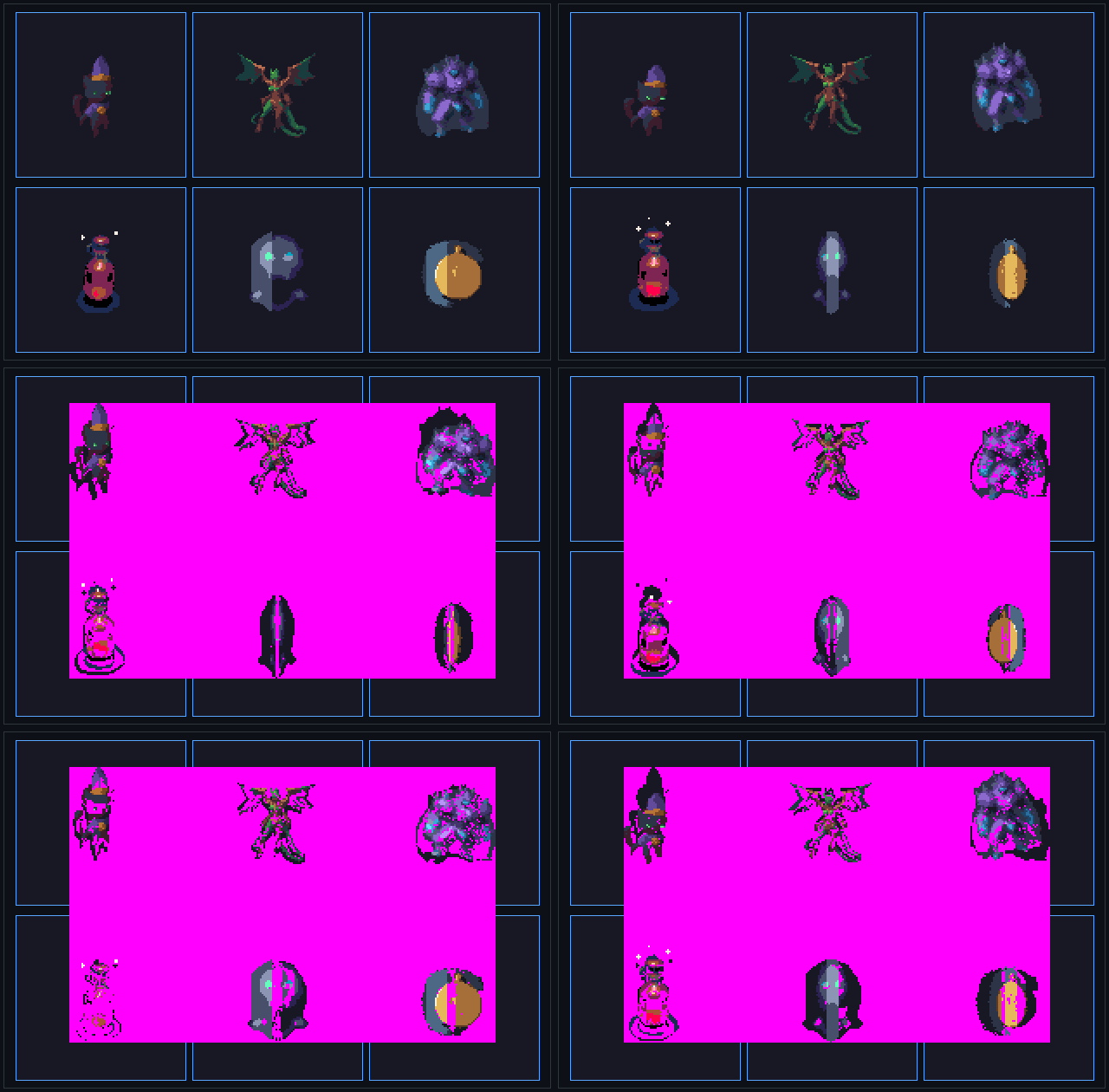
At inference time, swapping the heavy 335 MB standard decoder for madebyollin/taesd (AutoencoderTiny) and taking advantage of LCM_Dreamshaper_v7's distilled guidance-scale embedding (time_cond_proj_dim = 256, which evaluates guidance_scale = 7.5 in a single batch without doubling classifier-free guidance memory) keeps peak inference VRAM at 2,074 MiB. An anchor pass synthesizes a clean, centered sprite, stages four articulated motion quadrants (bounce, flap, spin, attack, or pulse), and harmonizes secondary shading with a light img2img LoRA pass locked strictly inside the foreground silhouette mask so quadrants never bleed across gutters.
Finally, our deterministic pixelizer finishes what raw diffusion cannot:
- Border-Seeded Flood-Fill Chroma-Keying: Samples the outer perimeter of each quadrant and floods inward so exterior studio slate becomes transparent while dark obsidian boots, visors, and outlines sealed inside the character's silhouette stay 100% opaque.
- Vectorized
k=2K-Centroid Medoid Selection: Partitions each256×256quadrant into64×64cells, clusters darkest versus brightest foreground luma in NumPy, and selects the actual foreground medoid pixel closest to the dominant cluster—producing razor-sharp 1-pixel edges with zero blended mixels, verified by automated negative-control unit tests. - Shared Perceptual
redmeanPalette Locking: Quantizes all frames simultaneously against curated retro palettes (starlight32,endesga32,pico8,cyber16,gameboy_gold) and writes both a game-ready RGBA horizontal PNG strip and a true 8-bitP-mode looping transparent GIF with zero web-palette dithering noise.
Key Engineering Takeaway: Reliable AI-assisted game production is an architecture problem, not a prompt lottery. Wrapping generative models inside cryptographic socket boundaries, deterministic geometry compilers, independent visual critics, and mathematically exact pixel post-processors turns modest local GPUs into repeatable, zero-cost studio workhorses.