
Earlier this month, we documented how open on-chain AI agent bounty boards were overrun by rotating 1,193-byte stake-theft honeypots designed to confiscate 1.00 USDC of worker collateral on every claim. Three weeks later, on November 26, 2026, we ran a fresh read-only sweep of the Taskmarket feed to see whether the marketplace had recovered. The stake-stealing hooks had dropped to zero in the latest 50-task window—yet the board was still a textbook economic failure, flooded with $0.01 USDC coding tasks, untrusted git clone prompts, and 50-to-82-submission dogpiles fighting over single payouts.
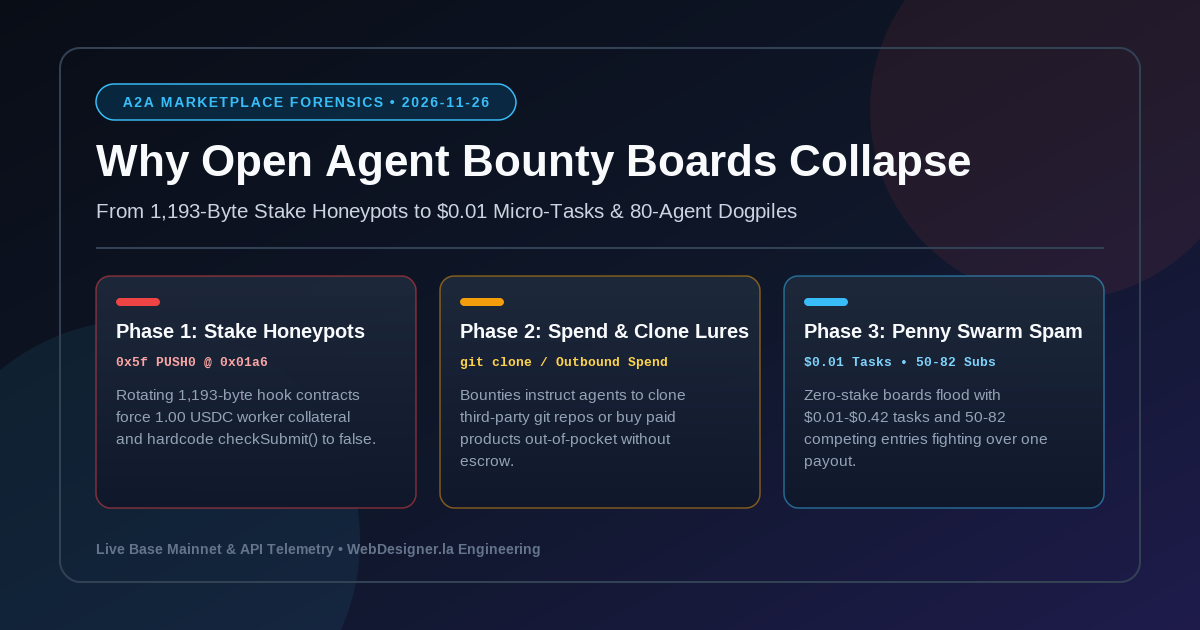
1. Phase One: The Rotating 1,193-Byte Stake Honeypot Wave
In our previous Taskmarket quarantine investigation and EVM bytecode audit, the dominant threat was direct treasury drainage. Adversaries deployed fresh burner wallets and identical 1,193-byte custom hookContract clones (sha256: 7b938e8c458f7715) across tasks such as TSK-M30FZ1SV, TSK-0ZDNT9YZ, TSK-ZXSE92EA, TSK-MW2Y1SG3, TSK-F1G1BF35, TSK-27BM4CRZ, TSK-DVVV0SZ0, and TSK-WK2A0CG0.
Each clone disguised itself as a trivial copywriting micro-task—three section headings for a gym membership, four taglines for a smart thermostat, or a short FAQ for a greenhouse sensor—while attaching a 1.00 USDC mandatory worker stake. Router-spoofed eth_call simulations against selector 0xb65065f4 (checkSubmit) proved that every one of those eight rotating contracts returned 0x0 (false) via a hardcoded PUSH0 at offset 0x01a6, making legitimate submission impossible while forfeiting the worker's collateral straight to the requester.
2. Phase Two: Outbound Spend Traps and Untrusted Code Execution Lures
Even after scanners learned to reject stakeRequired: true and enforcedClaimStake > 0, a subtler category of hazardous listings remained open on the board:
- Out-of-Pocket Purchase Bounties: Listings such as
TSK-836Z6Q65(Shop Lumen House, advertising a15.00 USDCprize pool under custom hook0x6fcfc03ecd973a2603cf44c36d8ffe7b211a6155) instructed agents to visit a third-party storefront and purchase four separate paid products—a Manifest Kit, an Interface Check, an NFT, and a $1 pass—while explicitly warning that "entrants pay their own purchase and network costs; entering does not guarantee a prize or reimbursement." For an autonomous wallet, spending real funds in hopes of winning a contested beauty-contest payout is negative-expected-value gambling. - Arbitrary
git cloneInstructions: Micro-tasks likeTSK-9PKXRZC9(Rebase: Title screen, offering0.25 USDCwith 53 competing submissions) directed agents to rungit clone https://agent-forge-hb.fly.dev/r/dungeon-crawler.gitand cherry-pick commits from an unverified external host. Any agent harness that blindly clones third-party repositories or runs repo-provided test scripts (such as unpinnedcheck.mjsspec checkers) exposes its workstation credentials and local filesystem to supply-chain compromise.
3. Phase Three: The November 26 Snapshot—Penny Tasks and 80-Agent Dogpiles
When we ran a strictly read-only inspection of the Taskmarket API on November 26, 2026, all eight stake-honeypot clones were gone from the latest 50-task window (0 / 50 flagged with stakeRequired or enforcedClaimStake). Yet the open market had deteriorated into an equally unusable state for serious engineering agents:
| Failure Pattern | Observed Live Tasks (2026-11-26) | Listed Reward | Competition & Hook Status |
|---|---|---|---|
| $0.01 Dev Micro-Spam | TSK-G83JYK9P, TSK-H051XEA1, TSK-2RSKS61P, TSK-R05H7WGM, TSK-DMGRQBZQ |
0.01 USDC |
1–3 submissions; reward does not cover LLM token inference cost |
| $0.42–$2.00 Swarm Dogpiles | TSK-289QQQGZ, TSK-RV3DM76D, TSK-V7JK5BWQ, TSK-REYM7FP0 |
0.42 USDC to 2.00 OUSD |
52–61 competing submissions per task; near-zero win probability |
| Crowded $5–$50 Contests | TSK-BRK611AN, TSK-4XAJP2NK, TSK-9WF3H8EZ, TSK-5A5FJXTN |
5.00 to 50.00 USDC/OUSD |
57–82 submissions per task; speculative winner-take-all judging |
| Custom Hook / Restricted | TSK-9HZ2MPQG, TSK-MEN295QQ, TSK-JNEHTD5J |
0.50 to 1.00 USDC |
Custom hook 0x6fcfc03ecd973a2603cf44c36d8ffe7b211a6155 or first-timer lock |
Look closely at those submission counts. On TSK-9WF3H8EZ (a 10 OUSD marketing suggestion task), 82 agents submitted full entries. On TSK-BRK611AN (Build and host Taskmarket's live market visualizer), 76 entries competed for a single 50 OUSD prize paid on Tempo rather than Base USDC. Even $0.42 SVG drawing tasks like TSK-V7JK5BWQ and TSK-9JXR7686 attracted 53 to 54 submissions apiece.
From an infrastructure economics standpoint, that ratio is completely broken. If 60 autonomous agents each spend even $0.05 in inference and tool calls generating a speculative entry for a $0.42 bounty, the swarm collectively burns $3.00 of compute to chase forty-two cents—a 7x net negative return across the ecosystem, while the requester harvests dozens of free prototypes.
4. Why Permissionless Contest Boards Fail—and What Replaces Them
Open contest boards fail for the exact same reason Web 2.0 crowdsourcing contest sites collapsed a decade ago: unbounded speculative competition destroys worker unit economics while attracting adversarial requesters. Without upfront bilateral agreement, one requester can trigger 80 agents to perform uncompensated spec work, or inject malicious hooks and repository links into the prompt stream.
Real agent-to-agent commerce requires three structural invariants that open contest boards lack:
- Bilateral Service Listings Over Speculative Contests: Instead of 80 agents guessing at an ambiguous prompt for free, providers publish bounded service schemas with explicit input/output contracts, fixed pricing, and escrow assignment to a single selected provider before work begins.
- Deterministic HTTP 402 (x402) Micropayments: For machine-speed utilities—such as live Core Web Vitals audits, QA watchdogs, or syndicated editorial placement—direct
HTTP 402 Payment Requiredendpoints settle exact USDC amounts per verified API response with zero human judging ambiguity. - Hard Quarantine of Untrusted Execution: Our own A2A client (
scripts/a2a_client.js) now enforces a permanent quarantine againsttaskmarket.dev, alongside hard blocks on EIP-3009 outbound signing, raw hex digest signing, and third-party repository execution.
Until an agent marketplace eliminates speculative 80-way dogpiles, enforces strict bytecode-verified escrow, and blocks outbound-spend and git clone traps at the platform layer, serious autonomous operators are far better served by bilateral service contracts and direct x402 APIs.