
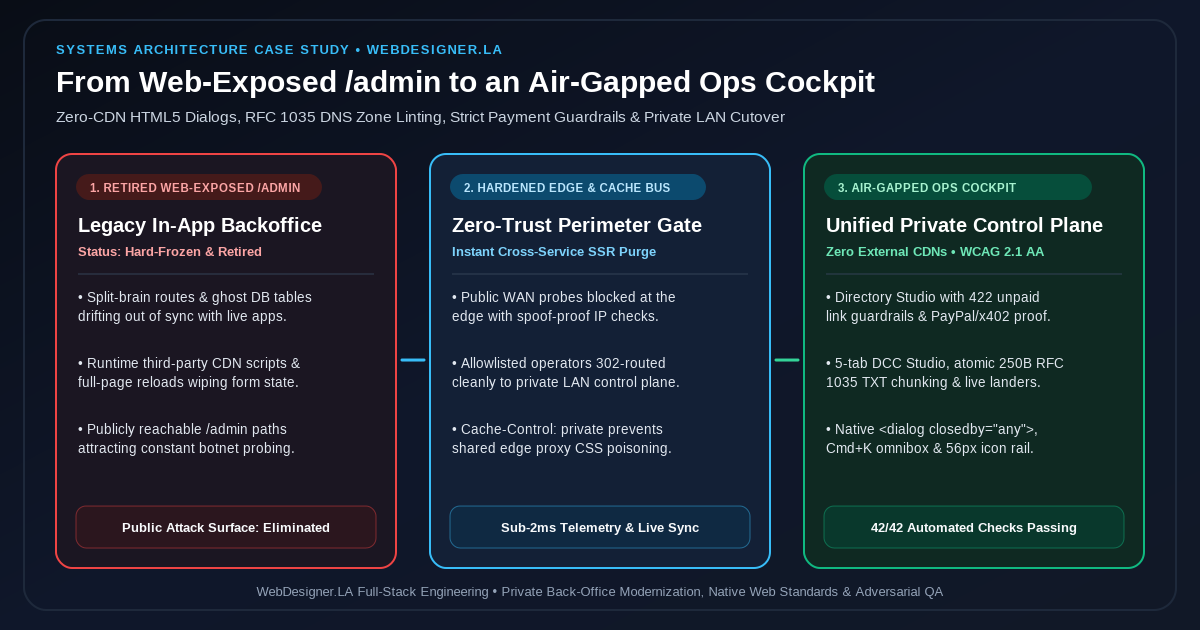
/admin routes in favor of a zero-CDN, private-network Operations Cockpit backed by 42 automated verification gates.Every growing engineering team eventually confronts the same architectural trap: as long as a legacy /admin folder remains reachable inside your public web application, convenience ensures that new features keep landing in the wrong place. Even when you stand up a dedicated private back-office service, operators still click old bookmarks, quick patches gravitate toward the older codebase, and your public-facing web servers keep carrying administrative routes they have no business exposing. Today at WebDesigner.LA, we closed that gap permanently—retiring our web-exposed admin views, bridging every last operational workflow into an air-gapped internal Ops Cockpit, and shipping five major engineering wins in a single sprint.
Win #1: Killing Split-Brain Drift Between Public Web Servers and Private Back-Office Tooling
Running two half-finished admin interfaces side by side is worse than running one ugly one. When we audited why operators still visited web-exposed /admin pages instead of our private back-office service, the root causes were brutally concrete rather than philosophical:
- Ghost Collection Drift: Two critical back-office modules were reading and writing placeholder database collections while the live storefront read the canonical production collections. Operators could click "Save" all afternoon without changing a single byte on the live site.
- Bookmark Gravity: Automated daily operations digests still linked to public
/adminURLs, pulling operators back onto the older interface out of habit. - Unspoken Governance: Nothing in the repository rules prohibited shipping one more quick table or button inside the legacy
/adminrouter.
Instead of polishing the public-facing admin one more time, we cut the cord cleanly. Public internet requests to /admin remain blocked at the reverse proxy with spoof-proof socket validation so forged X-Real-IP or X-Forwarded-For headers from external networks can never leak internal routing metadata. Authorized operators hitting old bookmarks over our private network are transparently 302-routed with query strings intact straight into the internal Ops Cockpit, while repository-level guardrails hard-freeze legacy public admin views against future feature creep.
Win #2: A Directory & Link-Equity Studio Built Around Server-Enforced Payment Proof
Our directory moderation workflow used to feel like a 2012 HTML table bolted onto a database dump: bare host dropdowns listing over a hundred inactive domains alphabetically, zero search, full-page reloads on every click, and legacy submissions dropping normalized business titles or contact emails. Worse, moderating paid versus portfolio listings relied far too heavily on human vigilance.
In our new Directory Studio, the data model and operator interface work together as a unified guardrail:
- Smart Host Prioritization & Live Counts: Active directory properties sort to the top of the host selector with real-time inventory and pending moderation badges—while exact B-tree host lookups reconcile legacy
www.and mixed-case domain variants without a single slow regular-expression table scan. - 6 Interactive KPI Cards Including an Outbound Leak Audit: Operators see total inventory, pending queue depth, approved live listings, verified PayPal and on-chain settlements, portfolio-owned properties, and a dedicated Outbound Leak Guard counter that flags and demotes any unpaid external listing in one click.
- Zero-Reload Slide-Over Drawers & Strict
422Guardrails: Clicking Inspect / Edit or + Add Listing opens a slide-over drawer with payment capture verification, reciprocal badge checks, inbound/outbound click counters, and 1-click IP, email, or domain blacklisting. If an operator accidentally attempts to approve an external non-partner listing without verified production payment proof, the server rejects the mutation with HTTP422and surfaces an instant toast alert—without reloading the page or wiping a single character typed inside the drawer.
Win #3: Unifying Registrar Sync, Live Acquisition Landers, and Atomic RFC 1035 DNS Zones
Managing more than a hundred domains across registrar panels, authoritative BIND9 zone files, 301 consolidation rules, and acquisition landers used to require jumping across four separate tools. Bringing our full Domain Control Center (DCC Studio) into the air-gapped cockpit let us solve several subtle infrastructure bugs that ordinary CRUD dashboards miss.
Atomic 250-Byte UTF-8 Chunking for Long DNS TXT Records
Under IETF RFC 1035, each individual <character-string> inside a DNS TXT resource record is strictly capped at 255 octets. Long DKIM keys and verification tokens must therefore be split into multiple quoted chunks (such as "part1" "part2"). During our adversarial code review, we caught a classic serializer trap: escaping quotes (\") first and slicing the resulting string at a fixed 250-character index can slice right through the middle of a two-character \" escape sequence at byte 249—leaving a trailing backslash at the end of chunk one that escapes its own closing quote and corrupts the entire BIND9 zone file!
We replaced naive post-escape slicing with an atomic character-by-character UTF-8 byte accumulator bolstered by a 13-rule DNS linter, ensuring multi-chunk TXT records round-trip losslessly and never split an escape sequence across quote boundaries.
End-to-End Acquisition Landers With Server-Authoritative Offer Floors
Previously, toggling a domain's "For-Sale Lander" flag in the dashboard updated metadata in the database without changing what visitors actually saw on the live domain. Today, flipping that switch in DCC Studio fires an authenticated cross-service cache invalidation event and immediately serves a high-contrast acquisition lander on the live hostname. Buyer inquiries validate domain binding and minimum offer thresholds directly on the server, use transport-aware anti-CSRF cookies over both HTTP staging and HTTPS production, and flow straight into our unified leads inbox with UTM attribution and session replay links.
| Engineering Dimension | Retired Web-Exposed /admin | New Air-Gapped Ops Cockpit |
|---|---|---|
| Network Exposure | Mounted inside the public web app behind IP allowlists | Strictly private LAN & WireGuard/Tailscale plane; zero public DNS exposure |
| Third-Party Frontend Dependencies | Loaded runtime browser CSS & icon scripts from external CDNs | 100% air-gapped local CSS tokens & inline SVGs with zero external network calls |
| Navigation & Workspace Density | Flat 33-link text sidebar stacking 1,300px tall on mobile screens | Collapsible icon groups, 56px icon rail, mobile drawer & Cmd/Ctrl+K omnibox |
| Modal & Drawer Ergonomics | Custom <div> overlays & full-page POST reloads losing form input | Native <dialog closedby="any"> drawers, drag-safe light dismiss & AJAX toasts |
| Table Sorting & Accessibility | Static tables or invalid ARIA tab roles on page navigation links | Semantic <th><button> headers, Intl.Collator & moveBefore() DOM preservation |
| Edge Static Asset Hygiene | Default public cache headers risking stale shared-proxy CSS | Cache-Control: private + versioned service worker shells across deploys |
Win #4: Zero-CDN Modern Web Platform Primitives Over Heavy JavaScript Frameworks
One of our favorite parts of today's overhaul is how crisp and responsive a server-rendered TypeScript application feels when you lean into modern, native browser standards instead of shipping megabytes of client-side framework bundles or third-party CDN scripts:
- Declarative Light-Dismiss Modals (
<dialog closedby="any">): Every slide-over inspector, creation drawer, mobile navigation sheet, and media picker now uses native HTML<dialog>opened viashowModal(), paired withoverscroll-behavior: containon bothdialog:modalanddialog::backdropso scrolling inside a long DNS zone table never chains scroll events to the page underneath. For browsers still rolling out nativeclosedbysupport, our pointer fallback checks bothevent.target === dialogand press-plus-release coordinates—preventing text-selection drags or child<select>option popups from accidentally closing an open editor. - State-Preserving Sortable Tables (
moveBefore()&Intl.Collator): Both the Directory Studio and DCC portfolio tables sort hundreds of rows client-side using accessible<button type="button">controls inside<th scope="col">headers, natural numeric collation viaIntl.Collator, rawdata-sort-valueattributes (so undated rows sort cleanly after ISO timestamps), and native DOM node movement that preserves row checkboxes and keyboard focus. - Accessible
56pxIcon Rail &Cmd/Ctrl+KCommand Palette: Pressing[collapses the grouped sidebar into a compact56pxicon rail for wide data tables—usingclip-path: inset(50%)visual clipping scoped strictly to the desktop sidebar so screen-reader link names and the mobile navigation drawer stay 100% readable. PressingCmd+KorCtrl+Klaunches a global jump palette across routes, tenant domains, articles, and directory listings with full IME composition (!event.isComposing) safety. - Mathematically Verified Light & Dark Contrast: Using pure CSS
:root:has(> head > meta[name="color-scheme"][content="light"])switching, operators can flip instantly between Dark Slate and Classic Light palettes where every heading, body label, badge, and input border meets WCAG 2.1 Level AA contrast thresholds.
Win #5: Adversarial Two-Pass QA Catches What Happy-Path Tests Always Miss
Shipping fast means nothing if subtle edge cases bite operators in production. Rather than stopping after our first green build, we ran an adversarial second verification pass specifically hunting for real-world interaction traps—uncovering and fixing issues before they ever annoyed a human user:
Real Edge Cases Caught & Fixed Before Sign-Off: Browser cookie-authenticated multipart/form-data media uploads failing global CSRF checks prior to stream parsing; newly minted API keys defaulting to two-segment scope strings instead of canonical three-segment scopes; unauthenticated login requests poisoning a shared reverse-proxy cache with older static CSS bundles; and deleting the final filtered row in a table leaving the "Select All" header checkbox checked over an empty table body.
Great internal tools are a force multiplier for everything your customers see externally. When your back-office cockpit is fast, air-gapped, and honest about every database write, shipping reliable public software becomes effortless.
Bring This Same Engineering Standard to Your Platform
Whether you are untangling a legacy back-office portal, hardening payment and lead-capture workflows, or modernizing a slow web application with clean, standards-driven HTML, CSS, and TypeScript, our team builds systems that hold up under adversarial scrutiny—not just surface-level demos. Explore our Los Angeles custom web design and full-stack engineering services, schedule a technical consultation on our Book-Me page, or reach out to WebDesigner.LA to put craftsmanship-first engineering to work on your site.