
If you have ever posted an article or product launch on X (Twitter), Facebook, Instagram, or LinkedIn and wondered why almost none of your own followers saw it, the reason is simple: traditional social networks are walled gardens that penalize outbound links to keep people scrolling inside their app. Over the past few years, two open protocols—the Fediverse and Nostr—have quietly flipped that model upside down. Instead of renting an audience inside one corporation's database, they let your own website domain become your social handle, your verified checkmark, and your direct broadcasting station.
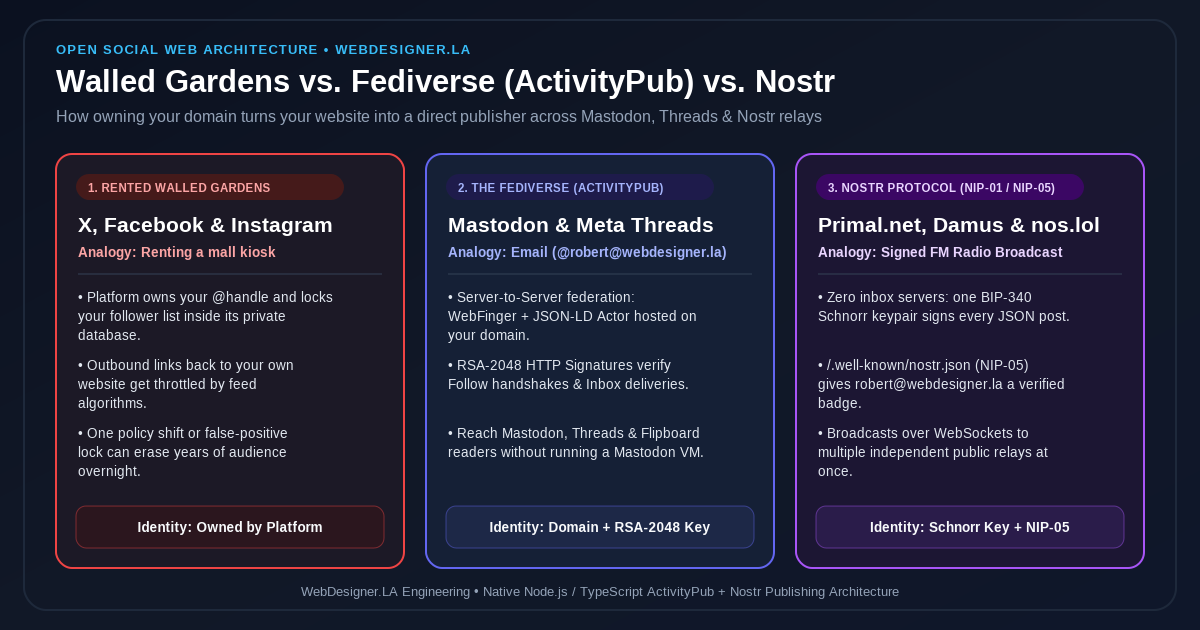
1. Why Traditional Social Networks Feel Like Renting a Mall Kiosk
When you open an account on Facebook, Instagram, or X, you do not actually own your username or your follower list. You are renting a booth inside a private shopping mall:
- You cannot export your followers: If you spend five years building 25,000 followers and an automated moderation filter locks your page, you cannot move those followers to another app.
- Links to your own website get buried: Feed algorithms routinely suppress posts containing external URLs because every click to your site means one less ad impression inside their app.
- Verification is a monthly subscription: Instead of proving who you are through the domain name you already own, platforms charge recurring fees for a badge.
Both the Fediverse and Nostr were invented so businesses, creators, and engineers never have to face that trap again—yet the two systems work in completely different ways under the hood.
2. What Is the Fediverse? (Think of It Like Email for Social Posts)
The word Fediverse combines federated and universe. Instead of one giant company running one giant server, thousands of independent websites and apps speak a shared open standard published by the World Wide Web Consortium (W3C) in 2018 called ActivityPub.
The easiest way to understand the Fediverse is email. If your email address is info@webdesigner.la, you can send a message to someone using @gmail.com, someone at @outlook.com, or someone running their own company mail server. Nobody thinks twice about it because every mail server speaks SMTP.
Plain-English Rule of Thumb: In the Fediverse, every handle has two parts—a username and a domain—such as @robert@webdesigner.la. Anyone on Mastodon, Meta Threads (with Fediverse sharing enabled), Pixelfed (an Instagram-style photo app), or Flipboard can type @robert@webdesigner.la into their search bar, click Follow, and receive our new engineering posts directly inside their chronological home feed.
Wait—Do You Have to Run a Heavy Mastodon Server?
No, and this is the part most people miss. Running a full Mastodon server for thousands of strangers requires background queues, PostgreSQL, Redis, and moderation overhead. Turning your own existing website into a single-brand Fediverse publisher takes just four lightweight endpoints:
- WebFinger Lookup (
/.well-known/webfinger): When someone searches@robert@webdesigner.laon Mastodon or Threads, their server asks our domain where our profile lives. - Actor Profile JSON (
/api/a2a/activitypub/actor): Returns our display name, bio, avatar, inbox URL, and our publicRSA-2048cryptographic key. - Inbox Handshake (
/api/a2a/activitypub/inbox): When a reader clicks Follow, their server sends a signedFollowrequest to our inbox. Our server stores their inbox URL in SQLite and sends back a cryptographically signedAcceptreceipt. - Signed Outbox Push: Whenever we publish a new case study or video showcase, our Node.js server wraps the post in a JSON-LD
Createactivity, signs the HTTP headers with ourRSA-2048private key, and delivers it straight to our followers' servers—zero algorithmic throttling.
3. What Is Nostr? (Think of It Like Signed FM Radio Across Independent Towers)
While the Fediverse works like email between servers, Nostr—short for Notes and Other Stuff Transmitted by Relays—strips social networking down to something even simpler. There are no accounts to register, no central database, and no server-to-server inbox queues.
In Nostr, there are only two moving parts:
- Your Cryptographic Keypair (Your Identity): You have a private signing key (kept secret) and a public key starting with
npub1...(shared publicly). Every profile bio (kind: 0) and every short post or video share (kind: 1) is just a tiny JSON object signed with a BIP-340 Schnorr signature—the exact same elliptic-curve math used by Bitcoin. - Relays (Dumb Broadcast Towers): Relays are simple WebSocket servers (such as
wss://relay.primal.net,wss://nos.lol, andwss://relay.damus.io). When we publish an article, our server opens a two-second WebSocket connection and pushes the signed JSON note to three or four relays at once.
Everyday users read and reply using slick web and mobile apps like Primal.net (web, iOS, Android), Damus (iOS), or Amethyst (Android). Because your identity is your mathematical key—not a relay—if one relay goes offline tomorrow, your followers still read your posts seamlessly from the other relays.
How Domain Verification Works on Nostr (NIP-05)
Nobody wants to memorize a 63-character public key like npub1zp6z2lhd6.... Nostr solves this with a tiny specification called NIP-05. By serving a ten-line JSON file at https://webdesigner.la/.well-known/nostr.json?name=robert that maps robert to our public key, apps like Primal and Damus automatically display a verified badge for robert@webdesigner.la—for free, forever, proved by DNS and HTTPS.
{
  "names": {
    "robert": "1074257eedd00b1e77f91efa46f41e81c8412fcf1b521a2a25b99069d9cdf64a"
  },
  "relays": {
    "1074257eedd00b1e77f91efa46f41e81c8412fcf1b521a2a25b99069d9cdf64a": [
      "wss://relay.primal.net",
      "wss://relay.damus.io",
      "wss://nos.lol"
    ]
  }
}
4. Side-by-Side Comparison: Big Tech vs. Fediverse vs. Nostr
If you are deciding whether either protocol makes sense for your company, software product, or media brand, here is how all three architectures stack up in practice:
| Feature | Big Tech Walled Gardens (X, Meta, LinkedIn) | The Fediverse (W3C ActivityPub) | Nostr Protocol (NIP-01 / NIP-05) |
|---|---|---|---|
| Everyday Analogy | Renting a booth in one private mall | Email between independent domains | Signed radio broadcast to public towers |
| What Your Handle Looks Like | @brand (owned by platform) | @robert@webdesigner.la | robert@webdesigner.la (via NIP-05) |
| Popular Apps People Use | X, Facebook, Instagram, LinkedIn | Mastodon, Meta Threads, Pixelfed, Flipboard | Primal.net, Damus, Amethyst, Coracle |
| Link Throttling? | Heavy algorithmic suppression of external links | Zero — chronological delivery to followers | Zero — raw chronological & topic feeds |
| Cryptographic Standard | None (centralized session cookies) | RSA-2048 HTTP Signatures | secp256k1 BIP-340 Schnorr Signatures |
| What Happens If One Server Dies? | Platform outage takes everyone offline | Your domain stays sovereign; remote server queues retry | Other relays keep serving your exact same npub feed |
5. How We Wired Both Into Our Node.js CMS—And Why Selective Scoping Matters
Here at WebDesigner.LA, we built native hexagonal social adapters for both W3C ActivityPub and Nostr directly into our multi-tenant Node.js and TypeScript publishing platform without adding any third-party daemon bloat:
- Zero Extra Containers: Node's built-in
cryptoandnode:sqlitemodules manage persistentRSA-2048keypairs, verify incoming Mastodon and Threads HTTP Signatures, protect against private-subnet SSRF callbacks, and store follower inboxes cleanly on NVMe disk. - Native 1080p Video Previews on Nostr (
NIP-92): When we broadcast a 3D WebGL or full-stack video showcase—such as our ArchitecturalNumbers.com 3D SignBuilder 2.0 case study—our Nostr adapter attachesimetavideo dimensions and poster metadata so Primal and Damus render an instant inline video player right inside the feed. - Selective Brand Isolation: Not every website belongs on developer-heavy open networks. Open protocols thrive on genuine software, cloud hosting, security research, and creator brands—while local consumer service websites (such as neighborhood legal clinics or consumer finance portals) should stay focused strictly on human searchers without exposing unnecessary federation endpoints.
6. See It Live in Your Browser Right Now
You do not need to install an app or create an account to see how open-web publishing looks in the wild:
- View Our Live Nostr Profile on Primal.net: primal.net/p/npub1zp6z2lhd6... (verified via
robert@webdesigner.la) - Follow Us from Mastodon or Threads: Search
@robert@webdesigner.lafrom any Mastodon server or Fediverse-enabled Threads account to follow our engineering releases directly.
Want your company website, SaaS product, or media publication to own its audience across both mainstream social channels and the open web—without slowing down your site by a single millisecond? Contact our Los Angeles engineering team at WebDesigner.LA to build a fast, sovereign publishing stack tailored to your brand.