
When engineering e-commerce systems, the industry conversation typically orbits around two standard monoliths: Shopify and WooCommerce. Yet when operating a proprietary portfolio spanning dozens of distinct brand properties, local directories, and vertical storefronts, off-the-shelf platforms present steep structural limitations. Here is a technical, under-the-hood comparison of how Shopify, WooCommerce, and our custom multiDomainCMS engine handle rendering, data persistence, multi-tenancy, and edge delivery.
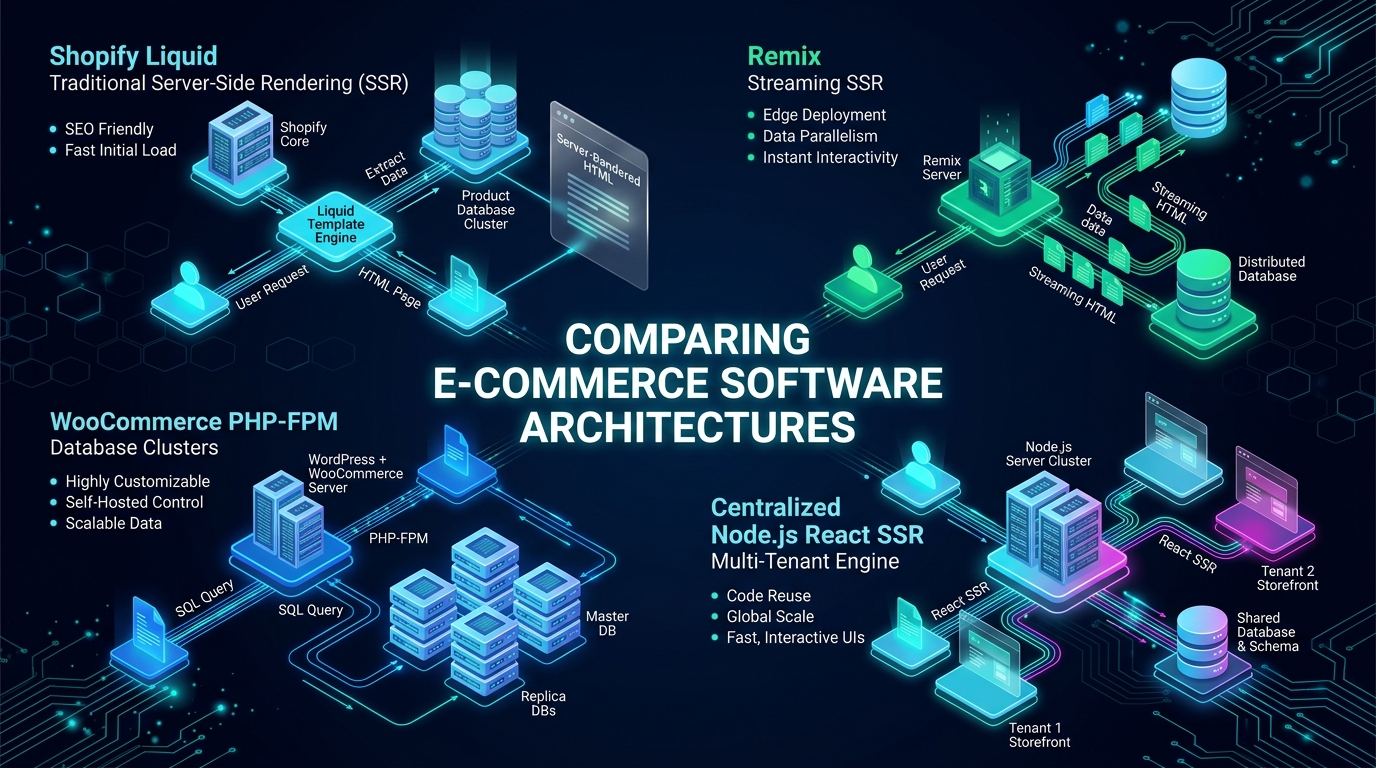
1. The Rendering Model: Why E-Commerce Demands SSR Over Pure SPAs
A recurring question in modern web architecture is whether storefronts should be single-page applications (SPAs) or server-side rendered (SSR). Across all three platforms, the consensus is clear: e-commerce demands SSR.
- Shopify (Edge Liquid & Hydrogen Remix): Shopify compiles Liquid templates into raw HTML directly at the CDN edge (Cloudflare/Fastly). For modern headless configurations, Shopify built Hydrogen, opting specifically for streaming server-side rendering on Remix rather than a client-side SPA.
- WooCommerce (Classic PHP-FPM SSR): WooCommerce executes PHP-FPM scripts against MariaDB/MySQL per HTTP request, generating a complete server-rendered document on every page view.
- multiDomainCMS (V8 React MVC SSR): Our platform executes React components in Node.js 26 via
renderToStaticMarkupinside an Express router pipeline. It delivers complete semantic HTML in the initial round-trip with zero client hydration overhead for static views.
Why do all three reject pure client-side SPAs? Because search crawlers (Googlebot, Bingbot), Google Shopping feeds, and social graph scrapers (OpenGraph, Twitter Cards) require immediate DOM hydration. Client-side SPAs force crawlers through a headless browser queue, delaying indexing and severely degrading Largest Contentful Paint (LCP) on mobile connections.
2. Multi-Tenancy & Portfolio Orchestration: 1 vs. 130 Instances
The starkest architectural divide emerges when scaling beyond a single storefront to a portfolio of 100+ domains:
- Shopify: Highly siloed. Running 130 domains requires 130 distinct store tenants, 130 monthly subscription tiers, isolated administration dashboards, and strict rate limits (typically 40 requests per second across Storefront and Admin GraphQL APIs). Synchronizing global schemas or executing cross-domain deployments requires external orchestration middleware.
- WooCommerce: Highly fragmented. Portfolio operations force engineers into either running 130 isolated WordPress installations (demanding massive RAM overhead for 130 PHP-FPM pools and Apache/Nginx vhosts) or running WordPress Multisite (which bloats MySQL schemas with repetitive
wp_1_posts,wp_2_poststables that degrade query caching). - multiDomainCMS: Unified multi-tenant microservice. A single Node.js cluster handles inbound traffic for 130+ domains. Domain resolution occurs via a lightweight host-header dispatcher middleware, routing requests to domain-scoped React MVC templates (
src/views/<domain>/) and unified data collections. Memory usage across the entire cluster remains under 200MB of RAM.
3. Data Layer & Schema Design: Relational EAV vs. Document Persistence
How catalog data is stored and fetched defines query latency under heavy concurrency:
- WooCommerce (MySQL EAV Antipattern): Product variations, attributes, stock status, and custom fields are stored in the
wp_postmetatable using the Entity-Attribute-Value pattern. Fetching a single product with 10 custom attributes requires 10 relational table joins or repeated key-value lookups, leading to slow database query times without Redis object caching. - Shopify (Proprietary Abstracted Store): Data persistence is completely abstracted behind proprietary APIs. While highly reliable, developers have zero direct SQL/NoSQL query access, and complex reporting requires slow batch ETL exports.
- multiDomainCMS (MongoDB + Bijective JSON Flat Shards): Products, categories, and articles are stored as clean JSON documents with native arrays for images, tags, and category hierarchies. Read operations achieve sub-millisecond lookups via indexed composite keys (
{ domain: 1, slug: 1 }). The system enforces a strict dual-write architecture: every mutation writes simultaneously to local version-controlled JSON shards and live MongoDB instances.
4. Edge Performance, Ingress Routing & Eliminating Plugin Bloat
E-commerce conversion rates drop by nearly 5% for every additional 100ms of latency. How each architecture manages third-party bloat directly impacts Core Web Vitals:
- WooCommerce: Susceptible to "plugin fatigue." Adding payment gateways, SEO tools, security firewalls, and custom checkout flows routinely requires 25-40 third-party plugins. Each plugin injects render-blocking CSS and legacy jQuery scripts, adding up to 1.5s of Time to First Byte (TTFB) delay.
- Shopify: Fast at the CDN layer, but merchant app injection scripts frequently degrade Interaction to Next Paint (INP) and Cumulative Layout Shift (CLS) as third-party widgets pop into the DOM asynchronously.
- multiDomainCMS: Strict microservice separation. The Node.js application layer does zero network firewalling, edge caching, or asset compression. Instead, the edge Nginx Gateway handles SSL termination, Brotli compression, subnet restriction, and micro-caching. The application layer delivers pure, minified HTML with vanilla JavaScript for interactive carts and drawers.
5. Architectural Summary Table
| Dimension | Shopify | WooCommerce | multiDomainCMS |
|---|---|---|---|
| Runtime Engine | Ruby on Rails + Liquid / Remix Edge | PHP 8.x + Apache/Nginx | Node.js 26 V8 (Express) |
| Rendering Architecture | Edge SSR (Liquid) / Streaming SSR (Remix) | Classic Monolithic Server SSR | Static React MVC SSR (Zero Hydration) |
| Data Store | Proprietary (GraphQL API) | MySQL / MariaDB (EAV schema) | MongoDB + Git-tracked JSON Shards |
| Multi-Tenancy Cost | High ($39-$399/mo per store) | Moderate (High RAM per server) | Near-Zero (<200MB RAM for 130+ sites) |
| Deployment Workflow | Shopify CLI / ThemeKit push | FTP / Git pull / WP-CLI | Zero-downtime Blue/Green PM2 Deploy |
Conclusion
Shopify is an unmatched turnkey platform for standalone DTC brands, and WooCommerce provides an open ecosystem for single-site WordPress operators. However, when managing a high-volume portfolio of 130+ web applications, a purpose-built Node.js React SSR microservice like multiDomainCMS delivers superior raw runtime efficiency, zero-cost tenancy expansion, sub-millisecond document persistence, and total architectural freedom.