
Location: Remote | Duration: 09/2021 – 08/2022 | Role: Senior Software Engineer
Featured Summary: Serving as Senior Software Engineer at Tebra (formed via the merger of Kareo and PatientPop), I engineered full-stack healthcare cloud services and modern React clinical portals. Operating within rigorous HIPAA compliance and zero-trust security mandates, I led architectural initiatives to untangle legacy monolithic Ruby dependencies, designed high-throughput Java Spring Boot microservices for patient billing and scheduling, automated multi-stage CI/CD pipelines using TeamCity, and mentored junior engineers to institute an elevated standard of engineering excellence and test coverage.
Healthcare Cloud Ecosystem & Merger Challenges
Tebra was established to provide an all-in-one operating system for independent medical practices, combining Kareo's clinical Electronic Health Record (EHR) and medical billing engine with PatientPop's patient acquisition and engagement suite. Supporting tens of thousands of healthcare providers, clinical administrators, and millions of patients nationwide required absolute high availability, sub-second latency for clinical record access, and continuous compliance with federal HIPAA privacy regulations.
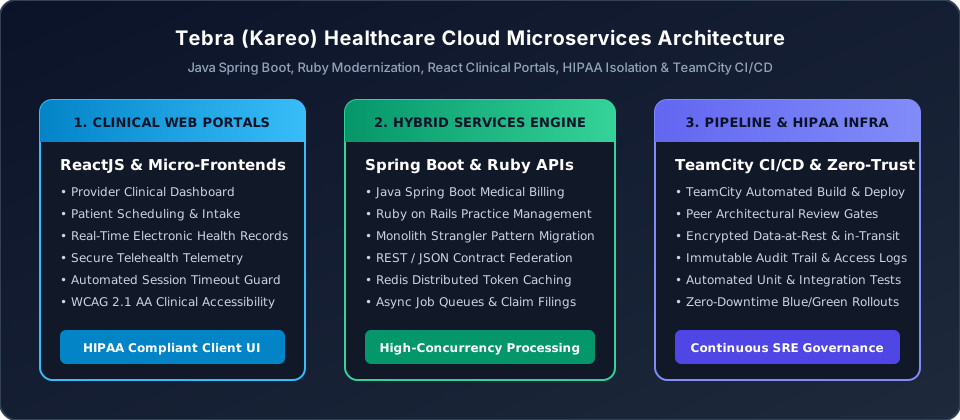
Key Architectural Contributions & Engineering Initiatives
1. Monolith Strangler Pattern: Modernizing Legacy Ruby Services
Kareo's foundational platform originated as a large, monolithic Ruby on Rails application handling patient intake, appointment scheduling, insurance verification, and billing code reconciliation. While highly featured, tightly coupled database transactions created scalability bottlenecks during peak morning clinical hours.
I formulated and executed a modernization roadmap leveraging the Strangler Fig design pattern. By establishing clear domain-driven bounded contexts, we incrementally carved out high-throughput capabilities—starting with appointment telemetry, automated SMS/email reminders, and batch claim validation—into decoupled Java Spring Boot microservices. Communication between legacy Ruby services and modern Spring Boot APIs was governed by standardized RESTful contracts, protected by mutual TLS (mTLS) and token-based service account authorization.
2. Clinical Web Portals & Micro-Frontends in React
Clinical staff require immediate, distraction-free access to patient charts, medication histories, and upcoming telehealth consultations. I led front-end modernization efforts converting legacy server-rendered views into responsive, modular React micro-frontends:
- Optimistic State Updates: Implemented responsive state management for rapid clinical note-taking and encounter updates, eliminating latency delays during active patient consultations.
- Automated HIPAA Session Guard: Built client-side idle detection timers with cryptographic token invalidation, enforcing mandatory lockouts when workstations remain unattended in examination rooms.
- WCAG 2.1 AA Accessibility: Hardened all patient-facing scheduling workflows and intake questionnaires with semantic ARIA landmarks, high-contrast typography, and complete keyboard navigation support.
3. TeamCity Continuous Integration & Automated Deployment Pipelines
Deploying software in a regulated healthcare environment requires rigorous auditability, repeatable builds, and zero downtime. I maintained and optimized enterprise TeamCity CI/CD pipelines that enforced automated quality gates on every Pull Request:
- Automated Test Verification: Integrated parallel unit and integration test suites spanning JUnit, RSpec, and Jest, maintaining strict code coverage thresholds before merge clearance.
- Static Analysis & Vulnerability Scanning: Automated SonarQube static code quality analysis and container dependency vulnerability scans to intercept potential CVEs before staging promotion.
- Zero-Downtime Blue/Green Rollouts: Orchestrated zero-downtime deployment pipelines that verified service health checks on standby slots before routing live clinical API traffic.
4. Engineering Mentorship & Peer Architectural Reviews
High-performing engineering teams require continuous knowledge sharing and rigorous code quality standards. During my tenure at Tebra, I actively promoted an engineering culture of craft and collaboration:
- Conducted comprehensive peer architectural and pull request reviews, ensuring new features adhered to domain-driven design, clean code principles, and secure coding practices.
- Pair-programmed with junior and mid-level engineers to level up technical proficiencies in TypeScript, asynchronous Java programming, and microservices design.
- Authored technical Architecture Decision Records (ADRs) and comprehensive developer documentation, significantly accelerating onboarding time for incoming engineers.
Technical Architecture Specification
| Layer | Technologies | Key Architectural Role |
|---|---|---|
| Clinical Front-End | React, TypeScript, Redux, Webpack | Modular micro-frontends, responsive EHR charts, accessible patient intake forms. |
| Backend Microservices | Java, Spring Boot, Ruby on Rails, Node.js | High-concurrency medical billing, claim filings, appointment scheduling APIs. |
| CI/CD & Infrastructure | TeamCity, Docker, AWS, Linux | Automated build validation, zero-downtime blue/green deployments, immutable artifacts. |
| Data & Security | PostgreSQL, MySQL, Redis, HIPAA Isolation | Encrypted data-at-rest (AES-256), distributed Redis token cache, audit logging. |
Frequently Asked Questions (FAQ)
What technologies were used in Tebra's healthcare microservices architecture?
The platform utilized Java Spring Boot for high-throughput billing and claim processing microservices, Ruby on Rails for practice management and clinical workflows, React with TypeScript for clinical front-end web portals, and TeamCity for enterprise CI/CD automation.
How was HIPAA compliance enforced across the application stack?
HIPAA compliance was enforced through end-to-end TLS encryption in transit, AES-256 encryption for all patient databases and file stores, automated client-side session timeout guards, strict role-based access control (RBAC), and immutable audit logs capturing every protected health information (PHI) query.
What was the strategy for migrating away from the legacy Ruby monolith?
The engineering team implemented the Strangler Fig migration pattern, identifying isolated bounded contexts (such as appointment scheduling and claim validation) and extracting them into independently deployable Java Spring Boot microservices communicating over governed REST APIs.
How did TeamCity improve release velocity and code stability?
TeamCity automated the execution of parallel unit and integration test suites, static code analysis with SonarQube, and container vulnerability scans on every pull request, allowing the team to deliver reliable zero-downtime blue/green production deployments.