
For over a decade, production backend engineering has demanded rigorous contracts: static type safety, predictable schemas, and sub-100ms deterministic execution. Yet the sudden ascent of generative Large Language Models (LLMs) forced distributed architectures into an awkward regression—replacing compiled functions and typed interfaces with freeform natural language prompts, brittle JSON regex parsers, and multi-second sequential decoders. Jev, the groundbreaking “System One” machine-native AI model unveiled by TypeSafe AI, shifts this paradigm entirely. By treating decision intelligence not as conversational text generation, but as strongly typed, non-autoregressive parallel evaluation, Jev delivers sub-100ms response times at $42 per billion tokens—a 440x cost reduction over frontier LLMs.
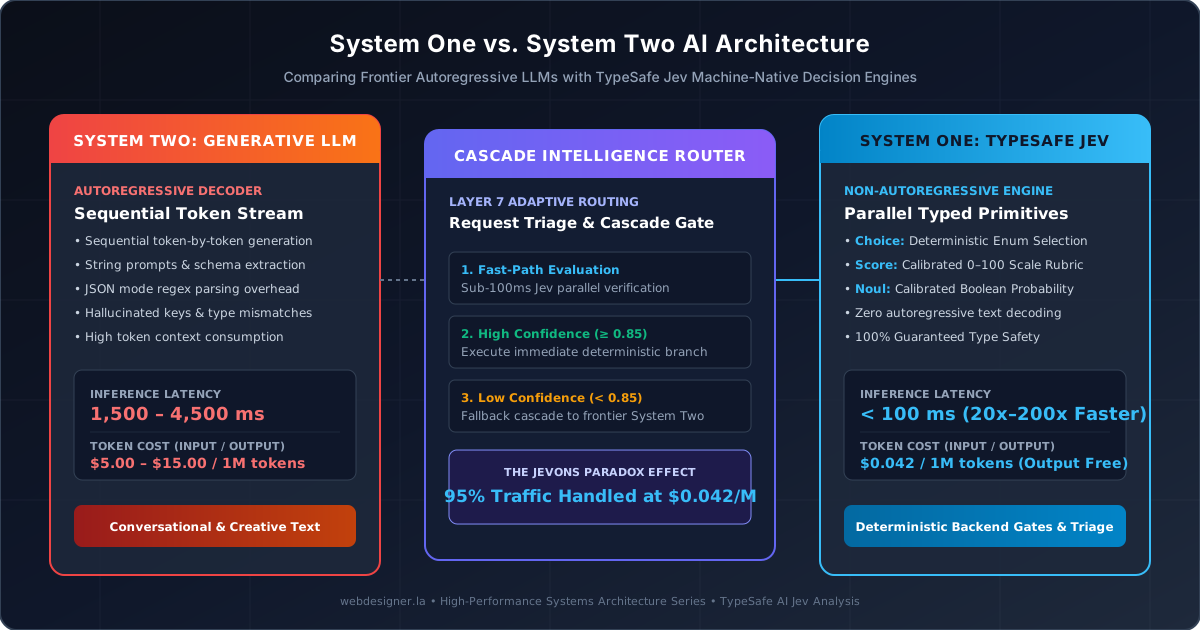
The Architectural Dilemma: Why Generative LLMs Fail Backend Logic
In Daniel Kahneman’s foundational cognitive framework (Thinking, Fast and Slow), human cognition is partitioned into two distinct operating modes:
- System One: Fast, instinctive, automatic, and highly parallel pattern matching (recognizing a familiar face, dodging an incoming projectile, assessing voice tone).
- System Two: Slow, deliberate, sequential, and computationally intensive reasoning (multiplying two prime numbers, authoring a legal contract, solving complex chess tactics).
The architectural error of early enterprise AI adoption was attempting to solve System One engineering problems with System Two machinery. When an API gateway needs to decide whether an incoming HTTP payload is an unauthorized bot probe, or an e-commerce checkout pipeline needs to evaluate a fraud tier, the backend does not require 300 words of conversational English commentary. It requires a discrete enum or a calibrated probability vector.
Traditional Large Language Models—such as GPT-4o, Claude 3.5 Sonnet, or Gemini 1.5 Pro—are fundamentally autoregressive decoders. They operate by predicting one token at a time sequentially. Each token requires an entire forward pass through hundreds of billions of transformer parameters. To return a simple JSON payload like {"tier": "vip"}, the model must sequentially decode opening braces, string keys, colons, quotes, values, and closing braces.
Even with constrained decoding solutions like JSON Schema mode or grammar-guided sampling, the sequential latency penalty remains locked between 1,500ms and 4,500ms. In high-throughput distributed microservices, injecting multi-second tail latencies and probabilistic string parsing into the critical path is catastrophic.
Enter Jev & TypeSafe AI: Non-Autoregressive Machine Judgment
Founded by Diogo Almeida (former OpenAI researcher and foundational contributor to InstructGPT, RLHF, and GPT-4), alongside Erik Gafni and Sasha Sheng, TypeSafe AI emerged from stealth backed by a $40M seed round led by DCVC. Their objective was not to build another consumer chatbot or markdown-generating coding assistant, but to build machine-native AI infrastructure for software engineers.
Their breakthrough model, Jev, completely discards autoregressive token decoding for decision tasks. Instead, Jev operates as a non-autoregressive parallel evaluation engine. When presented with application context and a set of typed queries, Jev processes the entire context window in a single forward pass and predicts outputs simultaneously across dedicated classification heads.
Autoregressive providers charge steep premiums for output tokens because each generated token requires a separate sequential forward pass through the GPU cluster. Because Jev computes all typed decisions simultaneously in one forward pass, generating output values incurs zero iterative compute overhead. Input tokens are billed at a microscopic $0.042 per million tokens ($42 per billion), while output values are 100% free.
The Three Core Typed Primitives
TypeSafe AI formalizes machine-native judgment into three core primitives that bridge seamlessly into standard TypeScript type definitions:
1. Choice<T> — Categorical Selection
Choice<T> evaluates input against a strict union of string literals or enum members (e.g. 'low' | 'medium' | 'high' | 'critical'). The output is mathematically constrained to members of T at the logit level, guaranteeing compile-time type safety with zero possibility of hallucinated enum variants.
2. Score — Calibrated Numerical Rubrics
Score assigns continuous or ordinal ratings (such as 0–100 or 1–5) based on a structured rubric. Unlike standard LLMs that exhibit severe calibration drift (frequently clustering scores around 7 or 8), Jev’s score heads are trained against calibrated benchmark distributions, yielding reliable, linear variance across queries.
3. Noul — Calibrated Boolean Probabilities
Derived from “null” and “boolean”, Noul represents a boolean decision accompanied by an empirical probability: P(true) ∈ [0.0, 1.0]. Rather than returning an uncalibrated boolean flag, Noul allows engineering teams to construct defensive threshold branches. A fraud check can require prob >= 0.95 before terminating a session, while routing events between 0.40 and 0.94 to secondary step-up verification.
System Two LLMs vs. TypeSafe Jev: Architectural Breakdown
| System Dimension | Frontier LLM (System Two) | TypeSafe Jev (System One) |
|---|---|---|
| Execution Model | Autoregressive sequential token decode | Non-autoregressive parallel evaluation |
| Median Latency (p50 / p95) | 1,500ms – 4,500ms | 45ms – 90ms (20x – 50x faster) |
| Input Pricing | $2.50 – $15.00 / million tokens | $0.042 / million tokens ($42 / billion) |
| Output Pricing | $10.00 – $60.00 / million tokens | $0.00 (Completely Free Output) |
| Type Enforcement | Probabilistic JSON parsing & regex grammars | Compile-time & runtime deterministic schema |
| Optimal Placement | Conversational chat, creative prose, research | API gateways, edge auth, routing, fraud scoring |
Architectural Economics: The Jevons Paradox in Modern Software
In 1865, English economist William Stanley Jevons published The Coal Question, highlighting a fundamental paradox of industrialization: when James Watt introduced radical thermal efficiency improvements to the steam engine, aggregate coal consumption did not decrease. Instead, coal usage multiplied exponentially because power generation became cost-effective for hundreds of manufacturing sectors that could previously only afford water or animal labor.
TypeSafe AI named their model Jev in direct homage to the Jevons Paradox.
When automated decision intelligence costs $0.02 and requires 3 seconds per API call, software architects are forced to restrict AI to high-margin, user-facing touchpoints (like conversational copilot windows). But when the cost of machine judgment plummets by 440x to $0.000042 and latency drops below 100 milliseconds, intelligence expands into every layer of systems infrastructure:
- Layer 7 Edge Ingress: Inspecting incoming HTTP requests and WebSocket frames for zero-day credential stuffing, DDoS anomalies, and semantic scraping patterns.
- Database Shard Dispatch: Analyzing incoming SQL and GraphQL query ASTs to intelligently route analytical vs transactional loads across distributed replicas.
- Automated CI/CD Triage: Pre-evaluating git diffs, build output, and unit test logs inside developer pre-commit hooks before triggering costly remote runners.
- Cascade Router Architectures: Serving as the fast-path Layer 1 triage layer. Jev handles 95% of incoming decisions at $0.042 / million tokens. Only the 5% of requests that exhibit low confidence cascade to frontier reasoning models, slashing organizational AI expenses by 90%+ while vastly improving system responsiveness.
Implementation Guide: Building a Cascade Router with TypeScript
Integrating Jev into existing Node.js and TypeScript services requires minimal boilerplate. Below is a production-grade example illustrating an API ingress gateway guard that evaluates incoming payloads and cascades to frontier models only upon ambiguous conditions:
import { TypeSafeClient, Choice, Score, Noul } from '@typesafe-ai/sdk';
import { Request, Response, NextFunction } from 'express';

// 1. Initialize the TypeSafe Jev Client
const typesafe = new TypeSafeClient({
  apiKey: process.env.TYPESAFE_API_KEY!,
  timeoutMs: 150 // Strict SLA timeout for edge middleware
});

// 2. Define the Typed Decision Schema for API Ingress Triage
const IngressSecurityDecision = typesafe.defineSchema({
  threatCategory: Choice(['clean', 'sql_injection', 'credential_stuffing', 'ddos_probe']),
  anomalyScore: Score({ min: 0, max: 100 }),
  requiresFrontierInspection: Noul({ confidenceThreshold: 0.88 })
});

// 3. High-Performance Express / Edge Ingress Middleware
export async function intelligentIngressGuard(req: Request, res: Response, next: NextFunction) {
  const startTime = performance.now();

  try {
    // Parallel non-autoregressive evaluation in <100ms
    const assessment = await typesafe.evaluate({
      schema: IngressSecurityDecision,
      context: {
        method: req.method,
        path: req.path,
        headers: req.headers,
        bodySample: JSON.stringify(req.body).slice(0, 1024),
        ip: req.ip
      }
    });

    const elapsed = Math.round(performance.now() - startTime);
    res.setHeader('X-System-One-Latency', `${elapsed}ms`);

    // High Confidence Threat Detection (System One Fast-Path)
    if (assessment.threatCategory !== 'clean' && assessment.anomalyScore > 75) {
      console.warn(`[Security Block] ${req.ip} blocked: ${assessment.threatCategory} (score: ${assessment.anomalyScore})`);
      return res.status(403).json({ error: 'Access denied by automated security policy.' });
    }

    // Cascade Trigger: If System One flags ambiguity, route to System Two
    if (assessment.requiresFrontierInspection.value) {
      console.log(`[Cascade Gate] Ambiguity detected (${assessment.requiresFrontierInspection.confidence}). Escalating to System Two.`);
      req.headers['x-requires-frontier-review'] = 'true';
    }

    return next();
  } catch (err: any) {
    // Graceful Fail-Open Degradation: Never let AI failures halt core traffic
    console.error('[Ingress Guard] System One evaluation bypassed:', err.message);
    return next();
  }
}
Frequently Asked Questions
System One models like Jev evaluate state in parallel through non-autoregressive forward passes to emit discrete typed decisions (Choice, Score, Noul) in sub-100ms latency. System Two models like GPT-4o or Claude 3.5 Sonnet decode tokens sequentially to produce freeform narrative text and long-chain logical deliberation.
Jev charges $42 per billion input tokens ($0.042 per million) and nothing for output values. Because Jev does not spend GPU cycles sequentially generating narrative text tokens, output compute overhead is negligible compared to autoregressive generative models.
Jev was trained using Reinforcement Learning from AI-directed Constitutional Distillation (RLCD), distilling calibrated confidence distributions from frontier foundation models into a highly optimized, non-autoregressive transformer backbone.
No. Jev is purpose-built for deterministic decision logic and request triage, not creative writing or conversational UI. Modern architectures pair Jev as a fast-path L1 cache and router in front of frontier LLMs to achieve maximum speed and minimal cost.
- Zero-Downtime Blue/Green Deployment Architecture — Atomic Nginx switching and PM2 cluster failover.
- Topological Knowledge Graphs & Semantic Meshes — Graph algorithms for automated content networks.
- Sub-5ms Server-Side Rendering (SSR) Benchmarks — High-throughput Node.js React pipeline optimizations.