
Building modern cloud software for the medical and healthcare sector presents one of the most stringent architectural balancing acts in software engineering. Engineering teams must harness multi-tenant cloud efficiencies—such as pooled compute, consolidated database instances, and automated operational pipelines—while strictly enforcing absolute data isolation under non-negotiable regulatory frameworks like HIPAA, HITECH, and GDPR. When dealing with Protected Health Information (PHI) and electronic health records (EHR), an accidental cross-tenant data leak is not merely a service-level failure; it triggers mandatory federal breach disclosures, catastrophic Office for Civil Rights (OCR) financial penalties, class-action litigation, and criminal liability under 42 U.S.C. § 1320d-6. To guarantee zero cross-tenant contamination, enterprise healthcare platforms discard single-layer perimeter defenses in favor of a rigorous defense-in-depth data isolation model spanning identity verification, application runtime contexts, database engine kernels, object storage prefixes, and cryptographic encryption boundaries.
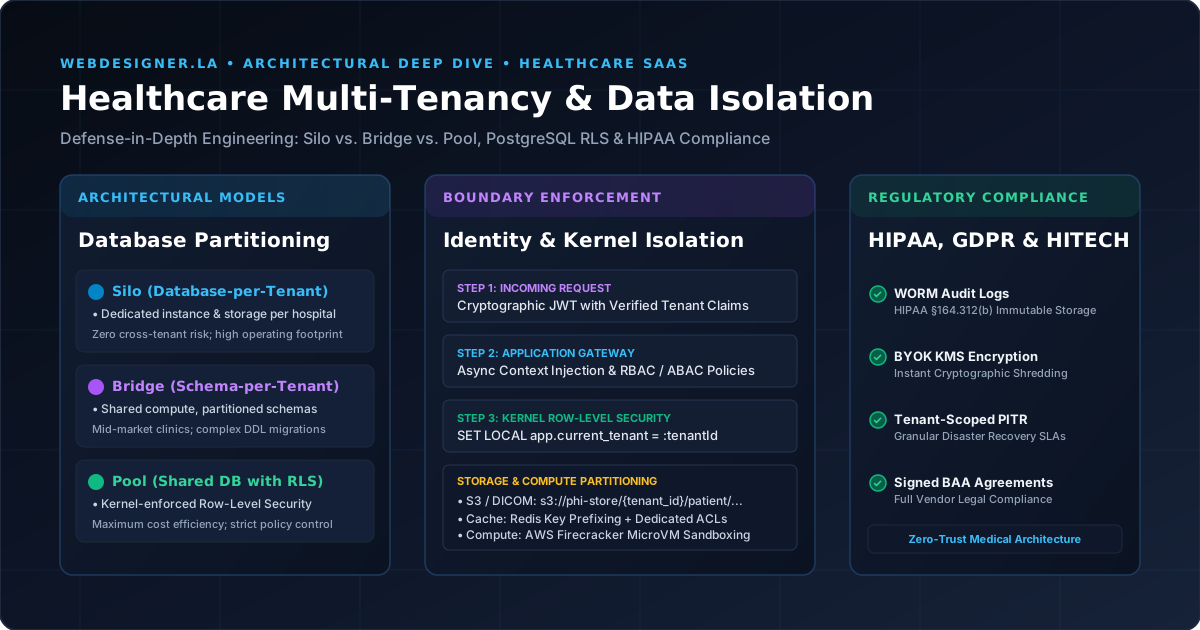
1. Database & Storage Isolation Models: Silo vs. Bridge vs. Pool
When engineering multi-tenant healthcare software, the primary architectural decision centers on where tenant isolation boundaries are enforced within the data persistence layer. Architectural patterns generally fall into three discrete models, each representing distinct tradeoffs between infrastructure cost, tenant blast radius, and schema maintenance velocity.
| Isolation Model | Persistence Topology | Blast Radius | Operational Cost | Schema Migrations | Target Healthcare Tier |
|---|---|---|---|---|---|
| Silo (Instance-per-Tenant) | Dedicated compute instance, dedicated storage volume, and isolated VPC per hospital system. | Zero cross-tenant blast radius; physical separation at infrastructure hypervisor. | Highest compute footprint; linear cost growth per added tenant. | Independent rolling deployments per tenant; high orchestration overhead. | Large hospital networks, clinical trial sponsors, and strict data sovereignty jurisdictions. |
| Bridge (Schema-per-Tenant) | Shared database engine instance with isolated database schemas or namespaces per clinic. | Engine-level isolation; contained query leaks, but shared CPU and memory contention. | Moderate cost; shared compute cluster with partitioned table spaces. | High migration complexity; DDL operations must run sequentially across hundreds of schemas. | Mid-market medical practices, specialized regional clinics, and outpatient networks. |
| Pool (Shared DB with RLS) | Shared tables distinguished by a tenant discriminator column (tenant_id) enforced via PostgreSQL RLS. |
Requires kernel-level policy enforcement; software misconfigurations risk cross-tenant reads if RLS is bypassed. | Lowest infrastructure cost; optimal resource utilization and consolidated pooling. | Single migration execution across unified tables; instant schema feature rollouts. | Digital health applications, patient portals, medical billing clearinghouses, and telemetry analytics. |
Silo Architecture: Physical & Infrastructure Isolation
The Silo model grants each client an entirely independent database cluster, storage bucket, and isolated compute pool. In high-stakes healthcare deployments—such as tertiary care hospital networks or clinical research organizations managing human genomics—this model provides the ultimate security guarantee. Network boundaries are enforced through dedicated AWS Virtual Private Clouds (VPCs) or Azure Virtual Networks (VNets), with cross-account IAM roles restricting access.
The primary advantage of the Silo model is blast radius containment: a catastrophic software bug, rogue SQL injection query, or denial-of-service spike originating from one clinic cannot compromise or degrade another tenant. Furthermore, point-in-time recovery (PITR) is straightforward, allowing operators to restore an individual hospital's database snapshot without impacting the wider network. However, the operational overhead is severe. Provisioning hundreds of independent PostgreSQL RDS instances drastically increases cloud expenditure and creates significant orchestration complexity when executing schema migrations or maintaining connection pools.
Bridge Architecture: Schema Separation on Shared Compute
The Bridge model balances resource consolidation with structural schema partitioning. Tenants share a single database cluster (e.g., an Aurora PostgreSQL cluster), but each tenant is assigned a distinct schema namespace within the database catalog. When an incoming request is authenticated, the backend application establishes a session and executes a search path command:
-- Set schema search path to the active healthcare clinic
SET search_path TO clinic_492, public;
This guarantees that unqualified table references (such as SELECT * FROM patients;) automatically resolve to the isolated tables of clinic_492. While the Bridge model reduces compute costs by consolidating database engines, it introduces operational bottlenecks. Running database migrations using tools like Prisma, Flyway, or Liquibase across 1,000 distinct tenant schemas requires coordinating thousands of transactional DDL statements, creating extended lock contention and risking partial migration failures.
Pool Architecture: Shared Tables with Kernel-Enforced Row-Level Security
In the Pool model, all tenant records co-exist within unified database tables. Every table containing Protected Health Information (PHI) includes a mandatory tenant_id UUID column. Because human developers are susceptible to omitting WHERE tenant_id = $1 filters during complex joins or high-pressure sprints, healthcare SaaS platforms running pooled databases must enforce boundary isolation directly at the database engine kernel via PostgreSQL Row-Level Security (RLS).
2. Technical Data Isolation Mechanisms
To safely operate shared infrastructure without risking cross-tenant data exposure, modern healthcare SaaS architectures implement multi-layered boundary controls directly into the database engine, encryption services, and caching layers.
Row-Level Security (RLS) in Database Engines
PostgreSQL Row-Level Security guarantees that the database engine itself enforces tenant boundaries on every SELECT, INSERT, UPDATE, and DELETE statement, completely independent of application-level query parameters. Even if an API query completely omits the tenant filter, the database kernel automatically injects the tenant policy prior to query execution planning.
The implementation requires three mandatory components: enabling RLS on the table, forcing RLS even for table owners, and establishing a restrictive policy linked to a transaction-local session configuration:
-- 1. Enable Row-Level Security on the sensitive medical records table
ALTER TABLE medical_records ENABLE ROW LEVEL SECURITY;

-- 2. CRITICAL: Force RLS so table owners and superuser-adjacent roles cannot bypass policies
ALTER TABLE medical_records FORCE ROW LEVEL SECURITY;

-- 3. Define the tenant isolation policy evaluating the transaction-scoped session variable
CREATE POLICY tenant_isolation_policy ON medical_records
  AS RESTRICTIVE
  USING (tenant_id = NULLIF(current_setting('app.current_tenant', true), '')::uuid)
  WITH CHECK (tenant_id = NULLIF(current_setting('app.current_tenant', true), '')::uuid);
When the application runtime checks out a database connection from the connection pool (such as PgBouncer or a Node.js pg.Pool), it executes a transaction-local command that binds the authenticated tenant context to that specific database transaction:
import { PoolClient } from 'pg';

export async function runInTenantTransaction<T>(
  client: PoolClient,
  tenantId: string,
  workload: () => Promise<T>
): Promise<T> {
  try {
    await client.query('BEGIN;');
    // Bind tenant context strictly to this transaction scope (SET LOCAL)
    await client.query('SET LOCAL app.current_tenant = $1;', [tenantId]);

    const result = await workload();

    await client.query('COMMIT;');
    return result;
  } catch (error) {
    await client.query('ROLLBACK;');
    throw error;
  } finally {
    // Clean up session state before returning connection to shared pool
    await client.query('DISCARD TEMP;').catch(() => {});
  }
}
Security Tip: Always use SET LOCAL rather than SET SESSION. SET LOCAL automatically resets the variable at the end of the current transaction block, preventing catastrophic connection state leakage when pooled connections are reused by subsequent HTTP requests serving different medical tenants.
Bring Your Own Key (BYOK) Encryption & Cryptographic Shredding
Under HIPAA § 164.312(a)(2)(iv), healthcare organizations must implement a mechanism to encrypt and decrypt Protected Health Information at rest. In enterprise healthcare multi-tenancy, standard disk-level encryption (like EBS encryption with an AWS-managed key) is insufficient because a single master key decrypts all tenant data. Enterprise health systems require Bring Your Own Key (BYOK) or Customer Managed Keys (CMKs) orchestrated through AWS Key Management Service (KMS) or Azure Key Vault.
The platform implements envelope encryption: each tenant possesses a unique Key Encryption Key (KEK) registered in AWS KMS. When sensitive clinical records or medical documents are persisted, a short-lived Data Encryption Key (DEK) is generated locally to encrypt the payload with AES-256-GCM. The DEK is then encrypted under the tenant's dedicated KMS KEK and stored alongside the ciphertext.
Beyond zero-trust isolation, this cryptographic architecture unlocks instant cryptographic shredding. If a hospital terminates its SaaS contract or exercises its GDPR Article 17 "Right to Erasure", deleting or revoking access to the tenant's dedicated KMS master key instantly and permanently renders all historical database records, archived backups, and replication logs completely unrecoverable across the entire multi-tenant storage cluster in milliseconds—without executing slow, error-prone, and destructive mass DELETE cascades.
Storage & Cache Namespace Partitioning
Medical platforms store high-volume unstructured binary objects—such as DICOM radiology scans, pathology images, and lab results—inside object storage services like Amazon S3 or Google Cloud Storage. A multi-tenant bucket architecture enforces rigid, automated object key prefixing:
s3://med-platform-phi-vault/tenants/{tenant_id}/dicom/{patient_id}/{study_instance_uid}.dcmTo enforce access boundaries without relying solely on application logic, the API Gateway requests temporary, scoped AWS STS credentials using an IAM Session Policy that restricts S3 access strictly to the tenant's assigned prefix:
{
  "Version": "2012-10-17",
  "Statement": [
    {
      "Effect": "Allow",
      "Action": ["s3:GetObject", "s3:PutObject"],
      "Resource": "arn:aws:s3:::med-platform-phi-vault/tenants/${aws:PrincipalTag/TenantId}/*"
    }
  ]
}
Similarly, auxiliary services such as Redis (session caching) and Elasticsearch/OpenSearch (clinical documentation search) enforce tenant namespaces. In Redis, all keys are automatically prefixed (t:{tenant_id}:session:{user_id}), and Redis 6+ Access Control Lists (ACLs) prevent broad cluster scanning commands like KEYS *. In Elasticsearch, document indexes enforce tenant routing keys (_routing=tenant_id), ensuring search queries execute strictly against tenant-specific shard partitions rather than broadcasting across the entire cluster.
3. Application, Compute & Identity Layer Controls
Enforcing database boundaries is meaningless if the upstream application gateway and compute runtimes permit cross-tenant identity spoofing or process bleed. A defense-in-depth healthcare SaaS platform establishes strict isolation across every tier of the execution lifecycle.
[ Inbound HTTPS Request ]
           │
           ▼
[ API Gateway / JWT Validator ]
- Cryptographic Token Verification
- Claims Extraction (tenant_id, clinic_id, roles)
           │
           ▼
[ Application Middleware ]
- Injects tenant context into AsyncLocalStorage
- Evaluates Contextual ABAC Authorization
           │
     ┌─────┴───────────────────────────┐
     ▼                                 ▼
[ Ephemeral Compute Sandbox ]     [ Persistence Boundary Enforcements ]
- AWS Firecracker MicroVM          - PostgreSQL Kernel: SET LOCAL app.current_tenant
- Isolated memory / CPU limits    - Object Storage: S3 Tenant Prefix & IAM Session Policy
- Customer script / AI execution  - In-Memory Cache: Redis Tenant ACL Key Namespaces
1. Context-Driven JWT Authentication & Async Context Injection
Every API request entering the cluster must carry a cryptographically signed JSON Web Token (JWT) issued by an enterprise identity provider (Okta, Auth0, or an internal OAuth 2.0 authorization server). The token contains immutable, digitally signed claims including tenant_id, organization_type, user_id, and assigned clinical roles.
At the application layer (e.g., Node.js / Express or Fastify), global middleware intercepts the request, validates the signature using public JWKS endpoints, and binds the tenant claims to Node's AsyncLocalStorage execution context. This guarantees that every downstream repository, logging service, and microservice call automatically accesses the authenticated tenant context without requiring developers to manually pass tenant arguments across internal function calls:
import { AsyncLocalStorage } from 'async_hooks';
import { Request, Response, NextFunction } from 'express';

interface TenantContext {
  tenantId: string;
  userId: string;
  roles: string[];
}

export const tenantStorage = new AsyncLocalStorage<TenantContext>();

export function tenantContextMiddleware(req: Request, res: Response, next: NextFunction) {
  const token = req.user; // Verified by upstream JWT middleware
  if (!token || !token.tenantId) {
    return res.status(401).json({ error: 'Unauthenticated: Missing verified tenant claims' });
  }

  const context: TenantContext = {
    tenantId: token.tenantId,
    userId: token.sub,
    roles: token.roles || []
  };

  tenantStorage.run(context, () => {
    next();
  });
}
2. Compute Isolation: MicroVM Sandboxing for Medical AI & Untrusted Workloads
Modern healthcare platforms frequently execute tenant-specific computation, such as customized HL7/FHIR message transformation scripts, algorithmic dosage calculations, or proprietary machine learning inference on patient pathology scans. In a shared SaaS environment, running multi-tenant code within standard Docker containers poses severe security risks due to shared Linux kernel attack surfaces (e.g., Dirty COW, kernel privilege escalations, or container breakouts).
To eliminate noisy-neighbor CPU starvation and prevent container escape vulnerabilities, healthcare engineering platforms utilize MicroVM sandboxing technologies such as AWS Firecracker or Google's gVisor. MicroVMs provide hardware-level virtualization through the Linux KVM hypervisor with launch latencies under 5 milliseconds and memory footprints under 5 MB. Each tenant calculation runs inside an isolated, disposable kernel sandbox that terminates immediately upon computation completion, ensuring zero persistent state or memory bleed between competing healthcare networks.
3. Role-Based & Attribute-Based Access Control (RBAC vs. ABAC)
While multi-tenancy prevents Clinic A from accessing Clinic B's records, healthcare platforms must also satisfy the HIPAA "Minimum Necessary" requirement (45 CFR § 164.502(b)) within each organization. A coarse-grained Role-Based Access Control (RBAC) model—such as assigning a blanket "Physician" role—is legally insufficient: an attending physician in Cardiology has no legitimate clinical need to inspect an unrelated patient's Psychiatric records.
Healthcare SaaS architectures implement Attribute-Based Access Control (ABAC) evaluating dynamic contextual attributes in real time:
- Subject Attributes: Clinician ID, department, active shift status, licensing credentials.
- Resource Attributes: Patient department, admitting care team, sensitive record classification (e.g., psychotherapy notes, substance abuse history).
- Environmental Attributes: Time of access, facility physical IP subnet, device MDM compliance status.
If an unassigned emergency physician requires urgent access during a trauma event, the platform provides an audited "Break-Glass" workflow. Break-glass access temporarily bypasses standard ABAC restrictions, immediately flags the access event as an elevated operational alert, and writes high-priority telemetry to immutable security queues for mandatory peer review.
4. Compliance & Operational Engineering Measures
Architectural boundaries are only as defensible as the operational tooling, telemetry, and legal agreements that support them. Ensuring compliance across HIPAA, HITECH, and GDPR requires continuous automated verification.
Tamper-Proof WORM Audit Logging (HIPAA § 164.312(b))
The HIPAA Security Rule mandates the recording and examination of activity in information systems that contain or use electronic protected health information. To withstand federal scrutiny and forensic audits, audit logs cannot reside in standard mutable databases where an administrative database engineer or compromised service could modify or erase records.
All PHI CRUD events (Create, Read, Update, Delete) emit structured JSON audit payloads sent directly to Write-Once-Read-Many (WORM) storage, such as AWS S3 Object Lock configured in strict Compliance Mode, or an immutable cryptographic ledger (AWS QLDB). Once written, compliance mode prevents any user—including cloud root administrators—from deleting or modifying log objects until the retention period (typically 6 to 7 years under state medical board statutes) expires.
{
  "event_id": "aud_8892f3a4-912c-4b51-9310-8b1731671e21",
  "timestamp": "2026-10-02T12:00:00.128Z",
  "tenant_id": "c71a39f0-291d-481e-9271-893112cba102",
  "actor": {
    "user_id": "usr_991240128",
    "role": "Attending_Physician",
    "ip_address": "198.51.100.42",
    "user_agent": "Mozilla/5.0 (HealthcareClient/2.4)"
  },
  "action": "READ_PHI",
  "resource": {
    "type": "Patient_Encounter",
    "id": "enc_55102914",
    "patient_id": "pat_110294"
  },
  "authorization": {
    "policy_evaluated": "ABAC_CareTeam_DirectAccess",
    "decision": "PERMIT"
  }
}
Tenant-Scoped Disaster Recovery & Point-in-Time Recovery (PITR)
In a pooled multi-tenant database, disaster recovery presents a major operational challenge. If Tenant A accidentally executes a catastrophic bulk update or data corruption script, restoring the entire PostgreSQL cluster from a backup snapshot to a point in time before the event would roll back valid clinical transactions executed by hundreds of innocent tenants.
To deliver tenant-scoped disaster recovery SLAs, enterprise healthcare architectures implement continuous Change Data Capture (CDC) pipelines using tools like Debezium and Apache Kafka. All database write-ahead log (WAL) events are streamed, partitioned by tenant_id, and written into tenant-isolated Apache Iceberg or Parquet delta lakes on Amazon S3. In the event of localized data loss, engineers execute tenant-specific replay jobs that reconstruct the affected tenant's data state without introducing downtime or rollback side effects for the rest of the SaaS portfolio.
Business Associate Agreements (BAAs) & Vendor Hardening
Under 45 CFR § 164.504(e), healthcare SaaS providers must execute legally binding Business Associate Agreements (BAAs) with every cloud infrastructure provider, vendor, and third-party SaaS tool that processes, transmits, or stores PHI. This includes cloud providers (AWS, Google Cloud, Microsoft Azure), logging and telemetry collectors (Datadog, Grafana Cloud, Promtail), error tracking services (Sentry), and communication APIs (Twilio).
Technical teams must configure third-party agents with strict data hygiene policies: application stack traces and crash reports sent to error trackers must run through automated PII/PHI scrubbing filters (stripping Social Security numbers, patient names, medical record numbers, and birth dates) prior to exiting the protected VPC boundary.
5. Architectural Case Studies & Real-World Implementations
The defense-in-depth isolation principles outlined in this guide represent battle-tested production practices refined across enterprise cloud platforms and mission-critical SaaS architectures. On WebDesigner.LA, we have extensively explored the real-world execution of these architectural disciplines across diverse enterprise domains:
- Healthcare SaaS & Practice Management: In our architectural case study on Tebra (Kareo & PatientPop), we detail the engineering challenges of consolidating multi-tenant electronic health records (EHR), patient billing clearinghouses, and clinical scheduling systems into unified cloud microservices while upholding strict HIPAA compliance and zero-trust data segregation.
- Enterprise Identity & Microservices: Read our architectural analysis of Universal Music Group (UMG), exploring how large-scale enterprise organizations enforce strict multi-tenant authorization policies, global API gateway orchestration, and high-throughput microservices.
- Operational Resilience & DevOps: Explore our comprehensive guide to Zero-Downtime Deployment & DevOps, demonstrating how automated blue/green PM2 workflows, rolling database migrations, and active health checks prevent production outages in high-availability environments.
- Full-Stack Architecture: For modern full-stack development patterns, explore our guide on MERN Solutions Architecture covering end-to-end TypeScript, React MVC paradigms, and scalable document storage models.
By enforcing security boundaries across every tier—pairing cryptographic identity verification at the edge with kernel-enforced Row-Level Security in the database and immutable WORM audit logs—engineering teams can confidently deliver high-efficiency, multi-tenant cloud software that satisfies the highest tiers of medical compliance and data protection.