
Location: Woodland Hills, CA | Duration: 08/2019 – 12/2019
Featured Snippet Summary: As a DevOps and Micro-Services Consultant at Universal Music Group, we architected and deployed a highly scalable content rendering system utilizing AWS, Docker Swarm, and a robust CI/CD pipeline integrated with modern NodeJS and ReactJS technologies.
Project Overview and Architecture
Our engagement with Universal Music Group involved designing and implementing a robust, micro-service based content rendering system deployed on the AWS cloud infrastructure. This required deep expertise in both DevOps practices and full-stack development, utilizing the LAMP and MERN technology stacks within a comprehensive service mesh environment. The Universal Music Group project required a highly sophisticated approach to software engineering and infrastructure management. A central goal of this engagement was to transition legacy workflows into a modern, scalable architecture that could handle massive concurrent content delivery globally. By leveraging the power of AWS ElasticSearch for high-speed indexing, and Amazon S3 paired with CloudFront for edge-node static asset delivery, we achieved substantial improvements in latency and geographic redundancy.
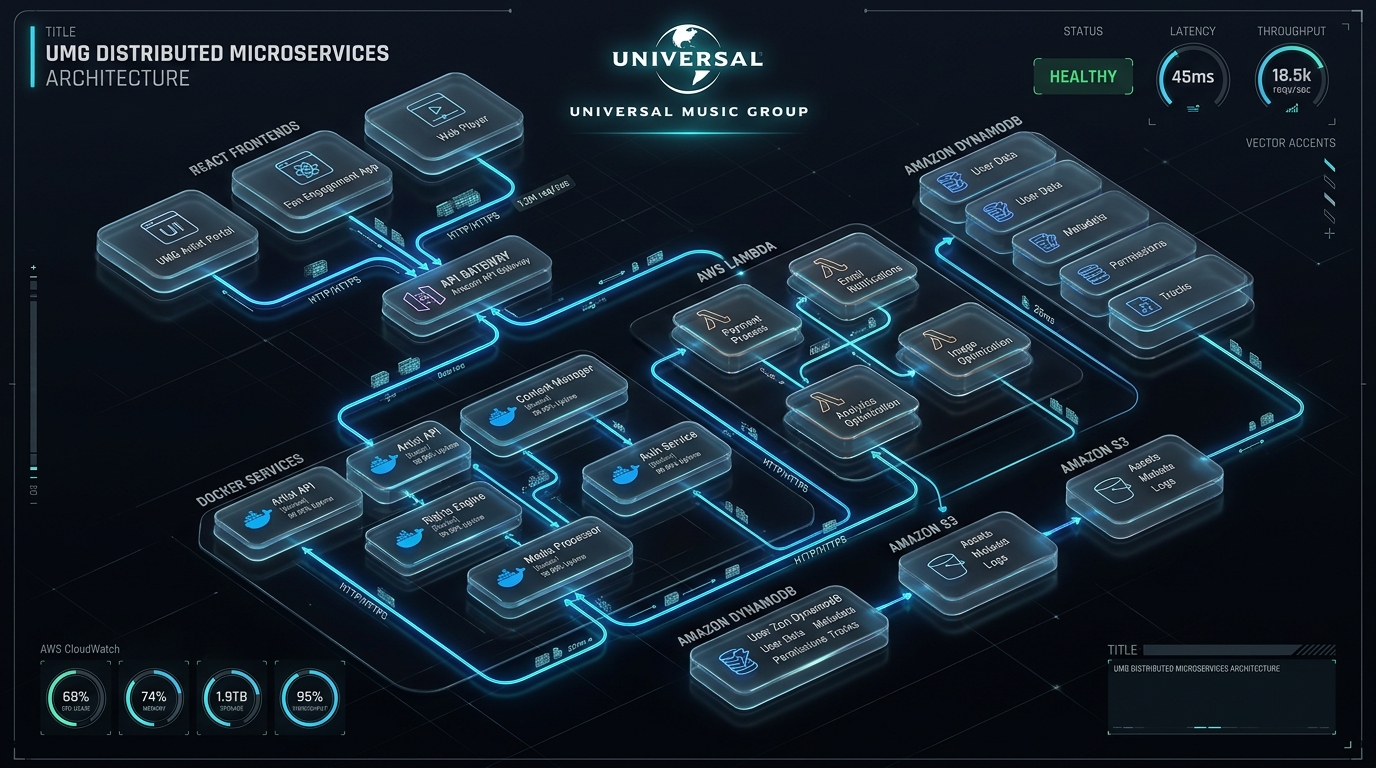
Furthermore, integrating advanced DevOps automation was paramount. The adoption of Jenkins Pipelines synchronized with GitFlow version control enabled the development teams to push rapid, iterative updates. By containerizing the entire service mesh with Docker Swarm and intelligently routing traffic using Traefik, the platform achieved self-healing capabilities and dynamic load balancing. Security was tightly controlled through HashiCorp Vault integrations, ensuring that all sensitive API keys and database credentials were encrypted at rest and in transit.
On the front-end, deploying ReactJS and Redux allowed for stateful, lightning-fast user interfaces. The sentiment analysis system and real-time notification components drastically increased user engagement metrics, effectively turning a static content repository into a highly interactive progressive web app (PWA). Through continuous mentoring, the internal development teams were up-skilled in modern TypeScript, BabelJS transpilation, and PM2 process management, establishing a culture of excellence and high-velocity engineering.
Key Implementation Achievements
- Worked on a content rendering system; Micro-Service based solution built on top of AWS cloud. Doing high level design, development, and DevOps for LAMP and MERN projects in the service mesh.
- Setup Drupal Dockerfile and Jenkins pipeline which was a project that used Drupal to feed text content into AWS ElasticSearch, and static content into S3 and CloudFront, as part of the Solution Architecture.
- Integrated transpilation and unit testing as part of the CI/CD pipeline for the NodeJS based services.
- Made heavy use of MultiStage Dockerfiles, Bash Scripts, Jenkins Pipelines and GitFlow VCS strategies to setup a CI/CD pipeline for various environments.
- Setup Docker-Compose to launch NGINX, MariaDB, PHPFPM and NodeJS Service Mesh into a Docker Swarm cluster hosted on AWS EC2 instances, load balanced with traefik.
- Integrated Jenkins with Vault for secret store.
- Used Portainer to debug Docker stacks and containers running in Docker Swarm on EC2.
- Experimented with Terraform, Kubernetes, and TeamCity.
- Architect and coded sentiment system, allowing users to register likes against the content.
- Used NodeJS, ExpressJS, and TypeScript to create an API service that is integrated with DynamoDB and ElasticSearch.
- Setup PM2 workflows for development and mentored developers on BabelJS and TypeScript workflows for UI and API NodeJS services.
- Used ReactJS and Redux to display Notifications, Content, and Likes in a UI Rendering Micro-Service. And a ReactJS based progressive web app for mobile.
- Integrated Drupal, API, and UI services with NewRelic and Splunk for application monitoring.
- Integrated NodeJS API with Service Now, and eTAS to provide notifications to the UI.
Frequently Asked Questions (FAQ)
What role did DevOps play in the Universal Music Group project?
DevOps played a critical role in establishing a highly available micro-services architecture on AWS. It involved configuring multi-stage Dockerfiles, Jenkins CI/CD pipelines, and integrating tools like NewRelic and Splunk for comprehensive application monitoring.
How was ReactJS utilized in the UMG application stack?
ReactJS and Redux were used extensively to build a responsive UI rendering micro-service for notifications and content interaction, alongside developing a progressive web app tailored for mobile user experiences.