
Location: Sunnyvale, CA | Duration: 11/2013 – 08/2014
Featured Summary: As a Senior Front-End Developer at Apple, I was instrumental in modernizing the Apple Online Store (AOS). My core contributions focused on a massive migration from legacy Web Objects to a modern Spring MVC architecture, heavily utilizing NodeJS, Mustache templating, and JSON data models. By building custom server-side rendering tools and driving the jQuery 1.10 migration, I significantly improved page load performance, maintainability, and the overall e-commerce user experience for millions of daily visitors.
Comprehensive Role Overview and Strategic Impact
Working at Apple as a Senior Software Engineer for the Apple Online Store was a transformative experience that required balancing meticulous attention to detail with large-scale architectural thinking. The Apple Online Store is one of the highest-traffic e-commerce platforms globally, meaning that even minor optimizations to the front-end architecture translate into massive improvements in bandwidth savings, page speed, and customer conversion rates.
During my tenure, the primary engineering directive was to modernize the legacy infrastructure. The existing platform was heavily reliant on Web Objects, an older application server technology that was becoming increasingly difficult to scale and maintain. The transition to a Spring MVC architecture presented an opportunity to completely rethink how front-end assets were delivered, rendered, and managed.
My role sat at the intersection of front-end execution and server-side orchestration. I was responsible for ensuring that the transition was seamless for the end-user while providing a robust, modern development environment for the internal engineering teams. This required a deep understanding of JavaScript, server-side rendering concepts, and strict adherence to Apple's world-class design and performance standards.
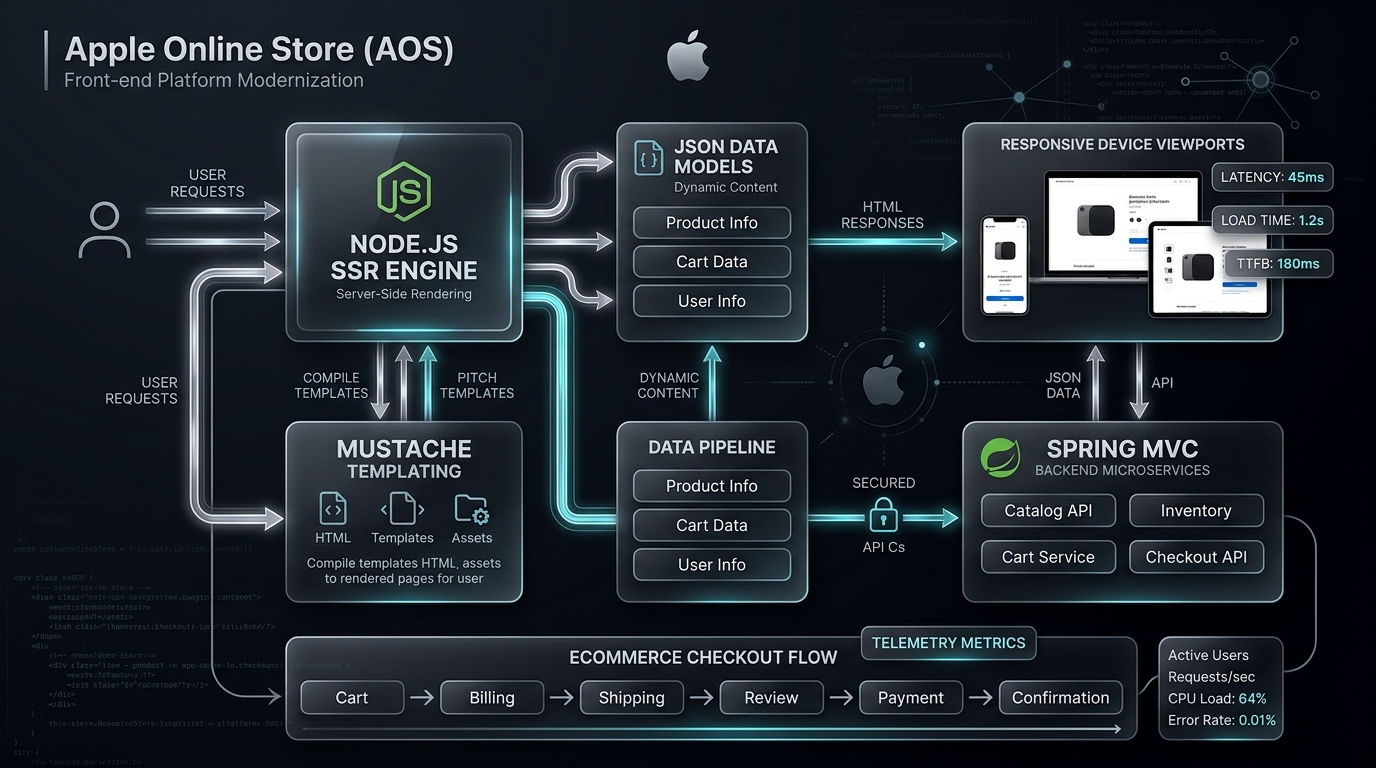
Architectural Engineering: Server-Side Rendering and Tooling
One of the most significant challenges during the migration was porting the existing production HTML into a more dynamic and maintainable format. We chose Mustache for its logic-less templating capabilities and JSON for structured data modeling.
Developing Custom NodeJS Rendering Tools
To facilitate the rapid development and testing of Mustache templates, I spearheaded the creation of custom server-side NodeJS tools tailored specifically for front-end developers. These tools allowed engineers to simulate the Spring MVC backend locally, rendering HTML on the server side using Mustache templates populated with mock JSON data models. This decoupling of the front-end and back-end development processes drastically accelerated the iteration cycle.
Evaluating and Implementing Rendering Engines
The journey to find the optimal rendering engine was rigorous. I conducted extensive research and development to identify a JavaScript-based, server-side Mustache rendering engine that could efficiently load templates directly from the file system. My initial evaluations focused on Hogan and FSHogan. While these tools showed promise, rigorous load testing and edge-case analysis revealed specific deficiencies that could not be overlooked in a production environment of Apple's scale.
To overcome these limitations, I engineered a custom, proprietary rendering tool utilizing a Mustache.Java implementation. This custom solution provided the precise control, performance characteristics, and file system integration required by our specific architectural constraints.
Core Migration Initiatives and Front-End Refactoring
Beyond the rendering engine, several critical migrations were executed to modernize the JavaScript ecosystem within the Apple Online Store.
jQuery 1.10 Migration and Performance Tuning
I was assigned the critical responsibility of leading the jQuery 1.10 migration across the entire store.apple.com domain. This was not merely a version bump; it required a comprehensive audit of existing scripts, identifying deprecated methods, refactoring custom plugins, and ensuring cross-browser compatibility across a vast matrix of supported devices. The result was a leaner, more performant JavaScript bundle that executed more efficiently, reducing time-to-interactive for end users.
Implementing Behavior-Driven Development with Jasmine
To ensure the stability of the new architecture, I championed the adoption of Behavior-Driven Development (BDD) methodologies. I integrated Jasmine unit tests into the build pipeline, establishing a culture of test-driven development within the front-end team. This comprehensive testing suite provided confidence during rapid deployment cycles and significantly reduced the introduction of regressions into production.
Enhancing Key User Journeys: Accessories and Navigation
While much of my work was architectural, I also had direct responsibility for highly visible, customer-facing components of the e-commerce experience.
Optimizing the Buy Flow Accessories Page
The Accessories page is a critical component of the buy flow, heavily influencing the average order value. I was responsible for the front-end implementation of this page, ensuring that product recommendations were displayed elegantly, dynamically, and with zero layout shift. I meticulously optimized the image loading strategies and interactive elements to provide a frictionless upsell experience.
Global Site Navigation Refactoring
Furthermore, I was responsible for the global site navigation, encompassing both the primary utility navigation and the comprehensive footer visible across all pages. This required writing highly modular, reusable code that could adapt to various localized contexts and device viewports seamlessly. The navigation system had to be fully accessible, keyboard-navigable, and optimized for immediate rendering.
Mentorship, Collaboration, and Engineering Culture
A critical aspect of a Senior Front-End Developer role is elevating the capabilities of the entire team. Throughout the migration process, I worked intimately with the backend engineering teams to define and finalize the JSON data model contracts. This cross-functional collaboration was essential for ensuring that the front-end templates received precisely the data they required, in the most efficient structure possible.
Beyond cross-functional collaboration, I actively provided mentorship and guidance to junior and mid-level developers. I conducted code reviews, established front-end best practices, and provided architectural recommendations that shaped the long-term technical direction of the Apple Online Store front-end ecosystem.
Frequently Asked Questions (FAQ)
What technologies were used in the Apple Online Store migration?
The migration involved transitioning from Web Objects to Spring MVC, utilizing NodeJS, Mustache templating, JSON data models, and jQuery 1.10.
What was the role of NodeJS in this project?
NodeJS was used to build custom server-side tools for front-end developers, enabling them to render HTML locally using Mustache and mock JSON data, independent of the backend.