
Location: Sunnyvale, CA | Duration: 08/2022 – 05/2024
Featured Summary: As a Senior Software Engineer at Fiserv, I spearheaded front-end architecture and the transition from monolithic financial reporting engines to high-performance React and TypeScript micro-frontends. My responsibilities encompassed building modular micro-apps, establishing real-time data filtering pipelines, driving accessibility compliance with axe DevTools, architecting contextual onboarding guides with WalkMe, and managing production SRE observability with Grafana, Snowflake, and PagerDuty.
Project Overview and Enterprise Modernization
Fiserv is a global fintech leader providing mission-critical payment, banking, and financial reporting solutions to thousands of financial institutions, enterprises, and merchants worldwide. In an enterprise financial ecosystem where data accuracy, real-time analytics, and regulatory compliance are non-negotiable, legacy reporting monoliths presented scalability and deployment friction.
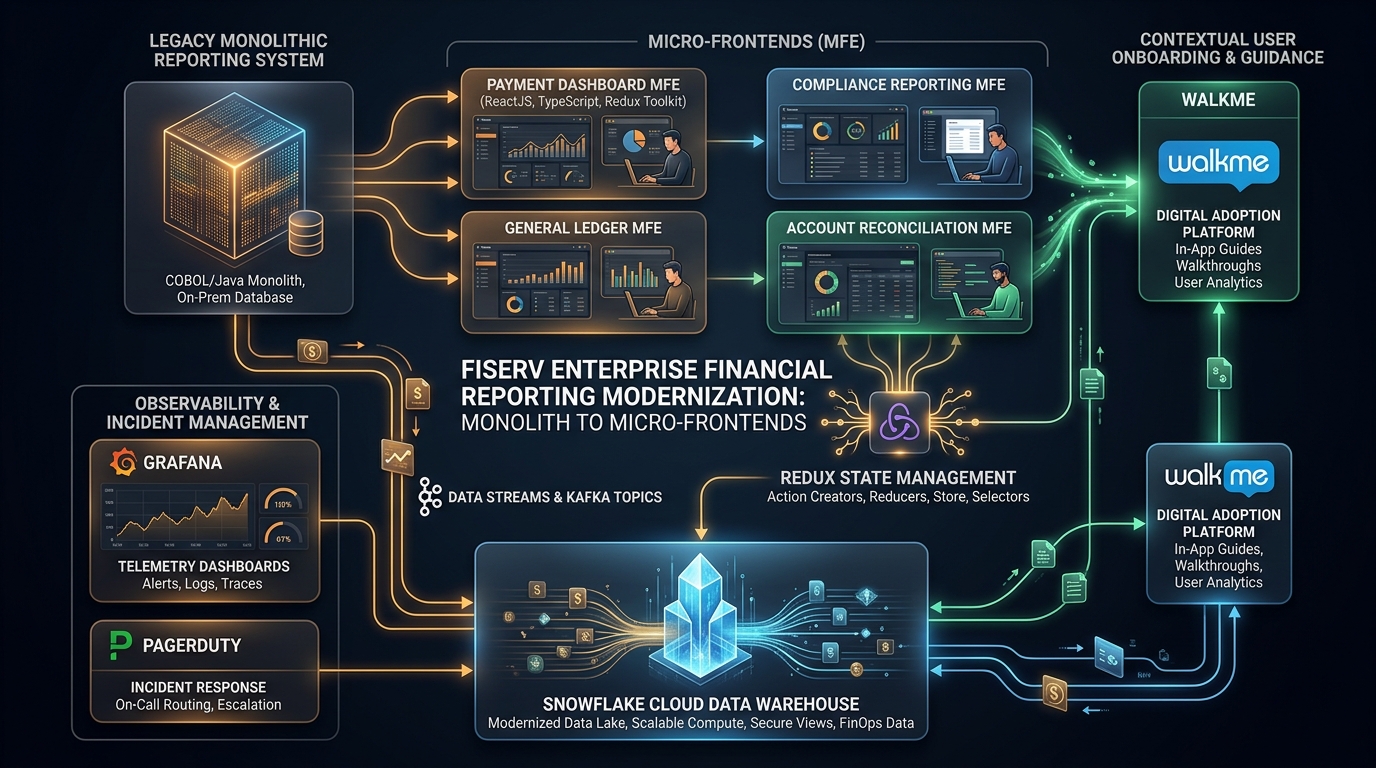
The primary mandate of our engineering team was to deconstruct legacy monolithic reporting platforms into isolated, resilient, and highly reusable ReactJS micro-frontends. This decoupled architecture enabled independent feature releases, reduced blast radiuses during deployments, and drastically accelerated feature delivery velocity across multi-tenant banking dashboards.
Core Architectural Accomplishments
Deconstructing Monoliths into Modular React Micro-Apps
I architected and implemented standalone micro-frontends using ReactJS, TypeScript, and Redux Toolkit. Each micro-app encapsulated specific business domains—including general ledger analytics, payment reconciliation, compliance auditing, and custom report builders. By utilizing Webpack Module Federation and modern package isolation, we enabled independent testing and continuous delivery without risking regression across adjacent financial reporting modules.
Advanced Report Filtering and Print Optimization
Financial analysts require granular filtering capabilities across multi-million-row transaction ledgers. I designed client-side and streaming server-side filtering mechanisms that minimized DOM re-renders and memory footprints. Additionally, I optimized complex multi-page PDF generation and print stylesheet layouts, ensuring pixel-perfect financial exports matching strict audit standards.
Contextual Onboarding with WalkMe
To reduce onboarding friction and customer support tickets for high-value enterprise users, I architected and deployed interactive, contextual user guidance flows using WalkMe. These interactive walkthroughs highlighted new feature releases, guided users through complex report configuration wizards, and tracked user telemetry to continuously refine UX flows.
Accessibility and WCAG 2.1 AA Compliance
Financial interfaces must be accessible to all professionals. I led accessibility auditing across our reporting surfaces using axe DevTools and screen reader automation, remediating color contrast violations, keyboard navigation traps, and ARIA role misconfigurations to achieve full WCAG 2.1 AA compliance.
Site Reliability, Observability & Incident Response
Operating in enterprise fintech requires rigorous production health monitoring. I participated in on-call rotations, responding to PagerDuty incident alerts, triaging urgent customer bottlenecks, and tracking latency metrics via Grafana dashboards and Snowflake data queries. As a Scrum Master and engineering lead, I facilitated sprint refinement, architectural reviews, and cross-functional alignment.
Frequently Asked Questions (FAQ)
How did micro-frontends improve Fiserv's financial reporting platform?
Micro-frontends decoupled monolithic legacy codebases into independent React/TypeScript applications. This allowed distinct engineering squads to deploy feature enhancements, security patches, and performance optimizations independently with zero cross-module blast radius.
What tools were utilized for observability and reliability at Fiserv?
Production health and data telemetry were monitored using Grafana dashboards, Snowflake cloud data warehouse queries, and PagerDuty automated escalation routing.