
When engineering interactive 3D WebGL product configurators for precision optical hardware, cinema camera rigs, or luxury industrial goods, procedural primitive geometry quickly hits a perceptual realism ceiling. Cylinders, bevels, and boolean extrusions can approximate overall silhouettes, but human vision immediately notices the absence of sculpted magnesium-alloy grip contours, knurled focus rings, recessed bayonet mount throats, and multi-coated spherical glass elements. Instead of modeling dozens of complex hardware assemblies from scratch or fighting restrictive proprietary marketplace paywalls, engineering teams can tap directly into two massive, openly accessible 3D repositories—AllenAI Objaverse 1.0 on HuggingFace and the BlenderKit CC0 Asset CDN—and pair them with headless Blender 5.2 LTS Python automation to build studio-grade WebGL catalogs.
Why Procedural BMesh Primitives Hit a Realism Ceiling in Optical & Hardware Commerce
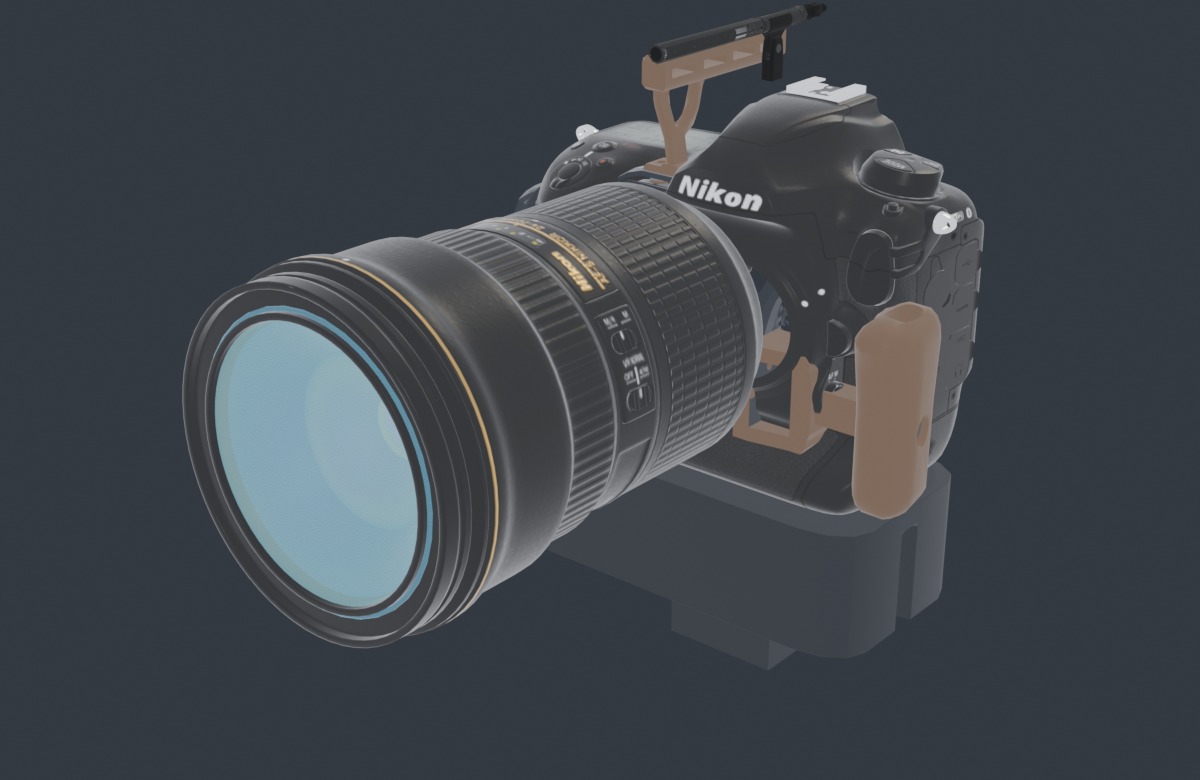
In a recent production build for a 77-item interactive camera and lens rig configurator (BestNikonCamera.com 3D Kit Builder), our initial baseline generated parametric bmesh primitives for camera bodies, telephoto zoom barrels, teleconverters, and hotshoe accessories. While parametric generation guaranteed exact millimeter bounding boxes and lightweight vertex counts, side-by-side studio renders exposed three fundamental limitations of purely procedural geometry:
- Compound Ergonomic Curvature: Flagship camera bodies such as the Nikon D6, Z8, and Z9 feature organic, multi-radius right-hand elastomer grips, angled shutter-button collars, and sculpted pentaprism housings that cannot be represented convincingly by extruded boxes or simple bevel modifiers.
- Surface Typography & Micro-Detail: Authentic optical hardware relies on silk-screened focal distance windows, gold
AF-S NIKKORnameplates, physicalM/A – MandVRslide switches, and embossed mode dials wrapped onto UV-mapped normal and roughness textures. - Multi-Part Mechanical Articulation: Vintage mechanical SLRs such as the 1959 Nikon F Photomic or cinema bodies like the RED V-RAPTOR 8K contain over 200 distinct mechanical sub-components—from scalloped metal aperture rings and self-timer levers to dual cooling fan grilles and bayonet locking pins.
Mining AllenAI Objaverse 1.0: Streaming 800,000+ Sketchfab CC-BY glTF 2.0 Assemblies
Developed by the Allen Institute for AI (AI2), Objaverse 1.0 curates more than 800,000 Creative Commons (CC-BY) 3D models originally contributed by artists and photogrammetry specialists on Sketchfab. Crucially for web engineers, AI2 standardized the entire archive into self-contained binary glTF 2.0 (.glb) files hosted on HuggingFace at datasets/allenai/objaverse, with embedded PNG/JPEG PBR texture maps (baseColorTexture, metallicRoughnessTexture, and tangent-space normal maps).
Streaming HuggingFace Metadata Shards Without Downloading Terabytes
Downloading the entire multi-terabyte Objaverse archive locally is unnecessary when targeting a specific hardware vertical. Instead, we stream lightweight caption indices (such as kiui/objaverse_captions and allenai/objaverse/object-paths.json.gz) over HTTP in Python, filtering UIDs against domain-specific regular expressions before fetching a single .glb binary:
import gzip
import json
import re
import urllib.request

OBJECT_PATHS_URL = "https://huggingface.co/datasets/allenai/objaverse/resolve/main/object-paths.json.gz"
HF_RESOLVE_BASE = "https://huggingface.co/datasets/allenai/objaverse/resolve/main/"

# Load the 800K UID -> glbs//.glb mapping in memory
req = urllib.request.Request(OBJECT_PATHS_URL, headers={"User-Agent": "Mozilla/5.0"})
with urllib.request.urlopen(req, timeout=60) as resp:
    object_paths = json.loads(gzip.decompress(resp.read()).decode("utf-8"))

def resolve_objaverse_glb_url(uid: str) -> str:
    rel_path = object_paths[uid]  # e.g. "glbs/000-023/d74969265fa94ca4890530f8d8dfcc86.glb"
    return f"{HF_RESOLVE_BASE}{rel_path}"
Using this two-stage lookup, our discovery pipeline scanned the metadata index in under 30 seconds, matched 492 camera, lens, tripod, gimbal, cage, and audio .glb models, and downloaded the top 43 multi-megabyte assemblies directly from HuggingFace CDN shards with zero API keys or rate-limit bottlenecks.
Harvesting Native CC0 .blend Scenes via the BlenderKit Public REST API
To complement Objaverse's photogrammetry scans and Sketchfab CAD exports, we queried the BlenderKit Public Search API (https://www.blenderkit.com/api/v1/search/?query=camera+is_free:true). For assets marked is_free: true, BlenderKit's REST response includes a files array containing a file_Type: "blend" object whose public download endpoint (/api/v1/downloads/<uuid>/?scene_uuid=00000000-0000-0000-0000-000000000000) issues an HTTP 302 redirect straight to public.blenderkit.com.
This allowed us to pull native Blender .blend files with clean quad topology and procedural node materials for essential rig accessories—including carbon-fiber travel tripods with ball heads, molded lithium-ion battery packs, UHS-II SDXC and CFexpress memory cards, and superzoom bridge bodies.
| Source Repository | Asset Format & License | Representative Hardware Extracted | Raw Vertex Count | Blender 5.2 Processing Applied |
|---|---|---|---|---|
AllenAI Objaverse (d7496926) |
glTF 2.0 (.glb) / CC-BY |
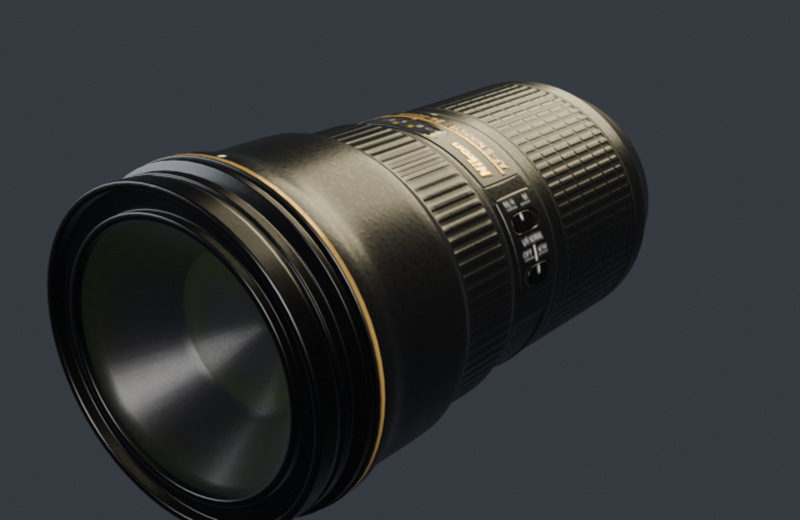
Nikon D6 Flagship Body + AF-S NIKKOR Gold-Ring Zoom Lens | 79,848 verts (78 meshes) |
Bounding-box Y-plane split at cy = -0.06 separating body from zoom lens; WebGL decimation. |
AllenAI Objaverse (854837eb) |
glTF 2.0 (.glb) / CC-BY |
Nikon D7100 Body + Nikkor 50mm f/1.8D Prime Lens | 196,064 verts (27 meshes) |
Stripped 3 studio backdrop planes; separated D7100.* and Nikkor50mm1.8D.* sub-meshes. |
AllenAI Objaverse (2eb18f84) |
glTF 2.0 (.glb) / CC-BY |
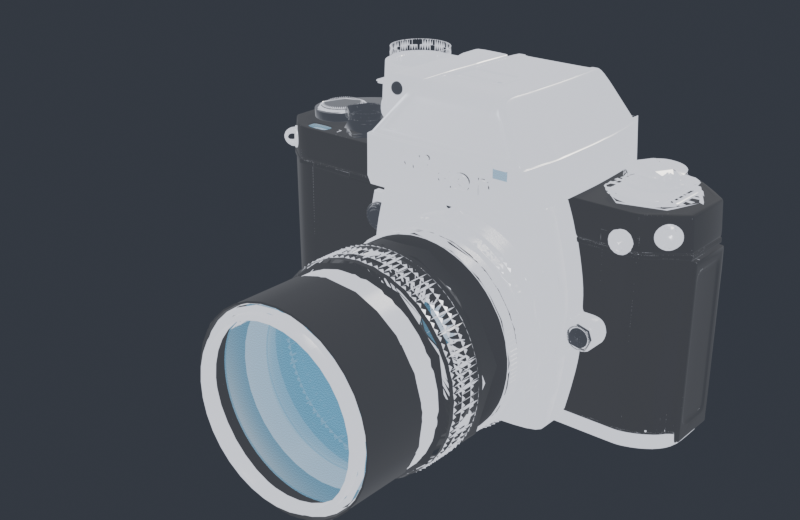
1959 Nikon F Photomic FTN + AI-S Nikkor Manual Lens | 283,797 verts (213 meshes) |
Assigned chrome, leatherette, brass, and optical glass PBR shaders by CAD part name prefix. |
AllenAI Objaverse (2b65882c) |
glTF 2.0 (.glb) / CC-BY |
RED Digital Cinema 8K Body + Matte Box & Top Handle | 266,739 verts (301 meshes) |
Removed turntable base meshes; rotated 180° around Z to align matte box with Three.js +Z. |
AllenAI Objaverse (8c103b0f) |
glTF 2.0 (.glb) / CC-BY |
Hotshoe i-TTL Speedlight Flash Unit (from Nikon D50 scan) | 49,955 verts (2 meshes) |
Executed bmesh.ops.delete vertex slice at world z >= 4.5 to isolate speedlight flash head. |
BlenderKit CDN (bk_tripod / sd) |
Native Blender (.blend) / CC0 |
Carbon-Fiber Travel Tripod, Li-Ion Battery & UHS-II SDXC Cards | 8,400–18,200 verts |
Appended mesh data blocks via bpy.data.libraries.load; downscaled embedded textures to 1024px. |
Automated Sub-Mesh Surgery, World-Matrix Baking & PBR Node Reconstruction in Blender 5.2 LTS
Raw community 3D models are rarely drop-in ready for a modular e-commerce configurator. Some scenes include giant studio cyclorama backdrops or wooden turntables; others bundle a camera body and lens into a single file; and CAD exports frequently arrive with flat placeholder materials. We solved all three challenges inside a headless Blender 5.2.2 LTS Python pipeline (blender --background --python process_real_assets_blender.py).
1. The glTF Parent-Empty Unparenting Trap: Baking World Matrices First
When Blender imports a complex .glb hierarchy, individual mesh parts are often parented to a chain of intermediate Empty transform nodes (inherited from Sketchfab, 3ds Max, or Maya exporters). A common mistake in automated cleanup scripts is deleting all non-mesh objects first (if obj.type != 'MESH': bpy.data.objects.remove(obj)). Deleting parent Empty nodes immediately unparents child meshes without preserving their accumulated world transformation matrices, causing sub-meshes to snap back to unscaled, unrotated local origins.
To flatten a glTF scene losslessly, you must force a dependency-graph evaluation, capture each mesh's matrix_world while its parent hierarchy is still intact, bake that matrix directly into the vertex coordinates (obj.data.transform(mw)), and only then purge non-mesh nodes:
import bpy
from mathutils import Matrix

def flatten_gltf_hierarchy_losslessly():
    bpy.context.view_layer.update()
    meshes = [o for o in bpy.context.scene.objects if o.type == 'MESH' and len(o.data.vertices) > 0]

    # 1. Capture world transforms BEFORE removing parent Empties
    saved_world_matrices = {o.name: o.matrix_world.copy() for o in meshes}

    # 2. Unparent and bake world matrix directly into vertex buffer
    for o in meshes:
        o.parent = None
        o.data = o.data.copy()
        o.data.transform(saved_world_matrices[o.name])
        o.matrix_world = Matrix.Identity(4)

    # 3. Safely remove all Empties, cameras, and lights
    for o in list(bpy.context.scene.objects):
        if o.type != 'MESH' or len(o.data.vertices) == 0:
            bpy.data.objects.remove(o, do_unlink=True)
2. Bounding-Box Sub-Mesh Separation & BMesh Vertex Slicing
Once all vertex coordinates live in a unified world space, multi-part assemblies become trivial to partition programmatically:
- Object-Level Centroid Partitioning: In the 78-mesh Nikon D6 assembly, every sub-mesh whose vertex bounding-box center satisfied
cy >= -0.06belonged to the magnesium camera body, while every sub-mesh withcy < -0.06belonged to the forward-protruding AF-S NIKKOR zoom lens. In the 196,064-vertex Nikon D7100 scene, strippingFloor,WarmLightPlane1, andPlanerevealed 16 body meshes (D7100.001..016) and 8 prime lens meshes (Nikkor50mm1.8D.001..008). - BMesh Vertex-Plane Slicing: When a desired accessory is fused into a single contiguous photogrammetry mesh—such as the hotshoe speedlight flash mounted atop the Nikon D50 scan—we load the mesh into
bmeshand slice along the hotshoe mounting plane (v.co.z < 4.5), cleanly extracting a standalone speedlight flash unit in milliseconds.
3. Procedural PBR Shader Graph Reconstruction for Untextured CAD Assemblies
High-precision mechanical CAD models—such as the 213-mesh, 283,797-vertex 1959 Nikon F SLR—often contain extraordinary geometric fidelity (individual shutter speed engravings, scalloped focus rings, and prism housings) but ship with uniform clay materials. Similarly, some glTF imports include pre-wired node links to flat color ramps that override base color tweaks unless cleared. By clearing the material node tree (mat.node_tree.nodes.clear()) and wiring fresh ShaderNodeBsdfPrincipled graphs based on semantic CAD part names (lente* and visor* to transmissive IOR 1.52 optical glass; body*, door*, and aneis* to high-roughness pebble leatherette; and mechanical dials to brushed silver chrome or satin titanium), we transformed untextured CAD geometry into museum-grade renders.
WebGL Payload Optimization & Three.js Coordinate Socket Alignment
Shipping a raw 283,000-vertex CAD assembly directly to mobile browsers would stall WebGL frame rates and inflate network payloads past 20 MB per component. At the same time, an interactive kit builder requires every interchangeable body, lens, teleconverter, battery grip, cage, tripod, and microphone to snap together at exact three-dimensional mounting sockets without manual per-pair offsets.
- Coordinate Handedness & Socket Normalization: Blender uses a right-handed
+Z Up, -Y Forwardcoordinate system, whereas Khronos glTF 2.0 and Three.js standardize on+Y Up, +Z Forward. Enablingexport_yup=Truein Blender's glTF exporter maps Blender(X, Y, Z)directly to Three.js(X, Z, -Y). By normalizing every camera body in Blender so its front Z/F lens mount flange sits aty = -0.52(Three.jsz = +0.52), every lens barrel so its rear bayonet sits aty = 0extending forward along-Y, every hotshoe microphone atz = +0.92, and every battery grip or tripod underneath the baseplate atz = -0.72, all 35 interactive components assemble seamlessly in Three.js. - Interactive Sub-Mesh Tagging: Before export, our script tags the front optical glass element as
Optical_Element_Frontand embeds an emerald full-frame or APS-C sensor plane namedSensor_CMOS_IBISrecessed inside the mirror box throat. When the user toggles X-Ray mode, adjusts the focal zoom slider, or triggers 5-axis IBIS sensor-shift simulation in Three.js, the client-side WebGL engine traverses the loaded glTF scene graph and animates those exact sub-meshes in real time. - Collapsible Ratio Decimation & Texture Clamping: Finally, applying Blender's
DECIMATEmodifier (COLLAPSEmode targeting16,000–28,000vertices per asset) and clamping embedded texture maps to1024×1024compressed every exported.glbbinary into the180 KB – 1.1 MBsweet spot—delivering instant 60 FPS WebGL inspection alongside 800×520 EEVEE studio renders lit by PolyHaven HDRIs.