
For over a decade, the default agency answer to “How long does organic search take to work?” has been a blanket 6 to 12 months. A recent viral breakdown (Which Directories Can Rank in 30 Days Without Backlinks?) challenges that timeline by auditing five brand-new web directories between 32 and 90 days old. Below is a full technical breakdown of the five directories analyzed in the video, my candid engineering verdict on where the advice is genuinely actionable versus where it leans on YouTube clickbait, and how we applied the legitimate architectural patterns directly to LinkDepot.net.
1. Deconstructing the 30-to-90-Day Directory Thesis
The core premise of the video is straightforward: when marketers complain that organic rankings take a year to materialize, they aren’t lying—they are simply competing head-on for high-difficulty commercial terms like “protein powder” or “best VPN in 2026.” By contrast, structured web directories can bypass that bottleneck by targeting millions of low-competition, long-tail entity and geographic queries that can reach Page 1 with minimal or zero external backlinks.
To test this hypothesis empirically, the video audits five recently launched directories discovered via a weekly domain scraper and verified through Ahrefs Site Explorer:
| Directory Domain | Site Age | Domain Rating (DR) | Est. Monthly Traffic | Page Footprint | Primary Niche & Monetization Model |
|---|---|---|---|---|---|
racefinder.ca |
59 days | DR 20 | ~600 visits/mo (57 keywords) | ~3,247 pages (61 indexed in Ahrefs) | Canadian running race calendar (746 races). Converts traffic via a 30-second running shoe quiz, local running store referrals, and a $25 newsletter giveaway. |
cardboardalpha.com |
38 days | DR 0 | ~500 visits/mo | Data-heavy TCG catalog | Pokémon, One Piece, Magic: The Gathering, and Yu-Gi-Oh price tracker. Monetizes via a $5/mo and $19/mo card-scanner SaaS subscription for card-show vendors. |
petfarewellfinder.com |
32 days | DR 0 | Early trickle (#3 & #10 rankings) | Small local directory | Local pet euthanasia and cremation lead generation. Ranks #3 for “pet euthanasia Dallas” (150/mo) and #10 for “pet cremation Reno” despite zero backlinks. |
visafreemap.com |
35 days | DR 0 | ~480 visits/mo (185 keywords) | 248,000 pages | Passport visa-free destination matrix. Ranks for ultra-low-competition queries like “Albania passport”; relies on programmatic volume for display ads. |
kitchenchecked.com |
~90 days | DR 0 | ~92 visits/mo | 140,000 pages | Restaurant health inspection lookup directory. Unfocused keyword strategy ranking randomly for street addresses and vending locations. |
2. Five Actionable Patterns Extracted from the Case Studies
Looking closely at why the top three directories succeeded in gaining early traction while the bottom two stalled reveals five structural patterns:
- Geographic Sub-Niching Beats Global Incumbents: Established running directories like
findarace.com(200,000 monthly visitors) andrunningintheusa.com(26,000 monthly visitors) dominate broad global queries. Rather than fighting them globally,racefinder.cascoped its taxonomy strictly to Canada—earning Page 1, Position 1 rankings for “Montreal races” and “Vancouver half marathons” within 59 days. - Interactive Micro-Tools Bridge Informational Traffic to Revenue: A directory visitor searching for a local 10K race date has informational intent, not immediate buying intent.
racefinder.casolves this with an interactive 30-second shoe finder quiz (“Find out which shoe you are”) that recommends specific running shoes (such as the Saucony Endorphin Speed), routes users to local running store fitting hubs, and captures newsletter subscribers. - High-Ticket Local Service Queries Can Rank at DR 0:
petfarewellfinder.comproved that even an unfinished site with zero backlinks (DR 0) can rank #3 for “pet euthanasia Dallas” and #10 for “pet cremation Reno” within 32 days because local service + city combinations are chronically underserved by dedicated directory hubs. With average service tickets around $500 (including paw print keepsakes and ash return add-ons), even a trickle of bottom-of-funnel traffic carries real lead-generation value. - Dumping 100,000+ Unlinked Pages Is an Indexation Trap: Both
visafreemap.com(248,000 pages for 480 visits) andkitchenchecked.com(140,000 pages for 92 visits) illustrate the failure mode of brute-force programmatic generation. Publishing a quarter-million thin pages on a brand-new domain dilutes crawl allocation and invites de-indexing during recurring search spam updates. - Orphan Pages Silently Kill Directory Indexability: Using his own appliance directory (
scratchanddentlocator.com) inside Ahrefs Site Audit, the creator demonstrates how orphan pages—listing URLs that exist in the database but have zero internal HTML links pointing to them—prevent deep catalog pages from ever getting indexed.
3. Honest Engineering Verdict: Legitimate Playbook or YouTube Clickbait?
If we evaluate this video with a critical engineering lens, the verdict is roughly 75% legitimate, practitioner-grade search architecture and 25% YouTube packaging clickbait. Here is a candid breakdown of what holds up under scrutiny and where viewers need to read between the lines.
What Is 100% Accurate (The Signal)
- Long-Tail Entity + Location Queries Really Do Rank in 30–60 Days: The traditional “6 to 12 months” agency rule applies to competitive commercial head terms. When a directory creates clean, dedicated landing pages for specific `[Category] + [City]` or `[Product Set] + [Attribute]` combinations where existing search results are fragmented, Google will routinely rank a DR 0 domain on Page 1 within 4 to 6 weeks.
- The Warning Against 100k+ Page Programmatic Bloat Is Spot-On: Too many AI-era tutorials tell developers to scrape a public dataset and dump 250,000 pages overnight. The host rightly calls out
visafreemap.comandkitchenchecked.comas cautionary tales. High-curation directories with 500 to 3,000 richly interlinked pages consistently outperform 200,000-page thin directories. - Refreshing Honesty About Monetization Friction: Unlike typical YouTube hustle channels claiming every 500-visit site is a passive cash machine, the creator openly admits that display ads on 480 international visitors (
visafreemap.com) will earn pennies, that converting free TCG price-checkers into $19/month SaaS subscribers (cardboardalpha.com) is an uphill battle, and that he himself owns high-traffic directories he hasn’t figured out how to monetize yet. - Internal Link Graphs Matter More Than Raw Page Count: Identifying and eliminating orphan pages via Ahrefs Webmaster Tools and wiring automated fixes through modern AI coding workflows (Claude Code / Codex) is genuinely how high-output technical operators work today.
Where the Video Uses Clickbait & Omissions (The Noise)
- The Opening Hook (“SEO Takes 6–12 Months Is Simply Not True”) Conflates Early Indexation with Business Viability: Earning 92 to 600 monthly organic visitors after 30 to 90 days is an encouraging early indexation signal, not a self-sustaining business. Furthermore, notice that
racefinder.ca—the strongest example in the video—actually has a Domain Rating of DR 20, meaning it did acquire foundational backlinks and citations early on. And out of its 3,247 total pages, only 61 pages were actively generating keyword rankings in Ahrefs at the 59-day mark. - The “Abandon After 90 Days” Mindset Encourages Disposable Sites: Toward the end of the video, the creator remarks that if a directory only gets ~92 visits after 90 days, he would comfortably abandon the project and spin up a new bet. While failing fast has merit when validating keyword demand, treating domains as 90-day lottery tickets often leads builders to launch ten half-finished directories (like
petfarewellfinder.comwith missing internal links) instead of compounding authority on one deeply curated platform. - Ahrefs Traffic Numbers on 30-Day-Old Domains Are Noisy Estimates: Third-party clickstream estimators frequently under- or over-estimate ultra-long-tail traffic by 3x to 10x compared to verified Search Console impression curves. Brief early traffic spikes on 35-day-old DR 0 domains (like the spike-and-dip shown on
cardboardalpha.com) are frequently temporary freshness tests before rankings settle. - Dual Funnel Context: Viewers should keep in mind that the video serves two commercial funnels: promoting the creator’s paid community database (Shipper Directory Pro Idea Database) and fulfilling a paid sponsorship for Ahrefs. Neither invalidates the technical teardown, but it explains why the narrative emphasizes rapid, repeatable site launches.
4. Turning Theory into Production Code: Upgrading LinkDepot.net
Rather than treating the video as passive entertainment, we immediately audited our own curated web directory—LinkDepot.net—against every failure mode highlighted in the transcript. Our audit uncovered three major architectural bottlenecks that mirrored the exact issues discussed in the video:
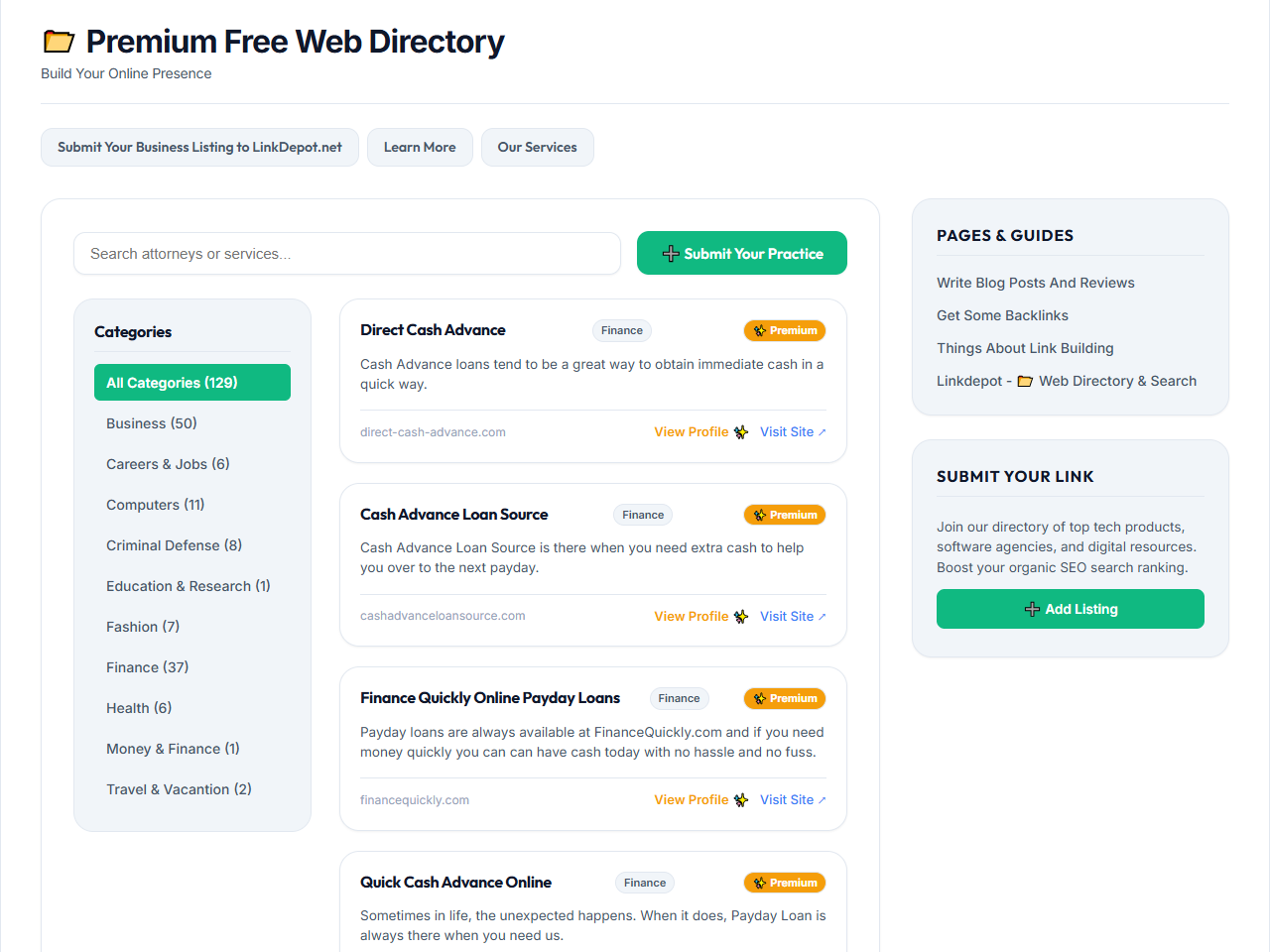
- JavaScript-Only Category Filtering (Hidden Hubs): Although LinkDepot held 554 human-reviewed listings across 27 industry verticals (including Business, Computers, Finance, Internet, Careers & Jobs, and Real Estate), the category pills on the homepage were rendered as client-side
<button>state toggles rather than crawlable<a href>landing pages. - Sitemap Under-Indexation (Orphaned Catalog): Because
linkdepot.net/sitemap.xmlonly exported 32 static CMS articles, all 27 category verticals and all 554 individual listing pages were effectively invisible to XML sitemap discovery. - Degraded Fallback Listing Profiles: Visiting a direct domain slug on LinkDepot previously fell through to a legacy dark-theme generator that injected duplicate headings and low-contrast text with zero internal cross-links to related peer listings.
The Four Architectural Upgrades We Shipped to LinkDepot.net
Applying the best practices from the racefinder.ca and petfarewellfinder.com teardowns, we engineered and verified four production upgrades on LinkDepot:
- 27 Programmatic Industry & Category Hub Pages (
/directory/:categorySlug): We transformed every directory category into a dedicated, server-side rendered landing page (/directory/business,/directory/computers,/directory/finance,/directory/internet) complete with vertical-specific editorial guides,CollectionPage,ItemList,BreadcrumbList, andFAQPageJSON-LD structured data, and crawlable links to every verified listing in that vertical. - Enriched Light-Theme Listing Profile Pages (
/:listingSlug) with Zero Orphan Pages: We built a dedicatedListingProfilePagecomponent in LinkDepot’s native Emerald & Slate light theme that renders verified citation metadata, live domain previews, and an automated Related Verified [Category] Websites mesh linking each profile to up to 6 peer listings in the same industry plus its parent Category Hub. - Interactive 30-Second Directory & Citation Readiness Quiz (
/citation-quiz): Inspired directly byracefinder.ca’s 30-second shoe finder quiz, we launchedlinkdepot.net/citation-quiz—a 4-step interactive diagnostic tool that calculates a website’s Citation Readiness Score (0–100), recommends the highest-impact LinkDepot category hub for their niche, and routes founders directly into verified listing submission or the Reciprocal Partner Program. - Sitemap Expansion from 32 URLs to 614 Indexable URLs: We expanded
linkdepot.net/sitemap.xmlandllms.txtto expose all 32 editorial guides, the interactive/citation-quiztool, all 27 Category Hub URLs, and all 554 approved listing profile URLs—eliminating orphan pages across the entire directory catalog without resorting to thin 100,000-page spam bloat.
Test the New LinkDepot Directory Hubs & 30-Second Citation Quiz
Explore LinkDepot’s newly launched Industry Category Hubs, take the 30-Second Citation Readiness Quiz to benchmark your domain, or book an architecture consultation to build high-converting programmatic web platforms.